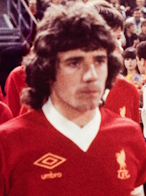
Kevin Keegan
Forward · Liverpool 1971–1977
Personal
- Born
- 14 February 1951
- Place of birth
- Armthorpe, England
- Died
- 20 July 2026
- International
- 63/21 (29/7 at LFC) - 05.07.1982 Debut 15.11.1972 vs. Wales
- Other clubs
- Scunthorpe (1967-71), Hamburg SV (1977-80), Southampton (1980-82), Newcastle United (1982-84), Blacktown City Demons (1985)
At Liverpool
- Signed from
- Scunthorpe
- Joined
- 3 May 1971
- Transfer fee
- £33,000
- Debut
- 14 August 1971
- First goal
- 14 August 1971
- Last goal
- 3 May 1977
- Last appearance
- 25 May 1977
- Left the club
- 3 June 1977
Also played against Liverpool — view opposition record
Liverpool career
- League 230 apps · 68 goals · 51 assists
- Win ratio 54.8% — W 177 · D 88 · L 58
Honours
Individual honours
- PFA Team of the Year
- 1976 · 1977
- FWA Footballer of the Year
- 1976
Player profile
Keegan joined Scunthorpe as an apprentice in 1968 and made his name as a midfield player in the Fourth Division playing 120 League games. He was signed when Liverpool were busy preparing for their FA Cup final date with Arsenal at Wembley. Shankly knew he had signed a player of exceptional potential whom he supposedly envisaged replacing Ian Callaghan on the right flank as the veteran had serious ligament problems. The 20-year-old Yorkshireman was left behind when Liverpool flew off on their traditional pre-season tour. Four days before the 1971/72 season was due to open, Shankly picked Keegan for the first team in a full-scale practice match at Melwood, normally a game where fitness is more important than the result. But Keegan created havoc that day and Shankly had no hesitation in giving him his debut against Nottingham Forest at Anfield the following Saturday when the League season opened. Keegan scored after 12 minutes and after netting three times in the opening five League fixtures, it was clear that he was in the first team to stay. In fact, Keegan never played in a single reserve fixture during the whole of his seven seasons at Anfield!
Defeat at Derby and a controversial draw at Arsenal in the last two first division games of Keegan's debut season cost Liverpool the title. But he only had to wait another 12 months to achieve that and added a UEFA Cup winners' medal too when his early strikes in the re-arranged home leg of the final against Borussia Mönchengladbach were the platform for the club's eventual aggregate victory, the club's first in a European club competition. He also received the first of numerous international caps during that season when picked for a World Cup qualifier with Wales in Cardiff on 15 November 1972. In 1973/74 Keegan played in every single one of the 61 competitive matches Liverpool had in the League and three cup competitions, contributing 19 goals. Six of those came in the successful FA Cup run, including two crucial strikes against his hometown club Doncaster Rovers, bottom of the old Fourth Division at the time, who threatened to make one of the biggest upsets in the cup's history when they took a 2-1 interval lead at Anfield, only to be pegged back by Keegan's second-half equaliser. Ever the man for the big occasion, he produced a sensational volley past Peter Shilton in the replayed semi-final victory over Leicester City at Villa Park and then netted two goals in the one-sided Wembley showdown with Newcastle United.
The 1974/75 season started badly for Keegan, perhaps the lowest point of an illustrious career. He was sent off during a pre-season match against Kaiserslautern in West Germany and also received his marching orders four days later after clashing with Billy Bremner in the Charity Shield at Wembley. Perhaps because the traditional curtain-raiser to the season was being played at the national stadium for the first time but also because both he and Bremner took off their shirts as they left the field, both men received lengthy bans and although Keegan was allowed to play in the opening League match at Luton, he didn't play in the First Division again until October. But he quickly found his old form and played in the remaining 33 first division fixtures as the Reds finished runners-up to Derby County. With goals hard to come by that season, how crucial his absence was, especially when the team was beaten three times in four games during September. In 1976 Liverpool repeated their League and UEFA Cup 'double' of 1973 and again Keegan was prominent, only missing one first division game and scoring in both legs of the European final against Bruges. "Mighty Mouse" was voted the Football Writers' Association Footballer of the Year in 1975/76, and then gave a season's notice, announcing he was moving to West Germany. At a time when it was almost unheard of for English players to try their luck abroad, this caused some friction but nobody could doubt Keegan's commitment to the cause in his farewell season. He was the club's leading scorer in the League and contributed valuable goals as the team reached the finals of both the FA and European cups. With the Championship clinched in the penultimate League match, a historic treble triumph beckoned but Manchester United ruined that dream and it was just a question of whether the players could lift themselves for one last effort in the European Cup final only four days later. In Rome, Kevin played his heart out and ran himself and Berti Vogts into the ground. Eight minutes from time, he started a typical run from forty or so yards out, which was only ended by Vogts' foul in the penalty area. Phil Neal converted the spot-kick to seal probably the most famous triumph in the club's history.
£500,000 was a record fee for a British footbal!er and Keegan was the most expensive player in the Bundesliga. He soon stamped his authority on the Bundesliga, winning the championship in his second season at Hamburg SV and and won incredibly two consecutive European Footballer of the Year awards, after being the runner-up his last season at Liverpool. In his last season Keegan featured in the European Cup final against Nottingham Forest but lost 1-0. After staying three years in Germany the 29-year-old Keegan was on his way home. Liverpool had first option on him but he moved to Southampton for £420,000. In Keegan's second season at the Dell he was the first division's top-scorer with 26 goals in 41 games and voted Player of the Year by his fellow professionals. After two years at Southampton he was on his way to second division Newcastle for £100,000, where he stayed until his retirement in 1984, after playing 85 matches and scoring 49 goals. Eight years later Keegan became manager of Newcastle, leaving after a five-year spell after winning the first division title and finishing runners-up in the Premiership as his highlights. Keegan was one year in charge at Fulham, before taking over as England's manager in February 1999. He was England's supremo for one and a half year before being sacked after England failed miserably in Euro 2000. In May 2001, Keegan was appointed manager of Manchester City, winning the first division title and even though he never reached the heights he had hoped for with City he still tried to entertain the audience as he did as a player. Keegan wanted to retire from management and left City in the 2004/05 season. He made an unexpected return to Newcastle in January 2008, a highly popular appointment as the Geordie fans saw him as their Messiah. Only eight months later Keegan left Newcastle claiming owner Mike Ashley wasn't providing him with the financial support that he had promised.
Keegan was an incredible player, tireless in showing off his talents and his enthusiasm invariably made his teammates more determined to succeed. He was a smashing success at every club he played. Dangerous in the air despite a comparative lack of height, he had a wonderful understanding with big John Toshack during his early seasons at Anfield and his speed of thought created numerous goals for his colleagues with his intelligent runs and passing. He was the first pin-up boy Liverpool had really ever had and made the number seven shirt so famous. Kevin Keegan should rightly be remembered as one of the finest players ever to wear a Liverpool shirt.
Appearances per season
| Season | League | FA | LC | Europe | Other | Total |
|---|---|---|---|---|---|---|
| 1971-1972 | 35 | 3 | 1 | 3 | 0 | 42 |
| 1972-1973 | 41 | 4 | 8 | 11 | 0 | 64 |
| 1973-1974 | 42 | 9 | 6 | 4 | 0 | 61 |
| 1974-1975 | 33 | 2 | 3 | 3 | 1 | 42 |
| 1975-1976 | 41 | 2 | 3 | 11 | 0 | 57 |
| 1976-1977 | 38 | 8 | 2 | 8 | 1 | 57 |
| Totals | 230 | 28 | 23 | 40 | 2 | 323 |
A more detailed look at the player's appearances
| Total | Started/substitutions |
|---|---|
| 323 | Started |
| 5 | Substituted |
| 0 | Substitute |
| 0 | On bench |
| Total | Venue |
|---|---|
| 157 | Home |
| 157 | Away |
| 9 | Neutral |
| Total | Competition |
|---|---|
| 230 | League |
| 28 | FA Cup |
| 23 | League Cup |
| 22 | UEFA Cup |
| 12 | European Cup |
| 6 | European Cup Winners Cup |
| 2 | Charity Shield |
| Total | W | D | L | Win% | Manager |
|---|---|---|---|---|---|
| 168 | 93 | 45 | 30 | 55.4% | Bill Shankly |
| 155 | 84 | 43 | 28 | 54.2% | Bob Paisley |
Goals per season
| Season | League | FA | LC | Europe | Other | Total |
|---|---|---|---|---|---|---|
| 1971-1972 | 9 | 2 | 0 | 0 | 0 | 11 |
| 1972-1973 | 13 | 0 | 5 | 4 | 0 | 22 |
| 1973-1974 | 12 | 6 | 1 | 0 | 0 | 19 |
| 1974-1975 | 10 | 1 | 0 | 1 | 0 | 12 |
| 1975-1976 | 12 | 1 | 0 | 3 | 0 | 16 |
| 1976-1977 | 12 | 4 | 0 | 4 | 0 | 20 |
| Totals | 68 | 14 | 6 | 12 | 0 | 100 |
The player scored 100 goals in 90 different matches.
A more detailed look at the player's goals
| Total | Opponent |
|---|---|
| 8 | Ipswich Town |
| 7 | Newcastle United |
| 6 | Leeds United |
| 5 | Coventry City |
| 5 | Leicester City |
| 5 | Tottenham Hotspur |
| 4 | Carlisle United |
| 4 | West Ham United |
| 3 | Birmingham City |
| 3 | Derby County |
| 3 | Manchester City |
| 3 | Manchester United |
| 3 | Sheffield United |
| 3 | Stoke City |
| 3 | Wolves |
| 2 | Aston Villa |
| 2 | Borussia Moenchengladbach |
| 2 | Chelsea |
| 2 | Club Brugge |
| 2 | Crystal Palace |
| 2 | Doncaster Rovers |
| 2 | Dynamo Dresden |
| 2 | Middlesbrough |
| 2 | Oxford United |
| 2 | Queens Park Rangers |
| 2 | Southampton |
| 2 | West Bromwich Albion |
| 1 | Arsenal |
| 1 | Bristol City |
| 1 | Crusaders |
| 1 | Eintracht Frankfurt |
| 1 | FC Zürich |
| 1 | Ferencvaros |
| 1 | Nottingham Forest |
| 1 | Oldham Athletic |
| 1 | Saint-Étienne |
| 1 | Sunderland |
| 1 | Trabzonspor |
| Total | Started/substitutions |
|---|---|
| 100 | Started |
| Total | Competition |
|---|---|
| 68 | League |
| 14 | FA Cup |
| 7 | UEFA Cup |
| 6 | League Cup |
| 4 | European Cup |
| 1 | European Cup Winners Cup |
| Total | Goal minute period |
|---|---|
| 11 | 1-15 minutes |
| 14 | 16-30 minutes |
| 19 | 31-45 minutes |
| 20 | 46-60 minutes |
| 10 | 61-75 minutes |
| 25 | 76-90 minutes |
| 1 | 91-120 minutes |
| Total | Assisted by |
|---|---|
| 19 | John Toshack |
| 8 | Steve Heighway |
| 5 | Emlyn Hughes |
| 5 | Ian Callaghan |
| 5 | Ray Kennedy |
| 5 | Tommy Smith |
| 4 | Alec Lindsay |
| 4 | Brian Hall |
| 4 | David Johnson |
| 2 | Alan Waddle |
| 2 | Phil Boersma |
| 2 | Phil Neal |
| 1 | Chris Lawler |
| 1 | Ian Ross |
| 1 | Peter Cormack |
| 1 | Peter Thompson |
| 1 | Phil Thompson |
| 1 | Ray Clemence |
| 1 | Terry McDermott |
Assists per season
| Season | League | FA | LC | Europe | Other | Total |
|---|---|---|---|---|---|---|
| 1971-1972 | 5 | 0 | 0 | 1 | 0 | 6 |
| 1972-1973 | 13 | 1 | 0 | 5 | 0 | 19 |
| 1973-1974 | 5 | 1 | 2 | 0 | 0 | 8 |
| 1974-1975 | 5 | 0 | 1 | 0 | 0 | 6 |
| 1975-1976 | 11 | 1 | 0 | 4 | 0 | 16 |
| 1976-1977 | 12 | 3 | 1 | 1 | 1 | 18 |
| Totals | 51 | 6 | 4 | 11 | 1 | 73 |
A more detailed look at the player's assists
| Total | Opponent |
|---|---|
| 7 | Derby County |
| 5 | Birmingham City |
| 4 | Leicester City |
| 4 | West Ham United |
| 3 | AEK Athens |
| 3 | Leeds United |
| 3 | Newcastle United |
| 3 | Queens Park Rangers |
| 3 | Sheffield United |
| 3 | Tottenham Hotspur |
| 3 | West Bromwich Albion |
| 2 | Burnley |
| 2 | Carlisle United |
| 2 | Chelsea |
| 2 | Coventry City |
| 2 | Crystal Palace |
| 2 | Ipswich Town |
| 2 | Southampton |
| 2 | Stoke City |
| 1 | Aston Villa |
| 1 | Barcelona |
| 1 | Bayern Munich |
| 1 | Borussia Moenchengladbach |
| 1 | Bristol City |
| 1 | Everton |
| 1 | Hibernian |
| 1 | Hull City |
| 1 | Manchester City |
| 1 | Manchester United |
| 1 | Middlesbrough |
| 1 | Norwich City |
| 1 | Real Sociedad |
| 1 | Slask Wroclaw |
| 1 | Trabzonspor |
| 1 | Wolves |
| Total | Competition |
|---|---|
| 51 | League |
| 9 | UEFA Cup |
| 6 | FA Cup |
| 4 | League Cup |
| 1 | Charity Shield |
| 1 | European Cup |
| 1 | European Cup Winners Cup |
| Total | For player |
|---|---|
| 27 | John Toshack |
| 8 | Steve Heighway |
| 6 | Ray Kennedy |
| 5 | Peter Cormack |
| 5 | Phil Boersma |
| 4 | Emlyn Hughes |
| 4 | Ian Callaghan |
| 3 | Brian Hall |
| 3 | Jimmy Case |
| 2 | Chris Lawler |
| 2 | Terry McDermott |
| 1 | Alun Evans |
| 1 | David Fairclough |
| 1 | Larry Lloyd |
| 1 | Phil Thompson |
Related Articles
Rigore!
We are pleased to welcome columnist Declan Sloan aboard at LFChistory.net. He takes a look at important penalties for Liverpool throughout the years.
Liverpool's thrilling football excites Keegan
Kevin Keegan believes Brendan Rodgers has returned the club to the attacking football played by Bill Shankly and Bob Paisley. From BBC Radio 5.
Liverpool reject Real Madrid’s bid for Kevin Keegan
A newspaper article from 28 June 1976 from the Daily Express.
Kevin Keegan's place in Liverpool FC legend will never be forgotten
Dominic King on Kevin Keegan's legacy at Liverpool on 6th March 2010.
Gerrard and Owen show City door marked exit
The Telegraph report on Liverpool - Manchester City on 11.02.2004.
Magnificent Keegan!
The Liverpool Echo on the FA Cup final Liverpool 3 -0 Newcastle on 4 May 1974.
Super spireites
Match report from British Soccer Week on Liverpool - Chesterfield on 22.09.1992.
King Cole on a roll
Match report from 21.11.1993 on Newcastle - Liverpool from British Soccer Week.