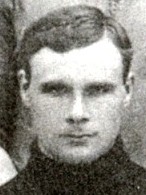
Sam Hardy
Goalkeeper · Liverpool 1905–1912
Personal
- Born
- 26 August 1882
- Place of birth
- Newbold, Chesterfield, England
- Died
- 24 October 1966
- International
- 21/0 (14/0 at LFC) - 10.04.1920 Debut 16.02.1907 vs. Ireland
- Other clubs
- Newbold White Star (1899-1902), Chesterfield (1902-05), Aston Villa (1912-21); Plymouth Argyle, Nottingham Forest (wartime guest), Nottingham Forest (1921-25)
At Liverpool
- Signed from
- Chesterfield Town
- Joined
- 19 May 1905
- Transfer fee
- £340
- Debut
- 21 October 1905
- Last appearance
- 6 April 1912
- Left the club
- 13 June 1912
Also played against Liverpool — view opposition record
Liverpool career
- League 219 apps · 0 goals
- Win ratio 45.83% — W 110 · D 44 · L 86
- League clean sheets 56
- Assists not recorded before 1945–46
Honours
- League Championship
- 1905-06
Player profile
Born a miner's son in a house on Highfield Lane, Sam first came to Chesterfield's attention as a member of the Newbold White Star side that beat their reserves in the 1902 Byron Cup final. Legend has it that, when manager Jack Hoskin was tipped off about Derby's reported interest in him, he rushed to sign Hardy, finally getting the man's signature under a lamp post in Newbold, but not until Hardy had forced Hoskin to increase his offer of five shillings (25p) a week to eighteen shillings (90p). His on-field performances reflected his character off it, for he was an even-tempered, down to earth man. Considering his great talents it was only a matter of time before he moved to a bigger club. Liverpool put six past Sam Hardy while he was in goal for Chesterfield in January 1905, but remembered that, but for Hardy, it would have been closer to twenty on the day. Accordingly, four months later the Reds came in with an offer of £300 plus a friendly, and the 22-year-old Hardy was on his way to greatness after keeping 30 clean sheets in 71 League appearances for Chesterfield. The friendly never took place, and Liverpool topped the fee up with another £40.
Hardy replaced Ned Doig, who had been the club's main 'keeper for the opening eight fixtures of the 1905/06 season. Liverpool had been struggling for consistency until that point, but Hardy's debut saw Forest beaten 4-1 and the Reds went on a terrific run, beating Middlesbrough 5-1, conquering champions Newcastle at St James' Park 3-2 and first-place Aston Villa were buried 3-0 at Anfield, Hardy saving a penalty from William Garratty. After only four games for the first team the joint Everton/Liverpool programme afforded Hardy the following praise: "Judging from the cool, yet effective, methods which he adopts in clearing his goal, we feel pretty well assured in prognosticating a successful future for this young player. He is fearless in stopping a rush, and remarkably agile in covering the goal space, and is equally at home with both high and low shots. When his first gruelling afternoon comes, we trust Hardy will show himself a master of his craft." After winning nine out of ten games, Liverpool were top of the table at Christmas, one point ahead of Aston Villa and with a game in hand. Hardy and his strong defence keeping four clean sheets. Liverpool didn't falter and finished four points ahead of Preston. Liverpool had won the League Championship for the first time in Hardy's first season.
Ten-year-old by the name of Walter Dutton was so impressed by Hardy's performances in goal that he put together a little poem for publication in the Liverpool Football Echo in April 1906.
I know a good goalie called Hardy
And when the ball comes he's not tardy
He belongs to the 'Pool
And he's been to school
Has that jolly good goalie called Hardy
Walter was not the only youth in Liverpool whose imagination Hardy had captured as T. Ellis' story records in the same issue as the poem above: "While walking through one of our parks the other day I met a youngster about the age of three walking along by his father's side. 'Eh, daddy,' said he, 'there's Hardy.' 'Where and what Hardy?' asked the parent. 'There he is, daddy - him as keeps goal for the Reds.' The father looked and I looked in the direction indicated by the youngster's pointed finger, and there stood, between two piles of coats and caps, a ragged barefoot lad, about ten, engaged might and main in resisting the earnest attempts of other lads to force a penny soft indiarubber ball between the said piles of coats and caps. This is true."
Looking through old copies of Liverpool Echo, some curious facts about Hardy can be found.- He was a smoker. Here's a description of him after a game: "Silent Sam, enjoying his cigarette whilst having his after-the-match bath at Anfield, is a picture of contentment." When Hardy was missing from Liverpool's starting line-up against Blackburn on 10 September 1910, he was in the stands smoking away...

On 17 April 1911 Hardy got his much-deserved benefit game when Liverpool faced Woolwich Arsenal at Anfield. The club and the Anfield crowd showed Hardy their appreciation: "Twenty thousand throats cheering the silent custodian to the echo. The band departed decorously, and the rival captains took the centre, Hardy proving fortunate with the coin, at which the generous crowd cheered again." Hardy was firmly first choice at Anfield for seven years until the 30-year-old was replaced by Scotsman Ken Campbell, ten years his junior, at the end of the 1911/12 season. Manager Tom Watson was clearly not afraid of putting his faith in his 'keepers while they were young. The Echo agreed with the management: "The change has been beneficial for the club, for whereas Hardy was beginning to show signs of inability to get to a shot with that electric speed that made him famous." Incidentally, Hardy's last game for Liverpool was on 6 April 1912 against Aston Villa. Campbell's success and Hardy's denial to move into the city of Liverpool signalled the end of his Reds' career. Two months later he joined The Villains who paid £1,500 to Liverpool. Following his move, Liverpool's board said they "were going to insist in future that their players should reside in the district." As in his debut season at Liverpool, Hardy was victorious in his first season with Villa. Villa won Sunderland 1-0 in the 1913 FA Cup final. Villa finished four points behind Sunderland in second place, but Liverpool with Ken Campbell in goal finished a disappointing twelfth. The following season Hardy suffered FA Cup heartache at the hands of his former team. Villa played Liverpool in the 1914 semi-final and Jimmy Nicholl scored two goals past Hardy. Liverpool had finally reached the final but lost 1-0 to Burnley. Hardy won a second FA Cup winners' medal in 1920 when Villa beat Huddersfield 1-0, but a year later he was on the move again after 183 games for the Villains.

Hardy further cemented his reputation as a conqueror of penalty takers in September, November and December of 1906
by saving three penalties from Everton, Newcastle and Sheffield United.
In 1921 he took over the pub Gardener's Arms on Glumangate in Chesterfield. His return to town fuelled fierce speculation that Chesterfield were going to sign him for their impending return to the Football League, but Villa, who had upset the player by insisting that he travel every day to Birmingham to train, were not taken in by Chesterfield's suggestion that a free transfer might be a fitting reward for his services. Villa got £1,000 from Nottingham Forest for him as the season started which was a gamble considering Hardy was a few days short of his thirty-ninth birthday. Of course, Hardy became a key member of Forest's team, helping them to promotion to the First Division in his first season. He paid scrupulous attention to his fitness which allowed him to keep playing in the top flight until just before his forty-third birthday, in an era when most players were clapped out at thirty. Hardy played 109 games for Forest before retiring in May 1925. He played 551 League games in 22 years and would have played many more if WWI had not intervened where he served in the Navy. He won one Championship medal and two FA Cup winners' medals in his brilliant career.
"Safe and Steady Sam" was one of the outstanding English goalkeepers of his time. He made 21 England appearances between 1907 and 1920, at a time when England usually played only three games a season and the nation went to war for four years. Any keeper enjoying a fourteen-year spell as his country's first-choice at the end of the twentieth century would have earned around 140 caps, knocking Peter Shilton's record easily of its perch. Hardy won his last and twenty-first international cap for England against Scotland on 10 April 1920. England beat the Scots 5-4.

"I liked Ray Clemence but he wasn’t as good a goalkeeper as Sam Hardy."
Bob Evans, a Liverpool fan of 76 years in the 1983 Liverpool annual
Appearances per season
| Season | League | FA | LC | Europe | Other | Total |
|---|---|---|---|---|---|---|
| 1905-1906 | 30 | 5 | 0 | 0 | 1 | 36 |
| 1906-1907 | 34 | 4 | 0 | 0 | 0 | 38 |
| 1907-1908 | 33 | 4 | 0 | 0 | 0 | 37 |
| 1908-1909 | 32 | 2 | 0 | 0 | 0 | 34 |
| 1909-1910 | 32 | 1 | 0 | 0 | 0 | 33 |
| 1910-1911 | 27 | 2 | 0 | 0 | 0 | 29 |
| 1911-1912 | 31 | 2 | 0 | 0 | 0 | 33 |
| Totals | 219 | 20 | 0 | 0 | 1 | 240 |
A more detailed look at the player's appearances
| Apps | Mins | Opponent |
|---|---|---|
| 240 | 21,600 | All opponents |
| 14 | 1,260 | Middlesbrough |
| 13 | 1,170 | Everton |
| 13 | 1,170 | Newcastle United |
| 12 | 1,080 | Arsenal |
| 12 | 1,080 | Aston Villa |
| 12 | 1,080 | Bury |
| 12 | 1,080 | Notts County |
| 11 | 990 | Blackburn Rovers |
| 11 | 990 | Sheffield United |
| 11 | 990 | Sheffield Wednesday |
| 11 | 990 | Sunderland |
| 10 | 900 | Bristol City |
| 10 | 900 | Manchester United |
| 10 | 900 | Nottingham Forest |
| 10 | 900 | Preston North End |
| 9 | 810 | Bolton Wanderers |
| 9 | 810 | Manchester City |
| 7 | 630 | Bradford City |
| 6 | 540 | Birmingham City |
| 6 | 540 | Chelsea |
| 6 | 540 | Tottenham Hotspur |
| 3 | 270 | Derby County |
| 3 | 270 | Oldham Athletic |
| 3 | 270 | Stoke City |
| 2 | 180 | Brighton & Hove Albion |
| 2 | 180 | West Bromwich Albion |
| 2 | 180 | Wolves |
| 1 | 90 | Barnsley |
| 1 | 90 | Brentford |
| 1 | 90 | Corinthians |
| 1 | 90 | Fulham |
| 1 | 90 | Gainsborough Trinity |
| 1 | 90 | Leicester City |
| 1 | 90 | Leyton |
| 1 | 90 | Lincoln City |
| 1 | 90 | Norwich City |
| 1 | 90 | Southampton |
| Total | Venue |
|---|---|
| 129 | Home |
| 109 | Away |
| 2 | Neutral |
| Total | Competition |
|---|---|
| 219 | League |
| 20 | FA Cup |
| 1 | Sheriff of London Charity Shield |
| Total | W | D | L | Win% | Manager |
|---|---|---|---|---|---|
| 240 | 110 | 44 | 86 | 45.8% | Tom Watson |
Clean sheets per season
Related Articles
The outlook – changes and revisions (by Sam Hardy, Aston Villa)
Published in the Tamworth Herald on 7 September 1912.
Kenneth Campbell continues his life story – Chapter 2
Scottish keeper, Kenny Campbell, told his life story in the Weekly News. Chapter two was published on 14 May 1921.
The thoughts of Sam Hardy
Published on 2 December 1909.
1901-1906: A rise from 2nd division to the title!
In 1904 Liverpool had been relegated to 2nd division only three years after winning the title for the first time. Liverpool were on their way to an amazing success!
Young Scot makes his bow
An excerpt from the Daily News on 21 May 1921.
Liverpool capture Hardy
From the Liverpool Daily Post on 19 May 1905.