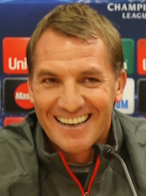
Brendan Rodgers
Manager · Liverpool 2012–2015
Personal
- Born
- 26 January 1973
- Place of birth
- Carnlough, Northern Ireland
- Other clubs managed
- Watford (2008-09), Reading (2009), Swansea City (2010-12), Celtic (2016-19), Leicester (2019-23), Celtic (2023-)
At Liverpool
- Arrived from
- Swansea City
- Appointed
- 1 June 2012
- First match
- 2 August 2012
- Final match
- 4 October 2015
- Left the club
- 4 October 2015
- Time in charge
- 3 years, 4 months
Liverpool record
- 122 league games · First match 2 August 2012 · Final match 4 October 2015
Season by season
Full season record →Final league position for seasons he finished; position at the end of his spell for seasons he didn't.
Honours
No major honours with Liverpool
Individual honours
- LMA Manager of the Year
- 2014
Manager profile
In being officially unveiled on 1 June 2012 as the man to replace Kenny Dalglish as manager of team affairs at Liverpool Football Club, 39-year-old Ulsterman Brendan Rodgers became the club’s youngest appointee to that position since Graeme Souness arrived as a 37-year-old in 1991. On taking up his new post Rodgers, however, despite a growing reputation and a managerial apprenticeship earned at Watford, Reading and Swansea, did not possess the experience or abrasiveness of the Scot who had previously been chosen to replace the Liverpool legend 21 years earlier. Although seemingly settled and happy in south Wales, having steered Swansea into the Premier League as the Championship play-off winners in 2011, what he had achieved at Swansea and the way he had achieved it made him an inevitable target for bigger clubs. It was probably more a question of when rather than if this next move would happen. After initially turning down the opportunity to talk to Liverpool’s owners in the middle of May about the vacant manager’s position at Anfield, it seemed that Wigan boss Roberto Martinez had become the American owners’ new target. But only days after Martinez had met representatives of Fenway Sports Group in Florida, attention turned again to Rodgers, who felt unable to turn down a second request from Liverpool to discuss the prospect of taking over the chair vacated by Dalglish.
Rodgers did not take up football seriously until he had become a teenager. He was a youth player with Ballymena United in his home county of Antrim but only played a dozen or so matches as a senior there before moving to England to further his career with Reading, then in the Third Division of the Football League. Unfortunately, a genetic knee condition forced him to terminate any ambitions of becoming a professional footballer before he had even appeared in a first-team match for the Berkshire club. Putting aside his disappointment at not being able to play on a full-time basis, Rodgers worked hard at pursuing a career as a coach. He became Reading’s Academy manager at the young age of twenty-two. Soon after arriving at Stamford Bridge in 2004 José Mourinho offered him the opportunity to manage Chelsea’s Academy and he impressed enough to be offered the reserve team’s manager’s job in 2006. Born exactly ten years to the day before Rodgers, Mourinho saw other characteristics which mirrored his own. "I like everything in him," Mourinho said. "He is ambitious and does not see football very differently from myself. He is open, likes to learn and likes to communicate."
In 2008 Watford, then in the Championship division, gave Rodgers the chance to manager a first team. Arriving at a time when the Hertfordshire club had made a dreadful start to the season, Rodgers steered them to mid-table safety after they had been in the relegation-zone in January. Rodgers likes to think his teams reflect his father's work ethic. "I used to help dad paint and decorate to earn pocket money. He installed in me the value of a hard day's work. He believes that leads to success in whatever you do. He's right," he said. "He'd work from dawn to dusk to ensure his young family had everything. I think you can see his philosophies in my team."
Rodgers’ first English club were obviously monitoring the Irishman’s progress. When Steve Coppell stepped down after failing to take Reading back into the Premier League they had left at the end of the 2007/08 season, Rodgers was appointed to replace him. But it was not a happy return to the Madejski Stadium and shortly before the end of 2009 he was sacked by the Berkshire club. For six months he said he couldn’t even get an interview with a League 2 club but Swansea Chairman, Huw Jenkins, recognised the superb job he had done working with youngsters at Reading and Chelsea and appointed him to the post of Swansea manager in the summer of 2010.
In a sensational first season based in south Wales, Brendan Rodgers led the Swans into the promised land of the Premier League, although it took a dramatic play-off final victory against his old club Reading at Wembley to achieve this. Tipped by many to make an immediate return to the Championship, Swansea impressed throughout the season and finished in a comfortable eleventh place with their home form being particularly strong. Rodgers’ team also took four points out of six from Liverpool, who ultimately finished only three places and five points above them. This might have been a factor, although possibly not a major factor, in Liverpool’s American owners seeing Rodgers as a potential manager of their own club.
Rodgers revealed to the Daily Mail in 2011 the reason behind the playing style of his teams. “I suppose I’m in a new breed of coaches coming through and the one thing I have is confidence in players. I had a timeline to be a good coach and nearly 20 years in the game at that level has given me that," Rodgers told Daily Mail's Neil Ashton. "People like Roy Keane, Gareth Southgate and Gary Neville all had unbelievable careers and they have done their coaching badges, but I didn’t have the playing career. I was brought up in a traditional 4-4-2, kick the ball up the pitch, but when I was a youth international with Northern Ireland we would play France, Spain and Switzerland and we would chase the ball. I wanted to play in their team, I liked the ideology. I educated myself by studying, watching and learning."
Rodgers’ lack of success or experience as a player need not necessarily be seen as a disadvantage because both Gerard Houllier and Rafael Benítez took the club to domestic and European honours despite very modest playing careers. Tom Werner, Liverpool’s Chairman emphasised that Rodgers will offer “relentless, attacking football” and was the owner’s first-choice and the only man offered the manager’s job. Rodgers, who was the first Ulsterman to manage Liverpool since John McKenna in 1892, is a visionary who has studied coaching techniques in Spain (Rodgers is fluent in Spanish) and Holland where he spent time with the legendary Rinus Michels. "My big dream is to be a highly successful football manager whose methods provide innovation for youth and senior footballers and coaches. I started coaching for one reason and that was to make a difference for people, not just as footballers but as human beings. I'm learning lessons all the time. My template for everything is organisation. With the ball you have to know the movement patterns, the rotation, the fluidity and positioning of the team. When we have the football everybody's a player. If you are better than your opponent with the ball you have a 79% chance of winning the game."
Brendan Rodgers arrived at Liverpool in June 2012 as one of the most highly regarded young managers in British football. He inherited a Liverpool side that had finished eighth in 2011/12 and began an extensive rebuilding process. His first season produced inconsistent results, but the January 2013 signings of Daniel Sturridge and Philippe Coutinho transformed the attack and provided a glimpse of what was to follow. Liverpool finished seventh, with Luis Suárez increasingly influential and several young players, most notably Raheem Sterling, given opportunities to develop. The 2013/14 campaign became the defining chapter of Rodgers’ Liverpool career. The original target was a return to the Champions League, but Liverpool developed into the most exhilarating attacking team in the country and came within touching distance of winning a first league championship for 24 years. Rodgers showed considerable tactical flexibility, moving between a 4-3-3, a 3-5-2 and a midfield diamond to accommodate the strengths of Suárez, Sturridge and Sterling.
Liverpool’s football was played at breathtaking speed. Rather than relying exclusively on the patient possession game associated with Rodgers at Swansea, the team attacked directly whenever space appeared, pressed opponents into mistakes and frequently overwhelmed them during the opening stages of matches. Arsenal were four goals down inside 20 minutes at Anfield, Tottenham Hotspur were comprehensively beaten home and away, and Liverpool recorded a memorable 3–0 victory over Manchester United at Old Trafford. Suárez produced one of the greatest individual seasons in the club’s history, scoring 31 league goals without taking a penalty, while Sturridge added 21. Sterling’s pace and intelligence gave Rodgers another attacking weapon and Gerrard contributed 13 league goals from midfield.
A run of 11 consecutive league victories carried Liverpool to the top of the table with three matches remaining. Anfield, which had waited years for another genuine championship challenge, rediscovered its intensity and belief. The 3–2 victory over Manchester City in April appeared to place the title within Liverpool’s control, but the momentum was broken by a 2–0 home defeat against Chelsea. Liverpool still had a chance, but the following match at Crystal Palace captured both the excitement and the vulnerability of Rodgers’ side. Leading 3–0 with 11 minutes remaining, Liverpool continued pursuing goals in an attempt to reduce Manchester City’s superior goal difference and conceded three times to draw 3–3. City completed the job by winning their remaining fixtures, leaving Liverpool second with 84 points and 101 league goals. Despite the painful conclusion, Rodgers had taken the club much further than expected and was named LMA Manager of the Year. For many supporters, 2013/14 remained an unforgettable campaign in which Liverpool recovered their identity as an attacking force and came closer to the title than at any point during the Premier League era until Jürgen Klopp’s arrival.
Rodgers was unable to sustain that progress. Suárez was sold to Barcelona in the summer of 2014, Sturridge missed most of the following season through injury and several of the players recruited to rebuild the attack failed to make the required impact. Liverpool briefly recovered after a poor start by adopting a system featuring three central defenders, but their Champions League return ended in the group stage and they lost to Aston Villa in the FA Cup semi-final. A 6–1 defeat at Stoke City on the final day provided a humiliating conclusion to the 2014/15 season in which Liverpool finished sixth. Gerrard departed for LA Galaxy and Sterling was sold to Manchester City during another summer of substantial change. Rodgers remained in charge for the beginning of 2015/16 despite the sacking of his coaching staff, but confidence in the project had faded. Liverpool won only three of their opening 11 matches in all competitions, and Rodgers was dismissed shortly after a 1–1 draw at Everton on 4 October 2015. Rodgers restored Champions League football, accelerated the development of several important players and created one of the most entertaining Liverpool sides of the modern era. At the same time, the failure to build on 2013/14 and the team’s recurring defensive weaknesses prevented his tenure from producing lasting success.
Rodgers rebuilt his career spectacularly at Celtic. Appointed in 2016, he completed an unbeaten domestic season and won the Scottish treble in his first campaign. Celtic repeated the treble the following year, becoming the first Scottish club to achieve consecutive domestic trebles, and Rodgers added another League Cup before leaving for Leicester City in February 2019. At Leicester he again demonstrated his ability to produce ambitious, attacking football. The club finished fifth in successive Premier League seasons, narrowly missing Champions League qualification on both occasions, and Rodgers delivered the first FA Cup in Leicester’s history by defeating Chelsea in the 2021 final. Victory over Manchester City in the Community Shield followed, but injuries, financial restrictions and a decline in results gradually weakened the team. Rodgers left by mutual consent in April 2023 with Leicester fighting relegation.
Rodgers returned to Celtic in June 2023 despite the hostility caused by the manner of his first departure. He answered much of the criticism by winning a league and Scottish Cup double in 2023/24, followed by another league title and the League Cup in 2024/25. His second spell ended less happily when he resigned in October 2025 following a poor start to the season and a very public breakdown in his relationship with the club’s hierarchy. Across his two periods at Celtic, he won 11 major trophies. Rodgers was appointed manager of Saudi Pro League club Al-Qadsiah in December 2025. His career after Liverpool underlined both his considerable strengths and the questions that followed him at Anfield. He proved himself capable of coaching technically accomplished attacking teams, improving players and delivering trophies, while occasionally struggling when momentum was lost or when rebuilding was required.
More on Brendan Rodgers
Quotes 1
“In this country we pay them to fail. We don’t want to give them the contracts. I had the situation last year with Raheem. He was brilliant t…”
All quotes →Record
| Competition | Total | Won | Draw | Lost | Goals for | Goals against |
|---|---|---|---|---|---|---|
| Grand totals | 166 | 85 | 39 | 42 | 293 | 201 |
| League | 122 | 63 | 30 | 29 | 232 | 151 |
| FA Cup | 12 | 7 | 2 | 3 | 17 | 11 |
| League Cup | 10 | 6 | 1 | 3 | 16 | 14 |
| Europe | 22 | 9 | 6 | 7 | 28 | 25 |
Related Articles
Being Liverpool Manager
"At a football club, there's a holy trinity - the players, the manager and the supporters." - Bill Shankly
Liverpool's Latin Americans
Declan Sloan has put together a complete record of every South American player to wear the famous Red Jersey, from Mauricio Pellegrino in 2005 to newly recruited Roberto Firmino.
Liverpool's thrilling football excites Keegan
Kevin Keegan believes Brendan Rodgers has returned the club to the attacking football played by Bill Shankly and Bob Paisley. From BBC Radio 5.
Boss shares secret to Stevie fitness
Brendan Rodgers on captain fantastic on 13th September, 2013.
Rodgers, Barca and 'Tiki Taka'
Football coach and blogger Jed Davies examines the 'Tiki-Taka' philosophy deployed by Barcelona under Pep Guardiola and Swansea under Brendan Rodgers. From 25 June 2012.