
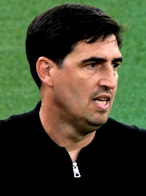
Andoni Iraola
Manager · Liverpool since 2026
Personal
- Born
- 22 June 1982
- Place of birth
- Usurbil
- Other clubs managed
- AEK Larnaca (2018-19), Mirandés (2019-20), Rayo Vallecano (2020-23), Bournemouth (2023-26)
At Liverpool
- Arrived from
- Free agent
- Appointed
- 4 June 2026
- First match
- 23 August 2026
- Latest match
- 14 October 2026
- Contract expiry
- 30.06.2028
- Time in charge
- 4 months
Liverpool record
- 6 league games · First match 23 August 2026 · Latest match 14 October 2026 · updated after every match
Season by season
Full season record →- 2026-27 9th current position in progress
Final league position for seasons he finished; position at the end of his spell for seasons he didn't.
Honours
No major honours with Liverpool
Manager profile
When Liverpool appointed Andoni Iraola in the summer of 2026, they turned to one of the most highly regarded young coaches in the game. The Spaniard had built his reputation not through trophies at Europe's elite clubs, but through an ability to transform teams, develop players and create a clear, aggressive footballing identity. Iraola's football education came through the famed Athletic Bilbao academy. As a player he embodied many of the characteristics that would later define his coaching career: intelligence, work ethic, tactical discipline and relentless intensity. A modern attacking full-back before the position became fashionable, Iraola made more than 500 appearances for Athletic and represented Spain on seven occasions.
His coaching career began shortly after retirement. Early spells at AEK Larnaca in Cyprus and Mirandés in Spain provided valuable experience, but it was at Rayo Vallecano where Iraola first attracted widespread attention. Working with one of La Liga's smaller budgets, he guided Rayo to promotion to La Liga and then established them as one of the league's most entertaining and tactically distinctive sides. Opponents found themselves harried and pressed from the first whistle, while supporters embraced an ambitious style that often took the game to clubs with far greater resources. Those principles would become even more evident after his move to Bournemouth in 2023. Replacing Gary O'Neil was never going to be straightforward. Bournemouth had survived relegation comfortably the previous season and many supporters questioned whether a more adventurous approach was worth the risk. The opening months of Iraola's reign appeared to justify those concerns. Results were difficult to come by as players adapted to new tactical demands and Bournemouth spent much of the early campaign in the lower reaches of the table. Yet the foundations were being laid.
Iraola asked his players to play in a way few Premier League teams attempted. Bournemouth pressed high and aggressively, often committing multiple players to winning the ball back within seconds of losing possession. Rather than retreat into defensive shape, they sought to suffocate opponents near their own penalty area. The objective was simple: force mistakes, regain possession quickly and attack before opponents could reorganise. The approach required extraordinary physical commitment. Players were expected to sprint repeatedly, close passing lanes, challenge aggressively and maintain concentration for the full ninety minutes. When the press succeeded, Bournemouth became one of the league's most dangerous transition teams. Unlike some possession-based coaches, Iraola was not interested in keeping the ball simply for the sake of control. His football prioritised speed and verticality. Once possession was regained, Bournemouth looked forward immediately. Attacks were often built around quick combinations, direct running and rapid movement into dangerous areas. Opponents frequently found themselves dragged into uncomfortable, high-tempo contests.
As players became increasingly familiar with the system, performance improved dramatically. Bournemouth evolved from relegation candidates into one of the Premier League's most difficult sides to face. Established clubs regularly struggled against their intensity, while several of the division's leading teams dropped points against them. One of Iraola's greatest strengths proved to be player development. Under his management numerous squad members reached levels previously unseen in their careers. Young players improved rapidly, while established professionals appeared revitalised by the clarity of their roles. Recruitment and coaching worked hand in hand, enabling Bournemouth to compete with clubs possessing significantly greater financial resources.
By the 2025/26 season, Bournemouth had become recognised as one of the Premier League's most progressive clubs. They consistently ranked among the league leaders for pressing statistics, ball recoveries in advanced areas and attacking transitions. More importantly, the style produced results. Bournemouth achieved their record points total in 2025/26 after being undefeated since early January and secured qualification for European competition for the first time in their history.
The transformation enhanced Iraola's reputation across Europe. He demonstrated that a clearly defined tactical vision could allow a club to outperform expectations while still playing attractive football. His teams are organised without being cautious, ambitious without being reckless and intensely competitive regardless of the opposition. Liverpool's interest therefore came as little surprise. The club had spent much of the previous decade associated with energetic, front-foot football built upon pressing, attacking movement and emotional intensity. Iraola's philosophy aligns naturally with many of those traditions. While every coach brings his own ideas, observers noted clear similarities between the values that had made Liverpool successful under Jürgen Klopp and the principles underpinning Bournemouth's rise under the Spaniard.
At Anfield, Iraola inherits one of football's most demanding jobs. Yet he arrives with credentials built not merely on reputation but on tangible achievement. He has consistently improved teams, elevated players and demonstrated the tactical flexibility required to compete in modern football. His appointment represents both continuity and evolution. Liverpool are hiring a coach whose teams reflect many of the qualities their supporters have traditionally admired: courage, intensity, work ethic and a willingness to take the initiative.
As Iraola was unveiled in Liverpool in 4 June he had a clear message to the fans: “You don't need a lot of things to get attracted by Liverpool. Liverpool is Liverpool. For me, football is about emotions. About passion. I'm quite cool-headed probably, during my life quite rational, I would say. But it's true that when the game starts, when you have to celebrate a goal, something is inside, no? I think this inner energy, you need it as a player, you need it as a supporter, you need it as a coach. No better place than Anfield. I can only say that I want to become one more of you. I want to earn the right to be one of you, so we can enjoy all together.”
More on Andoni Iraola
Record
| Competition | Total | Won | Draw | Lost | Goals for | Goals against |
|---|---|---|---|---|---|---|
| Grand totals | 9 | 5 | 3 | 1 | 18 | 12 |
| League | 6 | 2 | 3 | 1 | 7 | 7 |
| League Cup | 1 | 1 | 0 | 0 | 3 | 1 |
| Europe | 2 | 2 | 0 | 0 | 8 | 4 |