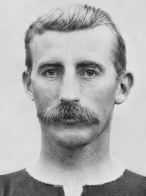
John Arnold Parkinson, usually known as Jack, made only one first-team appearance for Liverpool but enjoyed a much longer association with his hometown club, Blackpool. His early football took him through several local sides, including Blackpool Olympic, Lytham and South Shore, before he established himself with Blackpool. He joined Liverpool in May 1899, following Blackpool’s failure to secure re-election to the Football League. Parkinson’s solitary appearance came in the Merseyside derby at Anfield on 23 September 1899. Playing at inside-right alongside outside-right Jack Cox, he was part of a Liverpool side beaten 2–1 by Everton. Although Liverpool struggled against the wind in the first half, they improved after the interval. Parkinson forced an early corner and later supplied a pass from which Andy Robertson narrowly missed the target as Liverpool sought an equaliser. There were no further first-team opportunities for Parkinson, whose remaining football at Anfield was played with the reserves. He returned to Blackpool in the summer of 1900 and became a familiar figure during the following decade. Having made his reputation as a forward, he subsequently played at centre-half. Liverpool maintained a connection with their former player, visiting Blackpool for his benefit match in 1905. In January 1910 he moved to Barrow, choosing them despite interest from several other clubs, including Grimsby, Nelson, Colne and Rossendale.
Away from football, Parkinson was closely associated with Blackpool’s seafaring community and served with the local lifeboat crew. His willingness to help people in danger was demonstrated in September 1897, when he was among the men who rescued a music-hall performer from rough seas near Central Pier. Football was therefore only one part of a life in which working on the coast and taking part in rescues also featured prominently. His life ended tragically following an accident at Cocker Street Baths, where he worked as superintendent. On 12 December 1911, the engineer, Isaac Howcroft, fell into a tank of extremely hot seawater when the covering beneath him collapsed. Parkinson and his wife, Ada Bessie, helped Howcroft out, but another section gave way beneath Parkinson and plunged him into the tank. He managed to pull himself up, only for the boards to collapse again, causing a second fall. Although he eventually escaped, he suffered severe scalding and died on 20 December. The inquest returned a verdict of accidental death and drew attention to the rotten wooden supports over the tank. Parkinson’s funeral brought together representatives of football and the lifeboat service. His coffin was placed in his own boat, the Union Star, for the procession, and former colleagues helped accompany him on his final journey. The circumstances of his death added a tragic final chapter to the life of a footballer whose courage extended well beyond the playing field.