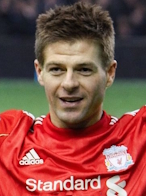
Steven Gerrard
Midfielder · Liverpool 1998–2015
Personal
- Born
- 30 May 1980
- Place of birth
- Whiston, Knowsley, England
- International
- 114/21 (24.06.2014) Debut 31.05.2000 vs. Ukraine
- Other clubs
- Los Angeles Galaxy (2015-16)
At Liverpool
- Signed from
- Local
- Joined
- 1988
- Debut
- 29 November 1998
- First goal
- 5 December 1999
- Last goal
- 24 May 2015
- Last appearance
- 24 May 2015
- Left the club
- 30 June 2015
Liverpool career
- League 504 apps · 120 goals · 92 assists
- Win ratio 52.39% — W 372 · D 167 · L 171
Honours
Individual honours
- PFA Team of the Year
- 2001 · 2004 · 2005 · 2006 · 2007 · 2008 · 2009 · 2014
- PFA Players' Player of the Year
- 2006
- PFA Young Player of the Year
- 2001
- PFA Fans' Player of the Year
- 2001 · 2009
- FWA Footballer of the Year
- 2009
Player profile
Finally, the England set-up took notice. He was nominated captain of the u-18 side and made his debut for the u-21s in September 1999. Houllier trusted the 19-year-old to begin the 1999/00 season in the starting line-up alongside Redknapp and promised him at least 20 games. Didi Hamann took his place eight games into the campaign in the Merseyside derby and disappointed Gerrard came on as a substitute. He lost his composure at the end of the match and was sent off for an ugly foul and was banned for three games. Gerrard returned stronger than before, determined to prove himself and his first goal for the club, against Sheffield Wednesday on 5 December 1999 proved to be spectacular. “A wonderful talent, a young man with the steel of a Stiles and the style of a Souness” – as Ric George described him in the Liverpool Echo – “side-stepped, danced and dribbled past three defenders before finishing decisively." He also proved his versatility as in one year he had played as a left-back, right-back, defensive and offensive midfielder and right-winger.
On 31 May 2000 Gerrard made his international debut, aged 20 years and one day, in a 2-0 win against Ukraine at Wembley. A relative newcomer to the England squad Gerrard only made one substitute appearance in Euro 2000 when he came on for Michael Owen in a win over Germany. Kevin Keegan's England team only recorded this one win and failed to qualify from their group. The boy had sure come far in a short period of time and his career rose rapidly in the 2000/01 season. He made 50 appearances for Liverpool, won the League Cup and FA Cup and scored a goal, which he ranks as one of his most memorable, in the brilliant 5-4 win over Alaves in the UEFA Cup final. Gerrard was named the Professional Footballers Association's Young Player of the Year. Liverpool, under the guidance of Houllier, continued its progress in the League and finished second in the 2001/02 season, seven points behind Arsenal. Gerrard was ruled out of England's World Cup squad in the summer through injury. Liverpool's form dropped considerably in the next two years. Despite these setbacks, Gerrard's influence had grown and on 15 October 2003 he was made captain of Liverpool Football Club, a dream come true for the boyhood Red: "I was captain of my school side and I used to go along to Anfield to watch the team. I used to watch Barnes with the captain's armband and dream that one day it would be me captaining the team I love."
Rafa Benítez took over in 2004 and in a season of reconstruction Gerrard elevated his status in the minds of Liverpool supporters when his tremendous goal against Olympiacos guaranteed his team's process from the group stages of the Champions League in front of a packed Kop. Gerrard's header nine minutes into the second half in Istanbul inspired an unlikely comeback that can be arguably called the greatest ever. What immediately followed no-one could have imagined. Liverpool's Chief Executive, Rick Parry, had told Gerrard that the club was going to renew his contract in the summer. Liverpool remained unresponsive and Chelsea with all its riches tempted Gerrard to leave for London. He later said in his autobiography it was the lowest point in his career. "I renew my deal with Liverpool in four or five years and when I do I would like Stevie to be my next coach, assistant manager and maybe even the next manager after me. He can even have the chief scout position if he wants it." - Rafa in July 2005.
Gerrard scored 20+ goals for Liverpool for the first time in the 2005/06 season and it was real "Roy of the Rovers" stuff for him when Liverpool faced West Ham in the 2006 FA Cup final. Gerrard scored with a stunning volley in the fifty-fourth minute to make it 2-2 and when West Ham seemed certain to lift the cup, being 3-2 up with time running out, he scored from a long way out because as he said his feet could not carry him any further; an incredibly audacious effort by the captain. Liverpool won the FA Cup after a penalty shoot-out. Gerrard was recognised by his professionals as the best player in the Premier League that season. Gerrard featured for Sven-Göran Eriksson's England in the 2006 World Cup in Germany, playing five games and scoring in two consecutive games against Trinidad and Tobago and Sweden. He missed a penalty as England was eliminated by Portugal in a penalty shoot-out in the quarter-finals. Liverpool's talisman had another stunning season in 2006/07, playing in 52 out of a maximum 59 competitive matches. His goal tally reached double figures for the fifth successive season. As autumn turned into winter, Gerrard scored in six successive home matches in League and cup and during the same period, he also scored a stunning free-kick up at Newcastle. But his most productive day goal-wise was when Luton Town came up to Anfield for an FA Cup third-round replay. Gerrard had not even made the squad for the original tie in Bedfordshire but in the replay, he scored a hat-trick in 17 second-half minutes to ensure that there would be no big cup upset. Like the rest of his club colleagues, Gerrard put the disappointment of losing the Champions League final in Athens behind him as Liverpool prepared for another season. Newspaper speculation again linked Liverpool's skipper with a big-money move to Chelsea in the summer of 2007. However, as he and Jamie Carragher signed new deals on 4 June 2007 to keep both players at Anfield for four more years.
Gerrard continued to be a hugely influential player for Liverpool in both 2007/08 and 2008/09, two years in which he added another 96 first-team appearances to an already impressive total. He also added another 45 goals. He scored twice as Real Madrid were humbled at Anfield in the last 16 in the Champions League, but he was unable to prevent Liverpool losing to Chelsea in the next round, the second leg of which he missed because of injury. Costly draws proved Liverpool's downfall in wrestling the championship from Manchester United in 2009. It was, however, the first time that Gerrard had been involved in a really serious Liverpool challenge for the much-coveted title and his talent was evident enough for Football Writers to vote him the best player of the season. There was something vital missing in Gerrard's game in the 2009/10 season. He knew that the team was expected to 'kick on' from the second place it had achieved in 2009 and win the ultimate prize. His extraordinary ability to get the team out of a hole, something he had done countless times in the previous ten years, was suddenly waning. He only missed seven matches so he was as much a regular in the first team as he had usually been. His contribution in terms of goals, just 12, was exactly half that of the previous season and his lowest for three years.
Liverpool's finest was named captain of the England team when injury ruled Rio Ferdinand out of the World Cup in 2010. He responded by netting England's first goal against the United States, but it was a lead he and his colleagues were unable to hold on to. He played in all four of England's matches including the one in the last 16 when Germany humbled them. In 2010/11 Gerrard played in the fewest number of competitive matches, just 24 out of 54, since his first full season of 1999/00. This was partly because of an injury he received against Manchester United at Anfield in March. United were prominent in Gerrard's season. The skipper scored twice at Old Trafford in September and his brace looked like rescuing a point until Berbatov's late winner. Back at Old Trafford in January in the FA Cup as Dalglish returned to the dugout, Gerrard was sent off by Howard Webb. Gerrard said after his successful groin operation that he hadn't felt as good for a decade as 2011/12 started.
However, injuries restricted Gerrard to only 28 appearances. Gerrard still showed glimpses of world-class talent, especially when scoring an Anfield hat-trick against Everton in March. He was also fit enough to lead the team out in both the domestic cup finals at Wembley. His joy in lifting Liverpool's first cup for six years was for all to see. In the middle of May, Roy Hodgson named Gerrard as outright England captain of the 23-man squad for the European Championships in which he was his country's key player. As the 32-year-old embarked on a new season under Brendan Rodgers he claimed he was not yet prepared to play in a deeper role in Liverpool's midfield, aiming to prove he is as dynamic as ever. Lucas' injury at the start of 2012/13 forced Gerrard to defend more than attack, being unable to showcase his talents in the final third of the field where he is the most effective. On 14 November 2012, Gerrard became the sixth Englishman to reach a century of caps for his country joining the illustrious group of Billy Wright, Bobby Charlton, Bobby Moore, Peter Shilton and David Beckham. As Liverpool progressed under Rodgers, Gerrard gained strength and provided quite a few assists for his teammates. A shoulder injury and the subsequent surgery on it prevented Gerrard from playing in every Premier League match in 2012/13. Despite missing the last two league matches against Fulham and Queens Park Rangers, he still made more first-team appearances than any other player. Ten goals was a respectable total for the season, the first time he had achieved double figures since 2009/10.
Although ultimately disappointed in his quest to finally get a Premier League winners' medal, 2013/14 was still a significant season for Liverpool's captain. As well as becoming the longest-serving skipper in the club's history Gerrard moved past Ray Clemence and Emlyn Hughes into third place in the club’s all-time competitive appearance list with only Jamie Carragher (737) and Ian Callaghan (857) now ahead of him; he also went past Kenny Dalglish’s total of 172 Liverpool goals to move just ten behind Robbie Fowler’s 183, and the penalty-kick against West Ham United in April that took him past Kenny Dalglish's total moved him level with Jan Mølby on 42 successful spot-kicks But possibly more important than any statistic was his manager's decision to try him out in a new 'holding' midfield role just in front of the back four. Gerrard adapted well to an unfamiliar position and his success played a big part in Liverpool almost achieving the impossible and winning the Premier League. Gerrard was one of five Liverpool players named in England's squad for the World Cup finals in Brazil. He played from the start and captained his country in the opening two group matches against Italy and Uruguay. With England eliminated after two defeats he came on with 17 minutes remaining in the final match against Costa Rica. Eight days after the World Cup it was announced that Gerrard had retired from international football after a 14-year spell that brought him one hundred and fourteen full international caps.
On 2 January 2015, Liverpool FC released this statement on its official website: "Liverpool Football Club can confirm Steven Gerrard is to leave the club at the end of the 2014-15 season. The Reds captain will bring the curtain down on a glittering Anfield career that has spanned nearly 17 years and included 10 trophies, as well as 695 appearances and 180 goals to date since joining the club's youth system aged eight."
Sadly, the 2014/15 season did not end on the high that the club's inspirational skipper for more than a decade had hoped for. Liverpool were beaten at the semi-final stage of both domestic cup competitions with the semi-final defeat in the FA Cup denying Gerrard the opportunity of playing in yet another final on his 35th birthday. He did, however, pass forty first-team appearances for the 12th time in his Liverpool career and in so doing reached five hundred Premier League appearances and seven hundred in all competitions. Thirteen goals took him to one hundred and eighty-six as he moved past Robbie Fowler into fifth place in the club's all-time list.
Steven Gerrard joined the Los Angeles Galaxy in the MLS as his contract expired in the summer of 2015. In his first MLS game, he was on target and also created a goal for fellow ex-Red Robbie Keane in a 5-2 win over San Jose Earthquakes. He finished the season with two goals from thirteen games, then announced early in the 2016 season that he would not be extending his contract any further, citing distances for away games as a problem. When the season ended he was linked with a move it Melbourne Victory but instead called time on his playing career, announcing his decision on 24 November.
Gerrard returned to Liverpool as coach of the under 18s, but left in May 2018 to take up his first management position with Glasgow Rangers. He led Rangers to the title in 2020/21, remaining unbeaten all season and ending Celtic's dreams of a ten year winning streak. He left in November to take over at Aston Villa, eventually ending the season in fourteenth. After just two wins in the opening twelve games of 2022/23 Gerrard was sacked and the following summer he was announced as manager of Saudi Pro League club Al Ettifaq. He spent 18 months there, leaving by mutual consent in January 2025.
Appearances per season
| Season | League | FA | LC | Europe | Other | Total |
|---|---|---|---|---|---|---|
| 1998-1999 | 12 | 0 | 0 | 1 | 0 | 13 |
| 1999-2000 | 29 | 2 | 0 | 0 | 0 | 31 |
| 2000-2001 | 33 | 4 | 4 | 9 | 0 | 50 |
| 2001-2002 | 28 | 2 | 0 | 15 | 0 | 45 |
| 2002-2003 | 34 | 2 | 6 | 11 | 1 | 54 |
| 2003-2004 | 34 | 3 | 2 | 8 | 0 | 47 |
| 2004-2005 | 30 | 0 | 3 | 10 | 0 | 43 |
| 2005-2006 | 32 | 6 | 1 | 12 | 2 | 53 |
| 2006-2007 | 36 | 1 | 1 | 12 | 1 | 51 |
| 2007-2008 | 34 | 3 | 2 | 13 | 0 | 52 |
| 2008-2009 | 31 | 3 | 0 | 10 | 0 | 44 |
| 2009-2010 | 33 | 2 | 1 | 13 | 0 | 49 |
| 2010-2011 | 21 | 1 | 0 | 2 | 0 | 24 |
| 2011-2012 | 18 | 6 | 4 | 0 | 0 | 28 |
| 2012-2013 | 36 | 1 | 1 | 8 | 0 | 46 |
| 2013-2014 | 34 | 3 | 2 | 0 | 0 | 39 |
| 2014-2015 | 29 | 3 | 3 | 6 | 0 | 41 |
| Totals | 504 | 42 | 30 | 130 | 4 | 710 |
A more detailed look at the player's appearances
| Total | Started/substitutions |
|---|---|
| 647 | Started |
| 139 | Substituted |
| 63 | Substitute |
| 12 | On bench |
| Total | Venue |
|---|---|
| 354 | Home |
| 337 | Away |
| 19 | Neutral |
| Total | Competition |
|---|---|
| 504 | Premier League |
| 87 | Champions League |
| 42 | FA Cup |
| 30 | League Cup |
| 24 | UEFA Cup |
| 18 | Europa League |
| 2 | World Club Championship |
| 2 | Community Shield |
| 1 | European Super Cup |
| Total | W | D | L | Win% | Manager |
|---|---|---|---|---|---|
| 292 | 166 | 62 | 64 | 56.8% | Rafa Benítez |
| 240 | 122 | 62 | 56 | 50.8% | Gérard Houllier |
| 126 | 60 | 32 | 34 | 47.6% | Brendan Rodgers |
| 34 | 17 | 7 | 10 | 50.0% | Kenny Dalglish (2nd term) |
| 18 | 7 | 4 | 7 | 38.9% | Roy Hodgson |
Goals per season
| Season | League | FA | LC | Europe | Other | Total |
|---|---|---|---|---|---|---|
| 1999-2000 | 1 | 0 | 0 | 0 | 0 | 1 |
| 2000-2001 | 7 | 1 | 0 | 2 | 0 | 10 |
| 2001-2002 | 3 | 0 | 0 | 1 | 0 | 4 |
| 2002-2003 | 5 | 0 | 2 | 0 | 0 | 7 |
| 2003-2004 | 4 | 0 | 0 | 2 | 0 | 6 |
| 2004-2005 | 7 | 0 | 2 | 4 | 0 | 13 |
| 2005-2006 | 10 | 4 | 1 | 7 | 1 | 23 |
| 2006-2007 | 7 | 0 | 1 | 3 | 0 | 11 |
| 2007-2008 | 11 | 3 | 1 | 6 | 0 | 21 |
| 2008-2009 | 16 | 1 | 0 | 7 | 0 | 24 |
| 2009-2010 | 9 | 1 | 0 | 2 | 0 | 12 |
| 2010-2011 | 4 | 0 | 0 | 4 | 0 | 8 |
| 2011-2012 | 5 | 2 | 2 | 0 | 0 | 9 |
| 2012-2013 | 9 | 0 | 0 | 1 | 0 | 10 |
| 2013-2014 | 13 | 1 | 0 | 0 | 0 | 14 |
| 2014-2015 | 9 | 2 | 0 | 2 | 0 | 13 |
| Totals | 120 | 15 | 9 | 41 | 1 | 186 |
The player scored 186 goals in 160 different matches.
A more detailed look at the player's goals
| Total | Opponent |
|---|---|
| 13 | Aston Villa |
| 10 | Everton |
| 9 | Manchester United |
| 9 | West Ham United |
| 8 | Newcastle United |
| 7 | Bolton Wanderers |
| 6 | Arsenal |
| 6 | Birmingham City |
| 6 | Manchester City |
| 5 | Total Network Solutions |
| 5 | Tottenham Hotspur |
| 4 | Blackburn Rovers |
| 4 | Fulham |
| 4 | Hull City |
| 4 | Luton Town |
| 4 | Marseille |
| 4 | Middlesbrough |
| 4 | Sunderland |
| 3 | Leicester City |
| 3 | Napoli |
| 3 | Portsmouth |
| 3 | PSV Eindhoven |
| 3 | Stoke City |
| 3 | West Bromwich Albion |
| 2 | AFC Wimbledon |
| 2 | Besiktas |
| 2 | Burnley |
| 2 | Charlton Athletic |
| 2 | Chelsea |
| 2 | Crystal Palace |
| 2 | FBK Kaunas |
| 2 | Grazer AK |
| 2 | Leeds United |
| 2 | Levski Sofia |
| 2 | Olympiacos |
| 2 | Reading |
| 2 | Real Madrid |
| 2 | Southampton |
| 2 | Watford |
| 1 | AC Milan |
| 1 | Alaves |
| 1 | Atletico Madrid |
| 1 | Basel |
| 1 | Bordeaux |
| 1 | Brighton & Hove Albion |
| 1 | Cardiff City |
| 1 | Coventry City |
| 1 | Deportivo Saprissa |
| 1 | Derby County |
| 1 | Dynamo Kiev |
| 1 | FC Porto |
| 1 | Gomel |
| 1 | Inter Milan |
| 1 | Lille |
| 1 | Ludogorets Razgrad |
| 1 | Norwich City |
| 1 | Oldham Athletic |
| 1 | Queens Park Rangers |
| 1 | Rabotnicki |
| 1 | Sheffield United |
| 1 | Sheffield Wednesday |
| 1 | Swansea City |
| 1 | Tranmere Rovers |
| 1 | Unirea Urziceni |
| 1 | Wolves |
| Total | Started/substitutions |
|---|---|
| 178 | Started |
| 8 | Substitute |
| Total | Competition |
|---|---|
| 120 | Premier League |
| 30 | Champions League |
| 15 | FA Cup |
| 9 | League Cup |
| 7 | Europa League |
| 4 | UEFA Cup |
| 1 | World Club Championship |
| Total | Goal minute period |
|---|---|
| 17 | 1-15 minutes |
| 18 | 16-30 minutes |
| 30 | 31-45 minutes |
| 39 | 46-60 minutes |
| 42 | 61-75 minutes |
| 40 | 76-90 minutes |
| Total | Assisted by |
|---|---|
| 6 | Fernando Torres |
| 6 | John Arne Riise |
| 5 | Didi Hamann |
| 5 | Peter Crouch |
| 5 | Xabi Alonso |
| 5 | Yossi Benayoun |
| 4 | Danny Murphy |
| 4 | Dirk Kuyt |
| 4 | Lucas Leiva |
| 4 | Luis Suarez |
| 4 | Michael Owen |
| 3 | Emiliano Insúa |
| 3 | Fernando Morientes |
| 3 | Glen Johnson |
| 2 | Albert Riera |
| 2 | Alberto Aquilani |
| 2 | Bolo Zenden |
| 2 | Gary McAllister |
| 2 | Jordan Henderson |
| 2 | Luis Garcia |
| 2 | Robbie Fowler |
| 1 | Andriy Voronin |
| 1 | Anthony Le Tallec |
| 1 | Djibril Cissé |
| 1 | Fabio Aurelio |
| 1 | Gabriel Paletta |
| 1 | Harry Kewell |
| 1 | Jamie Carragher |
| 1 | Javier Manquillo |
| 1 | Jermaine Pennant |
| 1 | Neil Mellor |
| 1 | Philippe Coutinho |
| 1 | Rickie Lambert |
| 1 | Rigobert Song |
| 1 | Robbie Keane |
| 1 | Ryan Babel |
| 1 | Stephen Warnock |
| 1 | Steve Finnan |
| 1 | Stewart Downing |
| 1 | Vladimir Smicer |
Assists per season
| Season | League | FA | LC | Europe | Other | Total |
|---|---|---|---|---|---|---|
| 1999-2000 | 3 | 0 | 0 | 0 | 0 | 3 |
| 2000-2001 | 2 | 1 | 0 | 3 | 0 | 6 |
| 2001-2002 | 8 | 1 | 0 | 2 | 0 | 11 |
| 2002-2003 | 7 | 0 | 1 | 0 | 0 | 8 |
| 2003-2004 | 7 | 2 | 1 | 6 | 0 | 16 |
| 2004-2005 | 4 | 0 | 0 | 2 | 0 | 6 |
| 2005-2006 | 5 | 6 | 0 | 5 | 0 | 16 |
| 2006-2007 | 2 | 0 | 0 | 2 | 0 | 4 |
| 2007-2008 | 8 | 2 | 2 | 4 | 0 | 16 |
| 2008-2009 | 9 | 2 | 0 | 1 | 0 | 12 |
| 2009-2010 | 7 | 0 | 0 | 4 | 0 | 11 |
| 2010-2011 | 5 | 0 | 0 | 0 | 0 | 5 |
| 2011-2012 | 2 | 3 | 0 | 0 | 0 | 5 |
| 2012-2013 | 9 | 0 | 1 | 1 | 0 | 11 |
| 2013-2014 | 13 | 0 | 1 | 0 | 0 | 14 |
| 2014-2015 | 1 | 0 | 0 | 0 | 0 | 1 |
| Totals | 92 | 17 | 6 | 30 | 0 | 145 |
A more detailed look at the player's assists
| Total | Opponent |
|---|---|
| 10 | Manchester City |
| 9 | Arsenal |
| 9 | Newcastle United |
| 8 | Bolton Wanderers |
| 7 | Fulham |
| 6 | Birmingham City |
| 6 | West Bromwich Albion |
| 5 | Sunderland |
| 5 | West Ham United |
| 4 | Chelsea |
| 4 | Everton |
| 4 | FC Porto |
| 3 | Benfica |
| 3 | Blackburn Rovers |
| 3 | CSKA Sofia |
| 3 | Manchester United |
| 3 | Portsmouth |
| 3 | Stoke City |
| 3 | Tottenham Hotspur |
| 3 | Wigan Athletic |
| 2 | Charlton Athletic |
| 2 | Ipswich Town |
| 2 | Leeds United |
| 2 | Levski Sofia |
| 2 | Luton Town |
| 2 | Marseille |
| 2 | Preston North End |
| 2 | Queens Park Rangers |
| 2 | Reading |
| 2 | Steaua Bucharest |
| 1 | Anderlecht |
| 1 | AS Monaco |
| 1 | Atletico Madrid |
| 1 | Bayer Leverkusen |
| 1 | Blackpool |
| 1 | Bordeaux |
| 1 | Brighton & Hove Albion |
| 1 | Burnley |
| 1 | Cardiff City |
| 1 | Crystal Palace |
| 1 | Dynamo Kiev |
| 1 | FBK Kaunas |
| 1 | Fiorentina |
| 1 | Haka |
| 1 | Havant & Waterlooville |
| 1 | Norwich City |
| 1 | Notts County |
| 1 | Olympiacos |
| 1 | Sheffield United |
| 1 | Swansea City |
| 1 | Watford |
| 1 | Wolves |
| 1 | Wycombe Wanderers |
| 1 | Young Boys |
| Total | Competition |
|---|---|
| 92 | Premier League |
| 17 | Champions League |
| 17 | FA Cup |
| 9 | UEFA Cup |
| 6 | League Cup |
| 4 | Europa League |
| Total | For player |
|---|---|
| 13 | Fernando Torres |
| 12 | Michael Owen |
| 9 | Sami Hyypia |
| 8 | Luis Suarez |
| 8 | Martin Skrtel |
| 7 | Dirk Kuyt |
| 7 | Emile Heskey |
| 6 | Daniel Sturridge |
| 5 | Daniel Agger |
| 5 | John Arne Riise |
| 5 | Milan Baros |
| 5 | Peter Crouch |
| 4 | Fernando Morientes |
| 4 | Yossi Benayoun |
| 3 | Danny Murphy |
| 3 | Djibril Cissé |
| 3 | Luis Garcia |
| 3 | Robbie Keane |
| 2 | Albert Riera |
| 2 | Craig Bellamy |
| 2 | Didi Hamann |
| 2 | Harry Kewell |
| 2 | Sotirios Kyrgiakos |
| 2 | Stewart Downing |
| 2 | Titi Camara |
| 1 | Bruno Cheyrou |
| 1 | David N'Gog |
| 1 | Djimi Traoré |
| 1 | Florent Sinama-Pongolle |
| 1 | Glen Johnson |
| 1 | Jamie Carragher |
| 1 | Jamie Redknapp |
| 1 | Joe Allen |
| 1 | Joe Cole |
| 1 | Lucas Leiva |
| 1 | Mamadou Sakho |
| 1 | Markus Babbel |
| 1 | Nabil El Zhar |
| 1 | Nick Barmby |
| 1 | Nicolas Anelka |
| 1 | Philippe Coutinho |
| 1 | Raul Meireles |
| 1 | Robbie Fowler |
| 1 | Ryan Babel |
| 1 | Vladimir Smicer |
| 1 | Xabi Alonso |
Related Articles
One of Premier League's greatest midfielders, if not the greatest
On 29th November 1998, Steven Gerrard made his Liverpool debut as a second-half substitute against Blackburn Rovers at Anfield.
Gerrard to leave Liverpool: 'Toughest decision of my life'
Originally published in Eight By Eight magazine in 2014.
Steven Gerrard - One of a Kind
Carl Clemente's tribute to the longest-serving captain in Liverpool FC's history as 17 years ago today he made his debut.
A Gerrard infographic for the ages!
Robin Richards is a seriously talented graphic artist who has made an incredible infographic covering the WHOLE of Steven Gerrard's career.
Portrait of a master
Instead of saying goodbye to Steven Gerrard in traditional fashion, writing a lengthy eulogy (like so many others have done) we salute him with illustrator's Chris Watson fantastic graphic of Stevie G's Liverpool career.
Norwich are AC Milan... that's how we must treat them if we want to win title
By the Daily Mail's DOMINIC KING 14 April 2014.
Gerrard cementing his place as Liverpool's greatest
Reds have got used to Steven George Gerrard creating or breaking records and setting new standards since his debut in Liverpool’s first team at the end of November, 1998.
Gerrard desperate to seize his one last shot at immortality with Premier League title
By the Telegraph's Jason Burt on 19 April 2014.
Premier League title would be Gerrard’s reward for staying loyal
By JAMIE CARRAGHER in the Daily Mail on 14 March 2014.
Steven Gerrard and the 'top, top' chop
How a line from Sir Alex Ferguson got the world wondering just how good the Liverpool and England midfielder really is. Published in Eight By Eight magazine in March 2014.
Boss shares secret to Stevie fitness
Brendan Rodgers on captain fantastic on 13th September, 2013.
Gerrard becomes the sixth player to reach a century of caps
Sportsmail pays tribute as Gerrard becomes the sixth player to reach a century of caps. By ADAM SHERGOLD on 12 November 2012.
Gerrard picks his LFC XI
To celebrate his upcoming 600th appearance for Liverpool on 4 November 2012 Gerrard was asked to pick his all-time eleven from players he has played alongside..
Steven Gerrard: My Liverpool Story
Chris Wood's review of "Steven Gerrard : My Liverpool Story".
Gerrard: I won't reinvent myself
Don't expect Steven Gerrard to reinvent himself as a defensive midfielder any time soon, says Stevie G on 17th August 2012.
Sven's samurai
Sunday 7 April 2002 in Observer Sport Monthly.
Stevie G as Roy of the Rovers
By DES KELLY at the Daily Mail on 6 November 2010.
Steven Gerrard magic ensures happy home debut for John W Henry
Liverpool Echo report on Liverpool - Napoli on 04.11.2010.
Why statistics show Steven Gerrard is a living Liverpool FC legend
By David Prentice on 20 August 2010 in the Liverpool Echo.
Footballer of the year
Steven Gerrard today spoke of his delight at being voted Footballer of the Year by the Football Writers' Association - 13 May 2009.
60 mins with Steven Gerrard
LFChistory.net has exclusive access to LFC.tv's "60 minutes" interviews in text-format. Read this great in-depth interview with Liverpool's captain.
Steven Gerrard Is Our Captain - Fanzone
Reds' fan Paul Jones on captain fantastic on 13 March 2009.
Gerrard's FA Cup dream
From Steven Gerrard's autobiography.
Shannon: Gerrard's our greatest talent
By Paul Hassall for Liverpoolfc.tv on 18 November 2008.
Stevie's school days
Published on 17 November 2008 on liverpoolfc.tv.
Ten years at Liverpool - Gerrard's top fives
By Paul Hassall on 16 November 2008 To commemorate the 10th anniversary later this month of Steven Gerrard's first team debut, Liverpoolfc.tv is pleased to announce the official launch of 'Gerrard Week'.
Gerrard 100
Liverpool Echo compiled a description of Steven Gerrard's first 100 goals for Liverpool.
Steven Gerrard: Paying the price for his versatility
Interview from The Times on 7th September 2008.
Only One Steven Gerrard
There has been much talk of Liverpool being a ‘one man team’ and depending entirely on Steven Gerrard. Alex takes at look at some Stevie G facts and figures.
SG: RAFA CAN MAKE OUR DREAM COME TRUE
An interview with Steven Gerrard by Paul Eaton on 30 January 2007.
Liverpool Echo match report
Liverpool Echo match report on Liverpool - Sheffield Wednesday on 05.12.1999.
Sea of controversy sparked by three second-half red cards
Liverpool Daily Post report Liverpool - Everton on 27.09.1999.
Gerrard's moment of madness
The Telegraph report on Liverpool - Everton on 22.12.2002.
Press Association match report
Match report from Press Association on Liverpool - Blackburn on 29.11.1998.
Henry Winter talks to Stevie G
An interview with Steven Gerrard by Henry Winter for the Telegraph on 23rd of September 2006.
Old Cup is filled with a new draught of drama
A report from the Liverpool - West Ham FA Cup Final.
Gerrard ignores striking poverty and drives Liverpool to fresh glory
Match report from The Guardian on the Liverpool - West Ham final.
Reactions to the Gerrard saga
Let's look at the reactions of the Liverpool fans on the Net, especially YNWA.tv and RAWK where emotions ran high.
Stevie: I just couldn't leave
Steven Gerrard's interview with liverpoolfc.tv on 06.07.2005.
Gerrard set to stay
by Dan Kay at Liverpool Echo on 06.07.2005
The Steven Gerrard saga - BBC
The latest chapter in the Steven Gerrard transfer saga as seen by the BBC in the summer of 2005.
Gerrard revels in the role of winner
Match report by Ian Doyle on Liverpool - Everton on 29.10.2000.
Phil Neal exclusive: Gerrard best ever captain
lfchistory met briefly with Phil Neal. We asked him about the current state of affairs. Neal promised a detailed interview on lfchistory about his career with Liverpool in a not too distant future.
How a 12-year-old showed the talent which took him to the top
Liverpool Echo article on 20th June 2000.