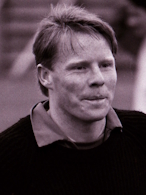
Sammy Lee
Midfielder · Liverpool 1976–1986
Personal
- Born
- 7 February 1959
- Place of birth
- Liverpool, England
- International
- 14/2 - 17.06.1984 Debut 17.11.1982 vs. Greece
- Other clubs
- Queens Park Rangers (1986-87), Osasuna (1987-90), Southampton (1990), Bolton Wanderers (1990-91)
At Liverpool
- Signed from
- Local
- Joined
- Apprentice 7 June 1974 - Professional April 1976
- Debut
- 8 April 1978
- First goal
- 8 April 1978
- Last goal
- 11 April 1984
- Last appearance
- 6 May 1986
- Left the club
- 26 August 1986
Also played against Liverpool — view opposition record
Liverpool career
- League 197 apps · 13 goals · 27 assists
- Win ratio 54.92% — W 162 · D 85 · L 48
Honours
- FA Cup
- 1986
Individual honours
- PFA Team of the Year
- 1983
Player profile
Sammy Lee was one of the most energetic and wholehearted midfielders to represent Liverpool, a diminutive player whose determination, enthusiasm and infectious personality made him a favourite among teammates and supporters alike. Standing just 5 ft 4 in (163 cm), he compensated for his lack of height with tremendous stamina, courage and an appetite for hard work. His contribution to Liverpool's success during the 1980s was considerable, and he became an important member of the sides that won five League Championships, four League Cups, two European Cups and the FA Cup. His popularity was reflected in the affectionate terrace song: “He’s fat, he’s round, he bounces on the ground. Sammy Lee, Sammy Lee.” Bob Paisley was particularly fond of the local youngster and once remarked: 'With the character and attitude he shows they’d make him Mayor of Liverpool if he was a few inches taller.'
Lee grew up in the city's Bull Ring area and came from a working-class family. His father worked as a butcher, and football was a passion shared throughout the household. Lee was a Liverpool supporter from childhood, regularly attending matches at Anfield with his father and other family members. His earliest memories of the club were closely associated with the Bill Shankly era, standing on the Kop. His footballing ability became apparent during his school years at St Francis Xavier College in Woolton, where he developed a reputation as a determined and skilful young player. Although he initially entertained ambitions of pursuing an academic career, football gradually became his overriding priority. He joined Liverpool as an apprentice on 2 June 1974, shortly after leaving school, and signed professional forms in April 1976. Lee progressed through Liverpool's youth and reserve teams during a period when the first team was among the strongest in Europe. He was learning his trade in the company of established internationals and experienced professionals, and the standards demanded by the club were exceptionally high. His opportunity to make a senior appearance finally arrived on 8 April 1978, when Liverpool entertained Leicester City in the First Division. The 19-year-old was introduced in the sixth minute after David Johnson suffered a serious knee injury. It proved to be a memorable afternoon for the youngster, who marked his debut by scoring Liverpool's second goal in a 3-2 victory. His effort was not particularly spectacular, with the Leicester goalkeeper allowing the ball to creep underneath him, but Lee had made the most of his unexpected opportunity. He made only one further substitute appearance that season and found opportunities equally limited during the following campaign, as Bob Paisley had an established and formidable team at his disposal.
An injury to Terry McDermott towards the end of the 1979/80 season provided Lee with another opportunity to demonstrate his ability. He featured in all four FA Cup semi-final encounters against Arsenal, including the two replays, although Liverpool ultimately lost the tie. He also played when Liverpool secured the League Championship with a victory over Aston Villa at Anfield. Despite these encouraging appearances, he was back in the reserves at the beginning of the following campaign. His breakthrough as a regular first-team player finally came in the autumn of 1980, when he displaced Jimmy Case on the right side of Liverpool's midfield. Lee brought tremendous energy to the position, supporting his teammates, tracking opponents and providing the kind of relentless running that allowed more creative players to flourish.
The 1980/81 season became a defining year in Lee's development. Liverpool lost the League Championship to Aston Villa but enjoyed considerable success in the knockout competitions, winning the League Cup for the first time in the club's history and then defeating Real Madrid 1-0 in Paris to claim their third European Cup. Lee played in both finals, gaining two of the most prestigious winners' medals available in European football. His performances had also captured the imagination of Liverpool supporters, who appreciated his enthusiasm and commitment. He was an overwhelming winner of the Liverpool FC Supporters Club's Player of the Year award, and the prize was presented to him by former manager Bill Shankly. Lee established himself as an important member of the side over the next three seasons, helping Liverpool win three successive League Championships between 1981 and 1984. The 1981/82 and 1982/83 campaigns brought further League Cup victories, against Tottenham Hotspur and Manchester United respectively, while his international recognition also arrived during this period. He made his England debut against Greece in a European Championship qualifying match on 17 November 1982, scoring in a 3-0 victory. He went on to win 14 senior caps and score twice for his country between 1982 and 1984. It was a considerable achievement for a player whose height had sometimes caused people to underestimate his abilities.
The 1983/84 season was arguably the high point of Lee's playing career. Under Joe Fagan, Liverpool achieved an extraordinary treble, winning the First Division Championship, League Cup and European Cup. Lee was ever-present throughout the campaign, starting all 67 of the club's matches. His durability, fitness and consistency were remarkable, particularly considering the physical demands of playing at the highest level in three major competitions. He was involved in the League Cup final victory over Everton at Wembley and subsequently played his part in Liverpool's European Cup triumph against Roma in Rome. The final was decided on penalties after the sides had drawn 1-1, and Liverpool secured their fourth European Cup. Lee had become a trusted member of one of the greatest teams in the club's history, contributing through his energy, tactical discipline and willingness to perform whatever role was required. The following campaign proved more difficult. After the extraordinary achievements of 1984, Lee's form dipped below his usual standards and his opportunities became increasingly limited. Craig Johnston and Kevin MacDonald were both preferred on occasions, and he found himself spending more time outside the starting eleven. He nevertheless remained part of the squad during a turbulent season that culminated in the European Cup final at Heysel. Liverpool's subsequent return to domestic competition brought further changes, and Lee was in and out of the team during the 1985/86 campaign. He still contributed to the club's historic League and FA Cup double, playing his part in a season that ended with victory over Everton at Wembley on 10 May 1986.
After ten years at Liverpool, Lee agreed to join Queens Park Rangers in the summer of 1986. It was an emotional departure for a player who had spent his entire professional development at Anfield and had become an integral part of the dressing-room spirit. His teammates valued not only his contribution on the pitch but also his humour, enthusiasm and ability to bring people together. One particularly amusing incident occurred on the flight carrying Liverpool and Everton players home after the 1986 FA Cup final. Jan Mølby later recalled the exchange that provided much of the entertainment: 'During the flight, there was a light-hearted disagreement between the players about the amount of room on the plane,' Mølby remembers. 'Move your fat arse,' Everton full-back Pat Van Den Hauwe shouted at little Sammy Lee. 'Sorry,' replied Sammy, 'but what do you expect? I've got two medals in my pocket!' Lee's departure from Liverpool was followed by a brief period in London. In 1987, he moved to Spain to join Osasuna, where he was reunited with former Liverpool teammate Michael Robinson. The move proved an important experience, both personally and professionally. He spent time in Pamplona, experiencing a different football culture and broadening his understanding of the game. He later reflected positively on the experience and the influence it had on his subsequent coaching career. His time in Spain was interrupted by a serious knee injury sustained against Valladolid in 1989, which kept him out of action for an extended period. He eventually returned to England, spending time on loan at Southampton before joining Bolton Wanderers. His playing career came to an end at Bolton, where he made only a handful of appearances before turning his attention towards coaching.
Liverpool remained central to Lee's life, and he returned to Anfield in 1992 to begin a new chapter in the game. Former teammate Graeme Souness, who had become Liverpool manager, invited him to join the coaching staff. Lee initially worked with the reserve team, drawing on his experience of the club's methods and standards to help develop younger players. He remained in the role when Roy Evans succeeded Souness and subsequently progressed to first-team coaching under Gérard Houllier in 1998. His knowledge of Liverpool's traditions, combined with his enthusiasm and ability to communicate with players, made him a valuable member of the coaching staff. He became particularly involved in the development of the first-team squad and was part of the management group that helped Liverpool win the UEFA Cup, FA Cup and League Cup treble in 2000/01, followed by the UEFA Super Cup and Charity Shield. Lee's growing reputation as a coach also brought opportunities at international level. He began working with England on a part-time basis under Sven-Göran Eriksson in 2001, before leaving Liverpool in 2004 to take up a full-time position with the national team.
In June 2005, Lee joined Bolton Wanderers as assistant manager to Sam Allardyce, bringing an end to his time with England. The two developed a close working relationship, with Lee becoming an important part of Allardyce's coaching team. Bolton had established themselves as a competitive Premier League side and were regularly challenging for European qualification. When Allardyce resigned in April 2007, Lee was appointed as his successor. It was his first major managerial appointment, but the transition proved difficult. Bolton struggled for consistency and results fell below expectations. Lee was dismissed in October 2007 after only 14 matches in charge, bringing a disappointing end to his first experience of management. In May 2008, Lee returned to Liverpool for a third spell at the club, this time as assistant manager to Rafael Benítez. He quickly became an important part of Benítez's management team, contributing to training, tactical preparation and the day-to-day running of the first team. In December 2008, he even took charge of Liverpool for a Premier League match against Arsenal at Anfield, as Benítez was absent through illness. Lee remained as assistant manager when Benítez departed in 2010, continuing in the position under Roy Hodgson and subsequently Kenny Dalglish. Lee's third spell at Anfield ended in June 2011, when he left the club as part of a restructuring of the coaching staff. It was another emotional separation from a club that had shaped almost every stage of his professional life. In February 2012, he returned to Bolton Wanderers, taking up the position of head of coaching at the club's academy. Bolton manager Owen Coyle welcomed the appointment, recognising the experience Lee could bring to the development of young footballers. He was also involved in first-team coaching and continued to work in a club environment where his knowledge and enthusiasm were highly valued.
In June 2014, Lee was appointed assistant manager to Sami Hyypiä at Brighton & Hove Albion. The move initially appeared to reunite two former Liverpool colleagues, but the arrangement changed almost immediately. Brighton announced that Lee would not be joining after all, as he had instead accepted a position working with Ronald Koeman at Southampton. The unexpected development attracted considerable attention, particularly as Lee had already been publicly announced as part of Hyypiä's coaching team. He subsequently spent two seasons at Southampton, where he worked with Koeman and helped oversee a successful period for the club in the Premier League. Following Koeman's departure for Everton in the summer of 2016, Lee reunited with Sam Allardyce, who had been appointed England manager. He returned to the national coaching set-up in July, but Allardyce's tenure ended after only one match in charge. Lee subsequently left the England staff following the appointment of Gareth Southgate. When Allardyce took over at Crystal Palace in January 2017, Lee was appointed his assistant once again. He remained at Selhurst Park through another managerial change before leaving in September. In December 2017, he reunited with Allardyce for a further time when the latter became Everton manager. Lee served as his assistant until Allardyce's dismissal in May 2018.
The pair worked together again in December 2020, when Allardyce was appointed head coach of West Bromwich Albion and brought Lee in as his assistant. Their task was to help the club avoid relegation from the Premier League, but West Brom ultimately finished in the bottom three. Both departed in May 2021 following Allardyce's decision to leave. By then, Lee had accumulated extensive experience across English football, working alongside some of the most prominent managers of his generation. His coaching career had taken him from Liverpool to England, Bolton, Southampton, Crystal Palace, Everton and West Brom, but his connection with Anfield had never disappeared. Phil Neal, who played alongside Lee throughout much of Liverpool's most successful period, summed up the character of his former teammate particularly well: 'If they are to get into the top three every side needs its hardworking bees. And Sammy was one of those bees,' Neal said. 'He played just in front of me and we formed a really good partnership. I remember Bob Paisley telling him to mark Paul Breitner when we played in the Munich Stadium and Sammy did a magnificent job. He was always the one who started the singing after we had picked up a trophy - all the old Liverpool songs. We had some great sing-a-longs. He created a really joyous arena. But he was always a very apologetic person. He always apologised for almost anything he did. He is a lovely natured person. I love him to bits.'
Few descriptions capture Lee's contribution to Liverpool quite as effectively. He was never the biggest player, nor was he among the team's most celebrated goalscorers, but he provided energy, commitment and a tremendous sense of togetherness. His success reflects a remarkable playing career, while his subsequent work in coaching demonstrated that his value to football extended well beyond his performances on the pitch. For a local boy who had grown up supporting Liverpool, becoming a first-team regular and winning the European Cup twice was the fulfilment of a childhood dream. His lasting popularity at Anfield owes as much to his personality and loyalty as it does to the trophies he helped the club win.
Appearances per season
| Season | League | FA | LC | Europe | Other | Total |
|---|---|---|---|---|---|---|
| 1976-1977 | 0 | 0 | 0 | 0 | 0 | 0 |
| 1977-1978 | 2 | 0 | 0 | 0 | 0 | 2 |
| 1978-1979 | 2 | 0 | 0 | 0 | 0 | 2 |
| 1979-1980 | 7 | 4 | 0 | 0 | 0 | 11 |
| 1980-1981 | 37 | 2 | 7 | 9 | 0 | 55 |
| 1981-1982 | 35 | 2 | 6 | 5 | 1 | 49 |
| 1982-1983 | 40 | 3 | 8 | 6 | 1 | 58 |
| 1983-1984 | 42 | 2 | 13 | 9 | 1 | 67 |
| 1984-1985 | 17 | 1 | 2 | 4 | 1 | 25 |
| 1985-1986 | 15 | 3 | 3 | 0 | 5 | 26 |
| 1986-1987 | 0 | 0 | 0 | 0 | 0 | 0 |
| Totals | 197 | 17 | 39 | 33 | 9 | 295 |
A more detailed look at the player's appearances
| Total | Started/substitutions |
|---|---|
| 288 | Started |
| 14 | Substituted |
| 7 | Substitute |
| 34 | On bench |
| Total | Venue |
|---|---|
| 139 | Home |
| 139 | Away |
| 17 | Neutral |
| Total | Competition |
|---|---|
| 197 | League |
| 39 | League Cup |
| 33 | European Cup |
| 17 | FA Cup |
| 5 | Screen Sport Super Cup |
| 3 | Charity Shield |
| 1 | World Club Championship |
| Total | W | D | L | Win% | Manager |
|---|---|---|---|---|---|
| 177 | 98 | 48 | 31 | 55.4% | Bob Paisley |
| 92 | 50 | 29 | 13 | 54.4% | Joe Fagan |
| 26 | 14 | 8 | 4 | 53.8% | Kenny Dalglish |
Goals per season
1,380 mins/goal
| Season | League | FA | LC | Europe | Other | Total |
|---|---|---|---|---|---|---|
| 1977-1978 | 1 | 0 | 0 | 0 | 0 | 1 |
| 1980-1981 | 4 | 0 | 2 | 2 | 0 | 8 |
| 1981-1982 | 3 | 0 | 0 | 1 | 0 | 4 |
| 1982-1983 | 3 | 0 | 0 | 0 | 0 | 3 |
| 1983-1984 | 2 | 0 | 0 | 1 | 0 | 3 |
| Totals | 13 | 0 | 2 | 4 | 0 | 19 |
The player scored 19 goals in 17 different matches.
A more detailed look at the player's goals
| Total | Opponent |
|---|---|
| 2 | Leicester City |
| 2 | Manchester City |
| 2 | Sunderland |
| 2 | Swindon Town |
| 1 | AZ Alkmaar |
| 1 | Coventry City |
| 1 | CSKA Sofia |
| 1 | Dinamo Bucharest |
| 1 | Everton |
| 1 | Oulu Palloseura |
| 1 | Stoke City |
| 1 | Swansea City |
| 1 | Tottenham Hotspur |
| 1 | West Bromwich Albion |
| 1 | West Ham United |
| Total | Started/substitutions |
|---|---|
| 18 | Started |
| 1 | Substitute |
| Total | Competition |
|---|---|
| 13 | League |
| 4 | European Cup |
| 2 | League Cup |
| Total | Goal minute period |
|---|---|
| 3 | 1-15 minutes |
| 2 | 16-30 minutes |
| 1 | 31-45 minutes |
| 5 | 46-60 minutes |
| 2 | 61-75 minutes |
| 6 | 76-90 minutes |
| Total | Assisted by |
|---|---|
| 3 | Graeme Souness |
| 3 | Kenny Dalglish |
| 2 | Ray Kennedy |
| 1 | Alan Kennedy |
| 1 | Craig Johnston |
| 1 | Ian Rush |
| 1 | Phil Neal |
| 1 | Terry McDermott |
Assists per season
6.86 games/assist
| Season | League | FA | LC | Europe | Other | Total |
|---|---|---|---|---|---|---|
| 1979-1980 | 1 | 0 | 0 | 0 | 0 | 1 |
| 1980-1981 | 3 | 0 | 0 | 2 | 0 | 5 |
| 1981-1982 | 10 | 1 | 1 | 3 | 0 | 15 |
| 1982-1983 | 7 | 1 | 1 | 1 | 0 | 10 |
| 1983-1984 | 6 | 1 | 1 | 1 | 0 | 9 |
| 1984-1985 | 0 | 0 | 0 | 2 | 0 | 2 |
| 1985-1986 | 0 | 1 | 0 | 0 | 0 | 1 |
| Totals | 27 | 4 | 3 | 9 | 0 | 43 |
A more detailed look at the player's assists
| Total | Opponent |
|---|---|
| 4 | Ipswich Town |
| 3 | Notts County |
| 3 | Oulu Palloseura |
| 3 | Stoke City |
| 2 | Brighton & Hove Albion |
| 2 | Leeds United |
| 2 | Norwich City |
| 2 | Sunderland |
| 2 | Tottenham Hotspur |
| 1 | Aberdeen |
| 1 | Aston Villa |
| 1 | Benfica |
| 1 | Birmingham City |
| 1 | CSKA Sofia |
| 1 | Dundalk |
| 1 | Everton |
| 1 | Fulham |
| 1 | Lech Poznan |
| 1 | Manchester City |
| 1 | Manchester United |
| 1 | Middlesbrough |
| 1 | Newcastle United |
| 1 | Panathinaikos |
| 1 | Southampton |
| 1 | Swansea City |
| 1 | Watford |
| 1 | West Bromwich Albion |
| 1 | West Ham United |
| 1 | York City |
| Total | Competition |
|---|---|
| 27 | League |
| 9 | European Cup |
| 4 | FA Cup |
| 3 | League Cup |
| Total | For player |
|---|---|
| 11 | Ian Rush |
| 8 | Kenny Dalglish |
| 5 | Ronnie Whelan |
| 3 | David Fairclough |
| 3 | Graeme Souness |
| 3 | Terry McDermott |
| 2 | Craig Johnston |
| 1 | Alan Kennedy |
| 1 | David Johnson |
| 1 | Howard Gayle |
| 1 | John Wark |
| 1 | Mark Lawrenson |
| 1 | Phil Neal |
| 1 | Ray Kennedy |
| 1 | Steve Nicol |
Related Articles
Michael Robinson - leaving Liverpool for Spain - Part 2
LFChistory.net recently met former striker Michael Robinson in Madrid and had a good chat with him about his career.
Roy Evans - 35 years of pure dedication
Roy Evans; youth player, first-team player, kit washer, physio, coach, reserve and first-team manager of Liverpool Football Club. An exclusive interview by LFChistory.net.
Lee returns as assistant manager
Liverpool have today confirmed that Sammy Lee will return to Anfield in the role of assistant manager. From 16th May 2008.
Bolton Wanderers part company with Sammy Lee
Times online from 17 October 2007.
Why Lee can make it on his own
After 14 years as a top coach, Sammy Lee has finally been given the chance to prove he can cut it as a Premiership manager.
Bob Paisley was a big fan of little Sammy Lee
Sammy Lee could run and run. He was small in stature but had the heart of a lion!
Sammy Lee for England
In May 2001, Sammy Lee was invited to join the England set-up.