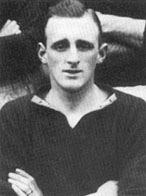
Barton was a fast right-winger whose occasional appearances at centre-forward produced two of the most memorable scoring performances of Liverpool’s interwar years. A native of Leigh in Lancashire, he joined from Whitegate Juniors in November 1928 and made his first-team debut in a 1–1 draw with Blackburn Rovers at Anfield on 9 October 1929. He played in 12 league matches during his debut season as Liverpool finished a disappointing twelfth. Initially overlooked during the following campaign, Barton became a regular from November 1930 and finished the season with 26 league appearances. His first Liverpool goal came against Newcastle United at Anfield on 7 February 1931. His emergence gave Liverpool another attacking option, although the question of where best to use his pace would remain a recurring theme.
On 23 January 1932, Barton scored all four Liverpool goals in a 4–2 FA Cup fourth-round victory at Chesterfield, becoming the club’s first player to score four times in an FA Cup match. His ability to finish chances complemented the speed that normally made him a threat on the flank. Nevertheless, his successful outings through the middle didn't persuade him that centre-forward was his best position. The 1932/33 campaign was his most productive at Liverpool, bringing 13 goals in 36 appearances. Its outstanding moment came on 11 February 1933, when he led the attack against reigning champions Everton and scored a hat-trick in a remarkable 7–4 victory at Anfield. Reporting the match in the Liverpool Post and Mercury, Stork identified speed as the decisive weapon against Everton’s experienced defence and praised Barton’s forceful leadership and shooting. The Liverpool Echo offered a revealing qualification two days later. Bee wrote that Barton disliked playing centre-forward and preferred the wing, despite the journalist’s belief that he was a “ready-made centre forward”. The report also settled a disputed Liverpool goal: initially credited to Barton, it was awarded to Syd Taylor after the club consulted both players and Barton confirmed that his teammate had scored. That left Barton with three goals rather than four. The match’s eleven goals remain the highest aggregate in a competitive Merseyside derby.
Barton’s opportunities declined sharply in 1933/34, when he made only seven competitive appearances. His final Liverpool outing came in a 5–1 defeat at Leeds United on 24 March 1934, and he joined Sheffield United that June. At Bramall Lane, Barton established himself in a side rebuilding after relegation to the Second Division. A major highlight came in 1935/36, when United reached the FA Cup final against Arsenal. Playing at outside-right at Wembley on 25 April 1936, he troubled England full-back Eddie Hapgood throughout the afternoon. Shortly after Ted Drake put Arsenal ahead, Barton raced past Hapgood and delivered the cross from which Jock Dodds headed against the crossbar. United lost 1–0, but Barton had helped create their clearest opportunity to equalise. He subsequently helped Sheffield United win promotion back to the First Division in 1938/39, only for the outbreak of war to interrupt their return. His peacetime United record stood at 47 goals in 203 competitive appearances. He continued playing during the war, representing United and guesting for several other clubs, including Sheffield Wednesday. After the war he became a publican in Sheffield.