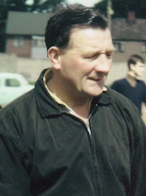
Bob Paisley
Manager · Liverpool 1974–1983
Personal
- Born
- 23 January 1919
- Place of birth
- Hetton-le-Hole, England
- Died
- 14 February 1996
- Other clubs managed
- None
At Liverpool
- Arrived from
- LFC coach
- Appointed
- 13 August 1974
- First match
- 17 August 1974
- Final match
- 14 May 1983
- Time in charge
- 8 years, 10 months
Liverpool record
- 378 league games · First match 17 August 1974 · Final match 14 May 1983
Season by season
Full season record →- 1974-75 2nd
- 1975-76 1st 2 trophies
- 1976-77 1st 2 trophies
- 1977-78 2nd 2 trophies
- 1978-79 1st 1 trophy
- 1979-80 1st 1 trophy
- 1980-81 5th 2 trophies
- 1981-82 1st 2 trophies
- 1982-83 1st 2 trophies
Final league position for seasons he finished; position at the end of his spell for seasons he didn't.
Honours
14 trophiesTrophy count excludes the Charity/Community Shield.
Individual honours
- LMA Manager of the Year
- 1976 · 1977 · 1979 · 1980 · 1982 · 1983
Manager profile
Liverpool offered Bob Paisley the job of reserve team manager in 1954 and eventually his skill with the new electrical equipment made him the in-house physio. Don Welsh was first-team manager and continued to struggle as Liverpool adjusted to life in the Second Division. Meanwhile, after finding his feet in his new role, Bob Paisley's reserves, whom he inherited from Jimmy Seddon, began to make pleasing headway. In his second term at the helm Paisley guided the reserves to runners-up spot in the Central league. Phil Taylor, who had quit playing for Liverpool at the same time as Paisley, took over essentially as caretaker-manager after Welsh's sacking at the end of the 1955/56 season and having served his apprenticeship for a whole season it was reported on 1 May 1957 that: "At their weekly board meeting last night Liverpool FC directors appointed Phil Taylor as manager. Hitherto he has been acting manager only. While Mr. Taylor has been acting manager, the club did not fill the coaching position which he formerly occupied. They have now appointed Bob Paisley, at present second-team trainer, as chief coach." A series of near-miss promotion attempts ensued as the 50's turned into a frustrating decade for the Reds that ended with the blessing of Bill Shankly's arrival.
In 1971 when Shankly signed what was to be his last contract for Liverpool Paisley was promoted to assistant manager with Joe Fagan replacing him as first-team coach. Three years later, at 55 years of age, Paisley became the successor to Shankly. Some thought that Shankly had made a hasty decision he would later regret. New chairman, John Smith, offered him a contract on an increased salary, but it wasn’t about money. Shankly had been at Liverpool for nearly 15 years and it was a terrible wrench to leave. He recalls in his autobiography that he suggested to the directors that “the only way to make the changeover was to promote the rest of the staff." He even added that he had “elevated them earlier with a view to what I was going to do later on." Having signed professional forms in May 1939, Paisley had already been at Anfield twice as long as Shankly and despite his reluctance to take the job, if the job was going to remain in-house, he was the only logical candidate. Paisley knew the club and the game inside out and was a fine judge of a player. He had an almost uncanny ability of being able to correctly diagnose an injury and treat it accordingly. But where personality was concerned Bob was totally opposite to Bill. He had been in the background for so long that the responsibility of dealing with the press was frightening. Paisley knew the enormity of the task at hand and confessed to the press: “It’s like being given the Queen Elizabeth to steer in a force 10 gale.” Chief Executive Peter Robinson confirms Paisley had to be virtually manhandled to accept the responsibility. "When we approached Bob he said no. In the end the Chairman, directors and I had to gang up on him.” An announcement at Liverpool's general meeting at the Adelphi hotel on 26 July 1974 revealed that Bob Paisley would succeed Bill Shankly as manager and officially take over on 13 August.
While Paisley prepared for his first game against Luton Town on 17 August 1974 Shankly spent his first Saturday afternoon in retirement watching his local home match; Everton - Derby County. Even though Paisley wasn't the darling of the media like Shankly he showed early on that he was also capable of a one-liner. When the press asked Bob what Shankly was doing this particular afternoon, he replied: "He's trying to get right away from football. I believe he went to Everton." Paisley’s first season in charge was not a success, not by the high standards set by his predecessor anyway. The team fought hard to reclaim the League title but defeat at Middlesbrough on the penultimate weekend of the season meant their challenge was over. There was disappointment in the cups too with a late Ipswich goal at Portman Road putting the holders out of the FA Cup and Middlesbrough beating them in the League Cup at Anfield in November. Liverpool enjoyed their biggest-ever competitive victory with an 11-0 thrashing of the Norwegian part-timers from Drammen in the opening round of the Cup Winners’ Cup but conceding a last-minute equaliser at home to Ferencvaros in the next round was a blow the team was unable to recover from and they eventually went out of the competition on the away goals rule a fortnight later. As things turned out, that 1974/75 season would be the only one during Paisley’s reign that no silverware was won.
Continuity on the pitch was vital to the club's success. The sort of wholesale buying and selling that would be commonplace long after his retirement was not part of Paisley’s agenda. Changes were made gradually and the newcomers integrated carefully into an already successful side. Phil Neal arrived in 1974 soon replacing Alec Lindsay, the only change to the regular 11 from Shankly's last campaign in Paisley's debut season. Terry McDermott, who had arrived from Newcastle, was having trouble adjusting as well as the final signing of the Shankly era, Ray Kennedy. In 1975/76 the most vital changes to Paisley's side took place in midfield. Peter Cormack's days were numbered following Paisley's successful transformation of Ray Kennedy into a left-sided midfielder and Jimmy Case was promoted from the reserves to replace the industrious Brian Hall. Liverpool's improvement on the road provided Paisley's team with nine more points to win the League Championship in 1976 as well as repeating Shankly's UEFA Cup success from 1973. Prior to the 1976/77 season Liverpool purchased David Johnson who slowly made his mark on the team while Joey Jones was preferred to Tommy Smith in defence. Liverpool retained the Championship and were unbeaten a home in the League, a feat Shankly only accomplished once in the top division, 1970/71. Liverpool embarked on a historic run in the European Cup in which young striker, David Fairclough proved vital as well old hand Smith who returned to centre of defence late in the season following Phil Thompson's injury. Shankly had seen his European dream crushed in 1965 at the hands of a dishonest referee, but there was no stopping Paisley's army. He put down a marker when Liverpool were triumphant in Rome in 1977.
Arguably the greatest signing Paisley ever made brought a new dimension to the side. Kenny Dalglish replaced Kevin Keegan as the catalyst at Liverpool, in 1977. Two months later Paisley made another key signing in Graeme Souness from Middlesbrough. The third Scot, Alan Hansen, had joined in May 1977. Paisley had formed the core of the side that was going to achieve more than any other previous Liverpool team. Amazingly Paisley won the European Cup for the second year running, but lost the League to Nottingham Forest. Winning can become a habit but Liverpool were winning in style, no more so than during the 1978/79 season when they scored 85 goals in their 42 League fixtures with Ray Clemence only conceding 16 at the other end. During the next eight years before he stood down in 1983, Paisley’s teams won the English Championship six times and also won four European trophies as well as taking the much-maligned League Cup more seriously than before and achieving a hat-trick of victories in his last three seasons as manager, an achievement that would be added to in Joe Fagan’s initial year in charge. The domestic success was remarkable on its own but to couple it with unparalleled success in Europe was almost beyond belief. Bob Paisley became the only man to coach teams to the European Champions’ cup on three different occasions.
By the time he retired in 1983, Bob Paisley had been associated with Liverpool Football club for 44 years. He would continue to offer advice to his successor Kenny Dalglish for a couple of years before becoming a boardmember. With his mentor by his side Dalglish led the club to the League and FA Cup double in his first season in charge. There was some irony in that because the FA Cup was the one domestic trophy that eluded Bob as a manager. There were as many great games during Paisley’s time in charge as there were great players. This can only be a general summary of an astonishing period in the club’s history. Will there ever again be one man who serves a single club for so long and with such devotion and such success? The answer is almost certainly not. Knowing that the 1983 League Cup final would be the last time Paisley would lead his team out as manager at Wembley, the players graciously allowed their boss to climb the famous steps to collect the trophy on their behalf. A man who preferred to stay in the background had a special moment to remember, that is the one of the most heartwarming sights Liverpool fans have ever seen. A few weeks later Paisley walked out at Anfield for the last time as the man in charge to be presented with the Championship trophy yet again. Bob Paisley, the man who had to follow a legend, had become one himself.
More on Bob Paisley
Quotes 33
“Tommy hated losing and was quite prepared to put himself through all manner of pain and suffering to avoid it. There was an element of notor…”
All quotes →Record
| Competition | Total | Won | Draw | Lost | Goals for | Goals against |
|---|---|---|---|---|---|---|
| Grand totals | 534 | 307 | 131 | 96 | 954 | 405 |
| League | 378 | 212 | 99 | 67 | 648 | 294 |
| FA Cup | 36 | 20 | 7 | 9 | 62 | 27 |
| League Cup | 53 | 32 | 13 | 8 | 98 | 31 |
| Europe | 61 | 39 | 11 | 11 | 140 | 49 |
| Other | 6 | 4 | 1 | 1 | 6 | 4 |
Related Articles
Review of Quiet Genius
The question is what Ian Herbert, who is the Independent's chief sportswriter and former deputy editor of the Liverpool Daily Post, can add to Bob Paisley's legacy.
Bruce Grobbelaar - 13 medals in 13 years
LFChistory.net wanted to get to know the man behind the myth and what drives Bruce Grobbelaar.
Barnesmania - Paisley's opinion on John Barnes
Bob Paisley gives his expert view of Liverpool's newcomer John Barnes. Has there ever been a better judge of a player?
Paisley's opinion on Ronnie Whelan
Bob Paisley looked to one player on the big occasion.
Paisley's opinion on Steve Nicol
Bob Paisley puts the spotlight on one of the best utility players in Liverpool's history.
Paisley's opinion on Bruce Grobbelaar
Bob Paisley had the best insight in football. Here is his view on Bruce Grobbelaar.
Alan Kennedy - European Cup hero
Alan Kennedy not only scored the winning goal in one European Cup final, but was destined to clinch Liverpool's success in two! A European legend for Liverpool and a winner of five League titles. It was an honour for LFChistory to interview this tremendous ambassador of Liverpool FC.
Paul Tomkins on Bob Paisley
Paul Tomkins' book, Dynasty, is a reassessment and an in-depth analysis of every manager of the club over the last 50 years.
David Fairclough - Don't call him a super ***
Exclusive LFChistory interview! David Fairclough was born few feet away from Anfield, and his dream came true when he signed for the Reds.
Bob Paisley to take over as manager of Liverpool
From Liverpool Daily Post on 20th July 1974.
Humble man who never walked alone
Frank Keating reports on Bob Paisley's funeral. From The Guardian on 22.02.1996.
Gerry Byrne played through the pain
Bob Paisley admired Gerry Byrne's courage in the FA Cup final when Liverpool triumphed over Leeds.
An inspirational leader at Liverpool
Bob Paisley profiles the Crazy Horse.
The quiet man makes an impression at Liverpool
Chris Lawler was one of Liverpool's most consistent performers.
Local boy Hughes leaves Tranmere for Liverpool
Liverpool born and bred Laurie Hughes started out at Tranmere but starred at Liverpool.
A Liverpool player has rarely been so badly treated by supporters
Jack Balmer's career at Liverpool was no walk in the park.
Bob Paisley was a big fan of little Sammy Lee
Sammy Lee could run and run. He was small in stature but had the heart of a lion!
Paisley added 10% to persuade Celtic to sell Kenny Dalglish
The story of how Liverpool's greatest legend joined the Reds.
A player who wasted his great talent at Liverpool
Bob Paisley's opinion on Alec Lindsay.
Liverpool's player career ended with 19 leg fractures against Man Utd
Eddie Spicer suffered the worst of luck regarding injuries. The second leg break of his career retired him.
Paisley's opinion on Peter Thompson
How do you take over from a living legend?, is the first question Bob Paisley poses in his profile of the Liverpool great, Peter Thompson.
Paisley takes the cautious line
The Times report on Liverpool - Manchester City on 09.04.1977.
Paisley's opinion on Mark Lawrenson
Paisley knew players better than anybody else. Here is his view on Mark Lawrenson.
Paisley's opinion on Paul Walsh
Bob Paisley was a great judge of players and in the 1986/87 season he looked at the players of Liverpool FC and treated us to his point of view on them.
1973-1985: The Golden Years
Shankly's parting gift to Liverpool was the F.A. cup so for the third time the club entered the Cup Winners' cup. LFC fan Chris Wood tells us Liverpool's European journey.
1964-1973: The Early Years
Republishing of the first chapter of Liverpool's exploits in Europe now including a video of the dramatic Inter Milan - Liverpool clashes where a certain Spanish referee bumped LFC out of Europe.
Chelsea hand out the punishment
Daily Mail report on Chelsea – Liverpool 4-2 on 9 January 1978.
Paisley's opinion on Craig Johnston
Craig Johnston is under Bob Paisley's microscope
Paisley says King Kenny is the best
Bob Paisley's view of Kenny Dalglish.
Paisley explains his controversial decision
Rarely does the manager change his captain after the season starts. When Gerrard replaced Hyypia on 15th of October 2003 it was by no means a unique occurance at Anfield.
Paisley's opinion on Jan Molby
Bob Paisley could always appreciate good footballers. Here he shares his views on the Great Jan Molby.
Paisley's opinion on John Wark
Bob Paisley had incredible insight. Here are his views on midfield goalscorer John Wark.
Two bad breaks
Fortunately it's not too common for footballers to break their legs. One game this season saw two leg breaks. Back in the 1986/87 season, two Liverpool players broke their legs destroying their Liverpool careers.