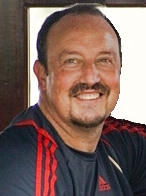
Rafa Benítez
Manager · Liverpool 2004–2010
Personal
- Born
- 16 April 1960
- Place of birth
- Madrid, Spain
- Other clubs managed
- Valladolid, Osasuna, Extremadura, Tenerife, Valencia, Internazionale, Chelsea, Napoli, Real Madrid, Newcastle, Dalian Professional, Everton, Celta Vigo
At Liverpool
- Arrived from
- Valencia
- Appointed
- 16 June 2004
- First match
- 10 August 2004
- Final match
- 9 May 2010
- Left the club
- 3 June 2010
- Time in charge
- 5 years, 11 months
Liverpool record
- 228 league games · First match 10 August 2004 · Final match 9 May 2010
Season by season
Full season record →Final league position for seasons he finished; position at the end of his spell for seasons he didn't.
Honours
3 trophiesTrophy count excludes the Charity/Community Shield.
Manager profile
Valencia had not won the Spanish title since 1971 when 41-year old Rafael Benítez took over from Hector Cuper in June 2001. Valencia was doing well in Europe reaching two successive Champions league finals, failing to win either of them. Valencia only managed 5th place in Cuper’s last season, 17 points behind champions Real Madrid, after finishing 3rd the season before. Valencia’s fans expected a big-name appointment following Cuper’s move to Inter. Benítez wasn’t Valencia’s first-choice, but probably the board was later relieved they were denied by more illustrious names. Valencia fans who had felt Cuper’s approach to the game was too cautious, were soon won over by Benítez when he introduced a more attacking style. Ruben Baraja, Pablo Aimar, Fabian Ayala and captain David Albelda who became the basis of his team had been bought the previous season. However the club's stars; Gaizka Mendieta and Claudio Lopez had left for Lazio. Benitez brought with him two players from Tenerife, Migel Angel Mista, who finished as Valencia’s top scorer in 2003-2004 with 19 goals and right-back Cristobal Curro Torres. Benitez kicked off his Valencia career in style by beating Real Madrid 1-0 on the 25th of August 2001. His rotation policy caused a few upsets, sometimes resting his best players, but he was confident his system would get the results. Benítez’ tactics earned Valencia their first title in 31 years, winning it by a good margin of seven points over Deportivo La Coruna.
Valencia failed to follow up to their title success. Benitez' team finished only fifth in the 2002/03 season, 18 points behind Real Madrid and with 15 points less than the season before. Benitez' first season in the Champions league proved to be a valiant effort, but fell short of his own ambitions. Valencia were paired with Liverpool in the Champions League first group phase. Valencia defeated Liverpool 2-0 and 1-0 but were knocked out in the quarter-finals by Inter on the away goals rule. Benítez began preparations for the 2003-2004 season under a cloud. Valencia’s Director of Sport Jesus Pitarch, refused Benítez' plea to finance a proven goalscorer and signed instead against his wishes winger Néstor Canobbio. Benitez was outraged: "I asked for a sofa and they bought me a standard lamp." Despite difficulties, Benítez’ side was crowned champions with three games to go and he was obviously delighted: "A month ago it looked pretty hopeless. We were eight points behind Real Madrid. But we never lost focus and knew this was a marathon. The team is a great long-distance runner and maintained a very high rate of form for a long period of time. Two championships in three years isn't easy - especially for a club of Valencia's size. But we have great professionals, who are also great human beings. This has helped us enormously." Valencia also beat Marseille 2-0 in the UEFA Cup final and a very successful season was in place, but Benítez' rift with the club's board hadn't healed. When Liverpool's interest was evident Valencia offered Benítez a better deal, but it was too late. He had decided to go to Liverpool. Benítez' philosophy seemed to suit Liverpool perfectly: "My ideas are near to the Milan of Arrigo Sacchi, I like technical and aggressive teams that don't allow the opponents to play. I like teams that play the ball with speed and look to score with as few passes as possible. My Valencia team is a mixture of youth and experience."
Guillem Balague, Sky Sports’ analyst in Spain and self-confessed Liverpool fan was delighted with Benítez’ capture: "He was at one point obsessed with detail but he has corrected that and improved his relationship with the players. He got rid of the players that he thought weren't with him and has stuck by those who were committed to his style of management. Since then they have reaped the benefits with success both at home and in European competition. His teams might be solid at the back but they are certainly given a licence to attack. He is a studious person and a very scientific coach. He uses computer technology to monitor his players' diets and physical development, and is keen to discover how he can apply computers to his football. He still maintains a little distance between himself and his players and is a disciplinarian. There is a famous story of him banning his players from eating paella on Sundays, which is a Spanish tradition. I would take him above every other coach in Europe. He speaks very good English. He would have no problem communicating with the players. He is a football man, a very big football fan and is a fan of English football. Liverpool would become like the great AC Milan team. Defending as a unit but always attacking as one as well. He would change Liverpool and he would make them a force again. He appreciates English football and knows all about Liverpool. He is still young for a manager and would enjoy the challenge of taking over one of the great teams in football. I am confident he would be a massive success at Anfield."
Before Benítez’ first season in English football had even started in earnest, the new manager had to persuade his captain Steven Gerrard not to move to Chelsea, although a similar attempt to convince Michael Owen to extend his contract proved fruitless, the striker deciding to move to Spain instead. Benítez inherited from Houllier a good squad but it’s probably fair to say not a great one. He immediately brought in from Spain Luis Garcia and Xabi Alonso and would in time recruit other players from his homeland. His first League season at Liverpool was a huge disappointment. Eleven of the nineteen away matches were lost and the team eventually finished in 5th place immediately behind their city neighbours Everton. It was the cup competitions that would build momentum as Rafa’s debut season reached a thrilling if unlikely climax. Although humbled by Burnley in the third round of the F.A. cup, Liverpool reached the final of the other domestic cup competition before losing to Chelsea after extra-time. In Europe, though, a remarkable journey that began in Austria in August ended in Turkey in May with Rafael Benítez proudly holding the European cup aloft after a truly astonishing final with A.C. Milan. Some of the home legs during that epic run were reminiscent of the great evenings of the past in previous decades. The Anfield crowd immersed itself happily into the euphoric atmosphere of the evenings in particular that saw Olympiacos, Juventus and Chelsea beaten on Merseyside.
It was a hard act to follow but Rafael Benítez had quickly cemented himself into the hearts and minds of Liverpool’s huge worldwide fan-base. Domestic success followed a year later after an F.A. cup final versus West Ham every bit as tense and dramatic as the European final in Istanbul. The team’s League form remained inconsistent, not good enough anyway for any sort of serious challenge for the championship. But on the European stage, Liverpool became the opponent most other clubs both respected and feared. Rafa’s tactical awareness was a match for any of his managerial colleagues on the continent. He lead Liverpool to the Champions League final for the second time in three years against AC Milan. Liverpool’s comeback came too late in Athens. 2007 was also the year in which the American partnership of Tom Hicks and George Gillett arrived on the scene. Their arrival seemed a significant watershed in the club’s fortunes as well as the manager’s aspirations. Money was found to bring in some of the players the manager wanted like Fernando Torres, Yossi Benayoun and Javier Mascherano. For the first time under his tenure, Benítez led Liverpool to the summit of the Premier League after thrashing Derby County 6-0 on the first day of September 2007. However, European results were not as positive and this led to a public falling-out with the club’s owners that the media couldn’t seem to get enough of. The fans showed their public support for a manager whose position was undermined still further by an apparent attempt by the Americans to bring in Jürgen Klinsmann to replace him. Benítez continued to insist that he saw his future at Liverpool for many more years and he brought in the popular Sammy Lee to be his assistant manager. But it was clear that a serious power-struggle was developing between the club’s manager and its Board of Directors. The Board’s failure to sanction the purchase of Gareth Barry from Aston Villa in the summer of 2008 was just one of many ‘differences of opinion’ between the two parties. Another was the signing of Robbie Keane, arguably against the manager’s wishes, which led to further friction between the manager and Chief Executive Rick Parry. In March 2009 Parry announced that he would be leaving at the end of the season; and in the same month Benítez signed a new five-year contract that would take him up to the year 2014. Liverpool ran Manchester United very close for the 2009 Premier League title and hopes were high that Liverpool would go one better in 2010.
Early exits from the two domestic cups followed a miserable Champions League campaign in 2009-10. Although the team reached the semi-final of the inaugural Europa League, Premier League results and performances were often woeful and the team finished the season in 7th place, just high enough for a Europa League qualifying place but nowhere near high enough to keep the supporters happy … or the club’s Board. Liverpool Football Club was no longer a member of the so-called “Big Four” of English football, the clubs that would compete in the Champions League. Nineteen competitive defeats placed even more strain on an already fractious relationship between manager and owners. Proud and defiant to the end and continuing to insist that he had no desire to leave Liverpool, parting of the ways that was pretty much inevitable finally came to pass on the 3rd of June 2010. The extended contract signed only the year before seemed to entitle the departing manager to a heavy sum in compensation for being dismissed; however, the sum eventually agreed was reported as being less than 50% of the original sum he was apparently entitled to.
Rafa’s reign ended after six seasons, an era that had begun with the hope and belief that the glory days really were returning to Anfield. Sadly but maybe not surprisingly following the change of ownership of the club in 2007 and all the ensuing problems that occurred, the last four years were not only trophyless but left many supporters wondering how and why such a proud and dignified man had been allowed to depart in such an acrimonious way. Less than a week after being dismissed by Liverpool, Benítez was appointed as head coach of European champions Inter Milan. Benítez' spell in Milan was an unhappy one. Although his team won the Italian Super Cup and the FIFA World Club Cup, poor league form left them at one point thirteen points adrift of the top club. He demanded that his squad be strengthened with new signings but failed to receive the backing he wanted and was dismissed by Inter two days before Christmas in 2010. After nearly two years without a coaching role, Benítez was approached by Chelsea after Roberto di Matteo had been sacked and he agreed to take charge of the west London club as interim first-team manager until the end of the 2012/13 season. Rafa's quote from 2007 sounds a bit hollow now to many Liverpool supporters. "Chelsea is a big club with fantastic players, every manager wants to coach a such a big team. But I would never take that job, in respect for my former team at Liverpool, no matter what. For me there is only one club in England, and that’s Liverpool." Despite saying that,Benitez agreed to become Chelsea's interim-manager even though it was immediately clear that he was not welcome by a large section of the club's fan-base. He took Chelsea to a third place finish in the Premier League as well as guiding them to the semi-final of the FA cup (which they lost) and the final of the Europa League (which they won). A week after the English season ended, the Spaniard signed a two-year deal to manage the Italian club SSC Napoli. Rafa Benitez has since then managed Newcastle United, Real Madrid, Dalian Professional in China and most controversial of all, Everton, where he proved an unpopular choice.
More on Rafa Benítez
Record
| Competition | Total | Won | Draw | Lost | Goals for | Goals against |
|---|---|---|---|---|---|---|
| Grand totals | 350 | 197 | 74 | 79 | 585 | 302 |
| League | 228 | 126 | 55 | 47 | 371 | 183 |
| FA Cup | 17 | 9 | 3 | 5 | 38 | 22 |
| League Cup | 17 | 11 | 0 | 6 | 31 | 27 |
| Europe | 85 | 49 | 16 | 20 | 140 | 68 |
| Other | 3 | 2 | 0 | 1 | 5 | 2 |
Related Articles
Dirk Kuyt - The Duracell Bunny
Arnie at LFCHistory.net (who incidentally shares a birthday with him) met with Dirk Kuyt to share his story with our readers.
Rafa uncovered
Published by the Daily Mail on 22 February 2019.
Being Liverpool Manager
"At a football club, there's a holy trinity - the players, the manager and the supporters." - Bill Shankly
Liverpool's Latin Americans
Declan Sloan has put together a complete record of every South American player to wear the famous Red Jersey, from Mauricio Pellegrino in 2005 to newly recruited Roberto Firmino.
Rafa Benitez: Champions League Dreams
Chris Wood's review of "Champions League Dreams : Rafa Benitez" written in conjunction with Rory Smith.
Blame, lies and broken promises at Liverpool
Interview by Rob Draper at the Daily Mail on 6th March 2011.
Rafael Benitez criticises Liverpool's former owners
The Telegraph on 19 October 2010.
Liverpool is my home and I will come back
The Sunday Independent on 3 October 2010.
Goodbye to Rafa
LFChistory.net's very own Chris Wood says his goodbyes.
Liverpool FC confirms Benítez's sacking
Published on the Liverpoolfc.tv on 3 June 2010.
Tony Evans with Rafa
Brilliant scribe Tony Evans interviews Rafa Benitez on 18th November 2009.
How Rafa's 200 compares to rival bosses
Jimmy Rice on liverpoolfc.tv on 23 October 2009.
Rafa Benitez's £229m spending spree
Analysis by the Daily Mail on 22 October 2009.
Rafa: I didn't regret to front Kuyt
An interesting interview with Rafa from Titan Spor from 27 August 2009.
Rafa had a look at Ian Rush as coach
LFChistory.net interviewed Ian Rush recently and here is an outtake from this exclusive interview that will be online next week.
Liverpool's revolution under Rafael Benitez
An article from the Daily Telegraph on 24 March 2009. Former assistant coach Paco Herrera revealed all about the revolutionary changes implemented by the Spaniard in his first five years at the Merseyside club.
Rafa Benítez hasn't got what it takes in the League
Our analyst, Alex, decided to look at Rafa's league results at Liverpool by league position, it doesn't make for pleasant reading.
Benitez faces up to bleak midwinter as reality bites at Anfield
The Guardian on 4 January 2008
Benitez can blast past Fergie and Wenger
RAFA can eclipse even the great Bob Paisley if he claims his 50th Reds league win on Saturday. Published in the Liverpool Echo on 8 December 2006.
Benitez baffles friends and foes alike with his left-field decisions
James Lawton from The Independent reflects on Rafa's tactics vs. Chelsea in the 1st leg Champions League semi-final on 25.04.2007.
Rafa report vs. top sides in the Premiership
There was optimism and much expectancy among Liverpool fans that 2006/7 would see Liverpool challenging for the Premiership. Alex analyses how Liverpool have coped against the top sides.
Reds' best signing: the totally thorough Rafa
An article by Andrew Tong from The Independent on 8th of April 2007.
SG: RAFA CAN MAKE OUR DREAM COME TRUE
An interview with Steven Gerrard by Paul Eaton on 30 January 2007.
We can be the Real deal
By Chris Bascombe, Liverpool Echo on 24 January 2007.
Benitez plays spot the difference after defeat
An article by Oliver Kay in The Times on 11.01.2007.
Liverpool running on empty
A full match report from the Telegraph of the Champions League game between Liverpool and Lyon at Anfield on Tuesday Oct 20 2009.
Frustrated Benitez happy with quality but not the control
An article from The Guardian on 18th of November 2006 on Liverpool's poor away form in the 2006-2007 season.
Carragher the perfectionist cast in the same mould as Benitez
An article from the Independent By Andy Hunter - Published: 13 May 2006.
Fowler lights up Benitez's night
Match report from The Guardian on Liverpool - Fulham on 15.03.2006.
Benitez enraged by Robben's reaction
Article from the Guardian By Jason Burt. Published: 06 February 2006.
How Benitez built Liverpool
The side that plays Manchester United tomorrow bears the mark of a manager who has figured out the English game. Article from the Guardian on 21.01.2006.
Why Reds are now Chelsea's main rivals
Benítez has transformed the club's fortunes with improvements in four areas, writes Dominic Fifield in the Guardian.
Benítez makes beeline for Blatter after night of frustration
Dominic Fifield from the Guardian at Yokohama International Stadium on 18th of December, 2005.
Benitez uncovered
BBC Sport spoke to Benitez's biographer Paco Lloret to get a better idea of the man Rafael Benítez. Published 6 December 2005.
In depth with Rafa Benítez
Andy Roxburgh interviews Rafa Benítez in October 2005.
Adios, boot room, the Spaniards are taking over
Guillem Balague's article in The Observer on Sunday May 22, 2005.
How Rafa made the people happy again
What a difference a year makes. 12 months ago today, Gerard Houllier was enjoying his last ever day as Liverpool manager. Who back then would have predicted Liverpool would be contesting their most important match in 20 years a year later?
Rafa on the night he went to the pub
Article from liverpoolfc.tv
All right Rafa - it's your round so get the beers in
Benitez left around 100 Reds fans stunned in March 2005 when he walked into Jamesons bar in Cologne city centre.
Valencia ease past Liverpool
BBC press report on Valencia - Liverpool 17th September 2002.
Senor Benitez outlines his Anfield ambitions
As Rafael Benitez prepares for his new life as manager of Liverpool Football Club he spoke at length about his Anfield arrival and his hopes for the future.
Rafael Benitez in profile
Rick Parry and the Liverpool board had one man particularily in mind when replacing Gerard Houllier. His name: Rafael Benitez.