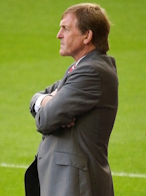
Kenny Dalglish
Manager · Liverpool 2011–2012 (second spell)
Personal
- Born
- 4 March 1951
- Place of birth
- Glasgow, Scotland
- Other clubs managed
- Blackburn Rovers (1991-95), Newcastle United (1997-98), Celtic (2000)
At Liverpool
- Arrived from
- Ambassador for Liverpool
- Appointed
- 8 January 2011
- First match
- 9 January 2011
- Final match
- 13 May 2012
- Left the club
- 16 May 2012
- Time in charge
- 1 year, 4 months
Also managed Liverpool 1985–1991 — view first spell
Liverpool record
- 56 league games · First match 9 January 2011 · Final match 13 May 2012
Season by season
Full season record →Final league position for seasons he finished; position at the end of his spell for seasons he didn't.
Honours
1 trophy- League Cup
- 2012
Trophy count excludes the Charity/Community Shield.
Manager profile
Kenny became Glasgow Celtic's Director of Football in June 1999 with John Barnes appointed at the same time as Head Coach. But Barnes was sacked in February 2000 and Kenny took over the manager's responsibilities and guided the Celts to a Scottish League cup final success over Aberdeen. Despite that trophy, Kenny himself was soon replaced as manager by Martin O'Neill. But the way his contract was terminated led to a short legal battle, at the end of which Dalglish accepted Celtic's settlement offer.
Kenny Dalglish was inevitably linked with many managerial posts during the first decade of a new millennium. But it seemed nothing could tempt him back into the game that had become his life. Twenty years after the Hillsborough Disaster, Kenny spoke openly about that day and its aftermath in a frank television interview. He also spoke at the Memorial Service at Anfield in April, 2009. It was clear that Liverpool's supporters admired, respected and loved him as much as they had when he had been player and manager. On the 3rd of July, 2009 the club officially announced Kenny's return to Anfield, where he was said to "assume a senior role at the Liverpool Academy and will also act as a Club ambassador working with the commercial side of the business around the world". Dalglish was asked to help the club find a replacement for Rafael Benítez as manager. Despite wanting the post himself, the job eventually went to Roy Hodgson. But a wretched start to the Premier League season saw the Reds in the unfamiliar territory of the relegation-zone after losing at home to Blackpool in October. When results failed to improve, Hodgson left the club 'by mutual consent' and Kenny was appointed on the 8th of January 2011 to replace him until the end of the 2010-11 season.
After successfully leading Liverpool from the bottom half of the table to challenging for a spot in the Europa League Dalglish was appointed long-term manager on the 12th of May, signing a three-year contract. Coach Steve Clarke, who arrived not long after Dalglish also signed a three-year contract. John Henry, Liverpool's new principal owner thankfully recognised Dalglish's importance to the club: "Kenny is a legendary Liverpool figure both as a supremely gifted footballer and successful manager. Since returning in January he has shown extraordinary leadership and the ability to bring the best out of so many people associated with the club. It was obvious to us very early on that the atmosphere surrounding the club had been transformed by his presence. No-one else could have produced such a response. Therefore, I’m delighted we have agreed to a new contract. We didn’t need nor want to look elsewhere for the right man to manage the team.”
Dalglish was back at the helm for real now: “I’m delighted to have the opportunity to help build something special here again. I want to salute the efforts of all the players as they have been fantastic and thank everyone at the club for the welcome they have given me since I returned in January. I also want to pay tribute to Steve Clarke’s input since we started working together as he has brought great experience and knowledge to the role. The players enjoy the training sessions, understand their relevance to our actual football games and have responded brilliantly.” King Kenny's smile lit up Anfield once again and the fans' faces once again and most importantly Liverpool had reclaimed its long-lost identity!
Despite winning Liverpool's first trophy for six years, the League Cup, and coming close to a cup double in the FA Cup Dalglish was sacked following his first full season after Liverpool's worst League campaign since the start of the Premier League. Liverpool Managing Director, Ian Ayre, said even though it was difficult to let Kenny go the reason was simple. "If you don't believe the results are right and feel 37 points off the champions and 17 points off Champions League pace is a long distance you have to make a change," Ayre said bluntly. "The history the club was built on was about success and that means success in the league, which leads to Champions League football, and also winning trophies. No-one is saying we didn't enjoy winning the Carling Cup and getting to the FA Cup final but ultimately the backbone of football now is the Premier League and European football at the highest level."
More on Kenny Dalglish
Record
| Competition | Total | Won | Draw | Lost | Goals for | Goals against |
|---|---|---|---|---|---|---|
| Grand totals | 74 | 36 | 16 | 22 | 115 | 73 |
| League | 56 | 24 | 13 | 19 | 82 | 57 |
| FA Cup | 7 | 5 | 0 | 2 | 18 | 8 |
| League Cup | 7 | 6 | 1 | 0 | 14 | 7 |
| Europe | 4 | 1 | 2 | 1 | 1 | 1 |
Related Articles
Being Liverpool Manager
"At a football club, there's a holy trinity - the players, the manager and the supporters." - Bill Shankly
Liverpool's Latin Americans
Declan Sloan has put together a complete record of every South American player to wear the famous Red Jersey, from Mauricio Pellegrino in 2005 to newly recruited Roberto Firmino.
Dalglish: It has been an honour
From LFC:tv on 16th May 2012.
King Kenny signs three year deal
Fenway Sports Group and Liverpool FC confirmed on 12th of May 2011 that Kenny Dalglish has been appointed as Team Manager.
Dear Mr./Sir/King Kenny Dalglish - open letter from Georgina Bowes
Hilarious letter from a long-suffering wive of a Liverpool supporter written on the 9th of May 2011. Every word is true by the way, not a spoof!
Kenny Dalglish's European debut tainted with memories of Heysel
Liverpool manager regrets tragedy and ban on English teams. Article by Andy Hunter at The Guardian on 17th of February 2011.
Chelsea big hitters stifled by Kenny Dalglish's defensive masterplan
David Pleat on guardian.co.uk, Sunday 6 February 2011.
Torres was no extra motivation says Dalglish
From Liverpool Daily Post on 6th February 2011
Dalglish celebrates his first win
Liverpool Echo press report on Wolves - Liverpool on 22.01.2011.
Kenny Dalglish’s Merseyside derby return
Liverpool Echo press report on Liverpool - Everton on 16.01.2011.
Kenny Dalglish begins his reign in the Liverpool hotseat
Liverpool Echo report on Manchester United - Liverpool on 09.01.2010 by Luke Traynor.
Dalglish's impressive managerial record at LFC
Liverpool fans' prayers were answered today when Liverpool confirmed The Return of KING KENNY to the managerial hotseat.
Kenny on LFC return
Shortly after arriving at the team hotel in Manchester ahead of Sunday's FA Cup showdown with Manchester United, Kenny Dalglish sat down with Liverpoolfc.tv to give his first in-depth interview after being named Reds boss for the second time.
Kenny relishing new dawn
Kenny Dalglish is relishing his return to Liverpool Football Club and believes the Reds' Academy is on the verge of something 'special' - From LFC Magazine.
Liverpool announce Dalglish appointment
Published on Liverpoolfc.tv by Paul Eaton on 3 July 2009.