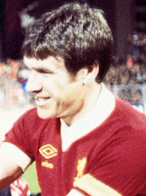
Emlyn Hughes
Midfielder · Liverpool 1967–1979
Personal
- Born
- 28 August 1947
- Place of birth
- Barrow-in-Furness, England
- Died
- 9 November 2004
- International
- 62/1 (59/1 at LFC) - 24.05.1980 Debut 05.11.1969 vs. Netherlands
- Other clubs
- Blackpool (1964-67), Wolverhampton Wanderers (1979-81), Rotherham United (1981-83), Hull City (1983), Mansfield Town (1983), Swansea City (1983)
At Liverpool
- Positions
- Midfielder, Defender
- Signed from
- Blackpool
- Joined
- 27 February 1967
- Transfer fee
- £65,000
- Debut
- 4 March 1967
- First goal
- 26 August 1967
- Last goal
- 19 December 1978
- Last appearance
- 4 April 1979
- Left the club
- 1 August 1979
Also played against Liverpool — view opposition record
Liverpool career
- League 474 apps · 35 goals · 29 assists
- Win ratio 53.08% — W 353 · D 179 · L 133
Honours
Individual honours
- FWA Footballer of the Year
- 1977
Player profile
When Suart was sacked in February 1967 Liverpool knew they had to react quickly. Suart wasted no time in serving as an intermediary between Shankly and Hughes contacting his former player the day after his sacking to advise him to join Liverpool. Shankly finally got his man but for a considerably higher fee of £65,000. Hughes recalls the most important day of his career in an interview with Shankly.com in 1999: "We had to get to Lytham St Anne's to complete the signing so I could play straight away in Liverpool's next match and Shanks drove us both down there. It's only about ten minutes from Bloomfield Road, but he was the worst driver in the world. He had this old brown Corsair and just as we left the ground he half went through a set of lights and a woman shunted into the back of us and smashed all the lights in. Next thing, a police car flags us down and the young officer comes up to the car and Shanks winds down the window. 'What is it, officer?' he asked, 'I'm sorry sir you can't continue the journey in that car as you've got no lights.' said the policeman. 'Do you know who's in this car?,' said Shanks, and I thought he was doing the old 'do you know who I am routine.' 'No', said the officer, 'I don't recognise you.' 'No not me you fool,' he said, 'I've got the future captain of England alongside me.'"
Shanks threw Hughes straight into the side and he played ten first division games before the end of that 1966/67 season, mostly at left-back. The Kop took him quickly to their hearts and he got the nickname "Crazy Horse" after he rugby-tackled Newcastle's forward Albert Bennett, who was slipping through his grasp, in his fifth game for Liverpool. Hughes revealed in his autobiography that Shanks had inspired him to do something special in this game: "Shanks took me to one side and said, 'The crowd are looking for a new name to take to. They need a new hero after the sixties side. They want someone to take over as their own. Go out and give them something to remember you by." Hughes duly obliged! Hughes took over Willie Stevenson's left-half position in the following season and was not only a hit with the Anfield crowd but also with the girls as he was voted the most attractive Football League player at the end of the 1968/69 season, polling 5,000 more votes than second place, receiving 36,000 votes in total. Hughes' strong runs from midfield made numerous openings for his colleagues, although he possessed a venomous shot which brought him nearly 50 goals as a Liverpool player. His goal celebrations were usually a sight to behold as he ran the length of the field like a wild man, displaying his great love for the game.
Hughes' Liverpool career started alongside most of the names that had brought the club so much success in the mid-'60s like Ian St John, Ron Yeats and Roger Hunt but he was never going to be one of the casualties in Shankly's 70's clearout. Shankly knew what a gem he had found and his was one of the first names on the teamsheet. The 1972/73 season was the big breakthrough for Hughes and Liverpool. After narrowly missing out on honours the previous two seasons, beaten by Arsenal in the cup final and being deprived of the League Championship again by Arsenal in the final fixture of 1971/72, the Reds gained ample compensation by winning the title after a seven-year absence and also collecting their first European trophy, the UEFA Cup. Hughes played in an astonishing 65 competitive games for Liverpool that season but never openly displayed any signs of real tiredness. In fact, Hughes' enthusiasm knew no bounds. "I have played at Spurs on a Saturday afternoon, caught the train to Liverpool and then driven north to Barrow late on Saturday night in order to turn out for a Sunday League team," Hughes said in this book "Crazy Horse". "I did that run when I was a current England international. If the authorities would have found out I would have been in terrible trouble, but I had so much extra energy that after those Sunday morning matches I was looking for a game of tennis in the afternoon."
Hughes played in midfield until 1973/74 when he moved to centre-half alongside Phil Thompson. They formed an innovative partnership, building Liverpool's attacks from the back by passing to the midfield instead of hoofing the ball upfield. Hughes was made captain instead of Tommy Smith, a fact that Smith resented. "It was my club. I'd been there a damn sight longer than him," Smith told the Telegraph. "Everything in my life was football, especially Liverpool, so why should I let this two-faced little so-and-so spoil my football life? But I did not entertain him, or speak to him off the pitch. Never." Bob Paisley didn't seem too fond of Hughes either but obviously rated him as a player: "Emlyn always struck me as a player who could have been an even better one if he had been a slightly different personality. He always liked to be King of the Roost," Paisley said in "My 50 Golden Reds". "They called him Crazy Horse on The Kop. But that was one of the more complimentary nicknames that Emlyn Hughes won for himself during his time at Anfield. I’m not giving away any great secrets of the Boot Room when I say he wasn’t – and still isn’t the most popular former player to have left Liverpool. Some of his teammates weren’t that fond of him and one of them, Tommy Smith, absolutely hated him. Smithy and Hughes never spoke to each other. I had to speak to them both when all the trouble was brewing up but it never mattered to me if players got on like a house on fire or if they couldn’t stand the sight of each other, as long as they didn’t let their personal feelings spill over onto the pitch."
The honours kept coming: the FA Cup in 1974, another League / UEFA Cup 'double' in 1976 and then finally in 1977 the biggest prize of all, the European Cup won in Rome and collected - as so aptly put by commentator Barry Davies at the time - by the man wearing 'the smile of the season'. He was also honoured by the sportswriters as their Footballer of the Year. Hughes was a versatile player equally at home in a full-back position, where he was often used by England, as a central defender or maybe his best years at Anfield were when he was surging through from his midfield position? Hughes was still skipper when the European Cup was retained at Wembley in 1978 but as his thirtieth birthday approached he could no longer be sure of his place in the side. Alan Hansen had taken his place, but Hughes could also feature at left-back in Alan Kennedy's absence. In August 1979, after twelve and a half wonderful years as a Liverpool player, he made the decision to move to Wolverhampton Wanderers, receiving a rapturous welcome when he returned to Anfield with his new club and also finishing his first season at Molineux by receiving the Football League Cup, just about the only trophy he hadn't won as a Liverpool player.
Hughes moved on to Rotherham as player-manager and proudly brought his team over to Anfield for a League Cup tie in November 1982, which the Reds only won thanks to Craig Johnston's late strike. He also had brief spells with Hull City, Mansfield Town and Swansea City but never approached the success as a manager that he had enjoyed as a player. As he passed his fiftieth birthday, Hughes was working as hard as ever with his business interests but always talked with enormous affection about his time on Merseyside. Very few men ever reached the heights that Emlyn Hughes did as a footballer and there is no doubt that he deserves to be in any "Hall of Fame" for what he achieved for the club he served so loyally and for so long. One of Liverpool's greatest players, his glorious career for the Reds boasted 665 games, 49 goals, four League titles, the FA Cup, two UEFA Cups and two European Cups. Hughes passed away on 9 November 2004, at the age of 57 from a brain tumour.
Appearances per season
| Season | League | FA | LC | Europe | Other | Total |
|---|---|---|---|---|---|---|
| 1966-1967 | 10 | 0 | 0 | 0 | 0 | 10 |
| 1967-1968 | 39 | 9 | 2 | 6 | 0 | 56 |
| 1968-1969 | 40 | 4 | 3 | 2 | 0 | 49 |
| 1969-1970 | 41 | 6 | 2 | 4 | 0 | 53 |
| 1970-1971 | 39 | 7 | 3 | 10 | 0 | 59 |
| 1971-1972 | 42 | 3 | 3 | 4 | 1 | 53 |
| 1972-1973 | 41 | 4 | 8 | 12 | 0 | 65 |
| 1973-1974 | 42 | 9 | 6 | 4 | 0 | 61 |
| 1974-1975 | 42 | 2 | 4 | 4 | 1 | 53 |
| 1975-1976 | 41 | 2 | 3 | 11 | 0 | 57 |
| 1976-1977 | 42 | 8 | 2 | 9 | 1 | 62 |
| 1977-1978 | 39 | 1 | 9 | 9 | 1 | 59 |
| 1978-1979 | 16 | 7 | 1 | 4 | 0 | 28 |
| Totals | 474 | 62 | 46 | 79 | 4 | 665 |
A more detailed look at the player's appearances
| Total | Started/substitutions |
|---|---|
| 665 | Started |
| 5 | Substituted |
| 0 | Substitute |
| 0 | On bench |
| Total | Venue |
|---|---|
| 330 | Home |
| 317 | Away |
| 18 | Neutral |
| Total | Competition |
|---|---|
| 474 | League |
| 62 | FA Cup |
| 46 | League Cup |
| 23 | UEFA Cup |
| 22 | European Fairs Cup |
| 22 | European Cup |
| 8 | European Cup Winners Cup |
| 4 | Charity Shield |
| 4 | European Super Cup |
| Total | W | D | L | Win% | Manager |
|---|---|---|---|---|---|
| 407 | 210 | 113 | 84 | 51.6% | Bill Shankly |
| 258 | 143 | 66 | 49 | 55.4% | Bob Paisley |
Goals per season
| Season | League | FA | LC | Europe | Other | Total |
|---|---|---|---|---|---|---|
| 1967-1968 | 2 | 0 | 0 | 0 | 0 | 2 |
| 1968-1969 | 3 | 1 | 0 | 1 | 0 | 5 |
| 1969-1970 | 7 | 0 | 0 | 0 | 0 | 7 |
| 1970-1971 | 2 | 0 | 1 | 2 | 0 | 5 |
| 1971-1972 | 8 | 0 | 0 | 1 | 0 | 9 |
| 1972-1973 | 7 | 0 | 2 | 3 | 0 | 12 |
| 1973-1974 | 2 | 0 | 0 | 0 | 0 | 2 |
| 1974-1975 | 1 | 0 | 0 | 1 | 0 | 2 |
| 1975-1976 | 2 | 0 | 0 | 0 | 0 | 2 |
| 1976-1977 | 1 | 0 | 0 | 0 | 0 | 1 |
| 1977-1978 | 0 | 0 | 0 | 1 | 0 | 1 |
| 1978-1979 | 0 | 0 | 0 | 1 | 0 | 1 |
| Totals | 35 | 1 | 3 | 10 | 0 | 49 |
The player scored 49 goals in 47 different matches.
A more detailed look at the player's goals
| Total | Opponent |
|---|---|
| 4 | Everton |
| 4 | Tottenham Hotspur |
| 3 | Newcastle United |
| 3 | Nottingham Forest |
| 3 | Stoke City |
| 3 | West Ham United |
| 2 | AEK Athens |
| 2 | Arsenal |
| 2 | Burnley |
| 2 | Crystal Palace |
| 2 | Manchester United |
| 2 | Norwich City |
| 2 | Southampton |
| 1 | Anderlecht |
| 1 | Athletic Bilbao |
| 1 | Benfica |
| 1 | Coventry City |
| 1 | Dinamo Bucharest |
| 1 | Eintracht Frankfurt |
| 1 | Ferencvaros |
| 1 | Ipswich Town |
| 1 | Leicester City |
| 1 | Mansfield Town |
| 1 | Middlesbrough |
| 1 | Servette |
| 1 | Strømsgodset |
| 1 | West Bromwich Albion |
| 1 | Wolves |
| Total | Started/substitutions |
|---|---|
| 49 | Started |
| Total | Competition |
|---|---|
| 35 | League |
| 3 | European Fairs Cup |
| 3 | League Cup |
| 3 | UEFA Cup |
| 2 | European Cup Winners Cup |
| 1 | European Cup |
| 1 | European Super Cup |
| 1 | FA Cup |
| Total | Goal minute period |
|---|---|
| 5 | 1-15 minutes |
| 10 | 16-30 minutes |
| 6 | 31-45 minutes |
| 4 | 46-60 minutes |
| 13 | 61-75 minutes |
| 11 | 76-90 minutes |
| Total | Goal origin |
|---|---|
| 49 | Open play |
| Total | Assisted by |
|---|---|
| 5 | Steve Heighway |
| 5 | Tommy Smith |
| 4 | Kevin Keegan |
| 3 | Ian Callaghan |
| 2 | Alec Lindsay |
| 2 | John Toshack |
| 2 | Peter Thompson |
| 1 | Bobby Graham |
| 1 | Ian St John |
| 1 | Jack Whitham |
| 1 | Peter Cormack |
| 1 | Phil Boersma |
| 1 | Ray Kennedy |
| 1 | Roger Hunt |
| 1 | Tony Hateley |
Assists per season
| Season | League | FA | LC | Europe | Other | Total |
|---|---|---|---|---|---|---|
| 1967-1968 | 3 | 1 | 0 | 1 | 0 | 5 |
| 1968-1969 | 2 | 0 | 1 | 1 | 0 | 4 |
| 1969-1970 | 5 | 0 | 0 | 4 | 0 | 9 |
| 1970-1971 | 2 | 0 | 0 | 1 | 0 | 3 |
| 1971-1972 | 3 | 0 | 0 | 0 | 0 | 3 |
| 1972-1973 | 6 | 0 | 1 | 1 | 0 | 8 |
| 1973-1974 | 1 | 0 | 0 | 0 | 0 | 1 |
| 1974-1975 | 3 | 0 | 0 | 0 | 0 | 3 |
| 1975-1976 | 0 | 0 | 0 | 1 | 0 | 1 |
| 1976-1977 | 2 | 0 | 0 | 0 | 0 | 2 |
| 1977-1978 | 2 | 0 | 0 | 0 | 0 | 2 |
| 1978-1979 | 0 | 0 | 0 | 1 | 0 | 1 |
| Totals | 29 | 1 | 2 | 10 | 0 | 42 |
A more detailed look at the player's assists
| Total | Opponent |
|---|---|
| 4 | Dundalk |
| 3 | Chelsea |
| 3 | Tottenham Hotspur |
| 3 | West Bromwich Albion |
| 2 | Birmingham City |
| 2 | Ipswich Town |
| 2 | Leeds United |
| 2 | Leicester City |
| 2 | Manchester City |
| 2 | Stoke City |
| 1 | Anderlecht |
| 1 | Arsenal |
| 1 | Aston Villa |
| 1 | Athletic Bilbao |
| 1 | Club Brugge |
| 1 | Dinamo Bucharest |
| 1 | Eintracht Frankfurt |
| 1 | Luton Town |
| 1 | Malmo |
| 1 | Norwich City |
| 1 | Sheffield Wednesday |
| 1 | Southampton |
| 1 | Sunderland |
| 1 | Swansea City |
| 1 | Walsall |
| 1 | West Ham United |
| 1 | Wolves |
| Total | Competition |
|---|---|
| 29 | League |
| 7 | European Fairs Cup |
| 2 | League Cup |
| 2 | UEFA Cup |
| 1 | European Super Cup |
| 1 | FA Cup |
| Total | For player |
|---|---|
| 6 | Roger Hunt |
| 5 | Kevin Keegan |
| 4 | John Toshack |
| 4 | Peter Thompson |
| 3 | Chris Lawler |
| 3 | Ian Callaghan |
| 3 | Tommy Smith |
| 3 | Tony Hateley |
| 2 | Alec Lindsay |
| 2 | Alun Evans |
| 1 | Bobby Graham |
| 1 | Jimmy Case |
| 1 | Kenny Dalglish |
| 1 | Peter Cormack |
| 1 | Phil Boersma |
| 1 | Ron Yeats |
| 1 | Steve Heighway |
Related Articles
Emlyn Hughes' widow on brain tumour which killed him
The Daily Mirror on 17 May 2014.
1964 interview with future Liverpool star Emlyn Hughes
A classic interview from 1964 between Blackpool and England star and journalist Jimmy Armfield and a 17 year old full back, who has just completed his first year as a professional footballer with Blackpool. His name, a certain Emlyn Hughes.
Emlyn Hughes - Crazy horse
Two days before the epic Euro 2000 first leg encounter between Scotland and England at Hampden Park, Shankly.com met an upbeat Emlyn Hughes to discuss England's chances and, of course, recall memories of a certain Bill Shankly.
An inspirational leader at Liverpool
Bob Paisley profiles the Crazy Horse.
Liverpool crash as Hughes is marched
Coventry Evening Telegraph report on Birmingham City 2 - 1 Liverpool on 7 April 1973.
Great matches: Liverpool could have scored six!
The FA Cup final in 1974 was a one-sided affair for Liverpool vs. Alan Kennedy's and Terry McDermott's Newcastle.
RIP Emlyn Hughes
Brian Glanville remembers Crazy Horse in The Guardian on 10th November 2004.