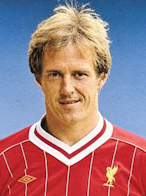
One of the most decorated players in English football history, Neal made his name with Northampton Town and had played in nearly 200 Football League games for the Cobblers when he was transferred to Liverpool in October 1974 as Bob Paisley's first managerial signing. Paisley did waste a journey to see him as Neal recollects: "Paisley often used to pay to go through the terraces and talk to people about the players like: 'What's that Phil Neal like?'. When Bob Paisley saw me for the last time at Northampton he brought a Liverpool director with him, Mr Sidney Reaks. For the first twenty minutes I played at right-back but rest of the game I played in goal. Bob said: 'We came all that way to see you for the last time. I wanted to show my director what good right-back you were. The keeper got carried off and you put the green jersey on.'" Vastly experienced already on the League scene even at the relatively young age of 23, being thrown into the Goodison derby with Everton just days after his arrival on Merseyside didn't bother Neal in the slightest. Neal missed the next three matches after that goalless debut but then played in the last 22 fixtures of the 1974/75 season, mostly at left-back in place of Alec Lindsay even though he preferred to be on the right. That started a quite astonishing run of consecutive appearances for Liverpool; a total of 417 between 23 October 1976 and 24 September 1983. That is, needless to say, a Liverpool record! Incidentally, he missed three games due to that injury against Manchester United in September 1983 before making another 127 appearances in a row!
Few know Neal better than Ray Clemence as he revealed in 1977: "Most people know that Phil is my roommate and best friend at the club. Phil adds an extra dimension to the team with his ability to surge forward and set things up," Clem said. "It’s easy to see when you’re playing with him, that he’s got a tremendous awareness of every other player in the side and what their job is. I suppose he picked it up in his utility days at Northampton – in fact, he often tells me he’s a better goalkeeper than I am! Phil has so much skill on the ground that I don’t think he’d be lost in midfield. Add to that, his defensive qualities and the fact he’s no mean performer in the air and you’ve got a very good player indeed."
"Zico", so-called by the supporters for the number of goals he scored as a defender, won a League Championship medal in his first full season at Anfield in 1975/76, something he would achieve on no less than eight occasions. He also played in six European club finals for Liverpool and was the only member of the 1977 European Cup-winning side in Rome to return there seven years later for a similar but much sterner test against the Italian champions. Neal's cool penalty in 1977 sealed that first triumph in the continent's premier club tournament as Neal fondly remembers. "As I ran up to the ball I then did something I never did and which you should never do – I changed my mind. Instead, I hit it low to the other side of the 'keeper but it went in and up came Cally in delight. I still get a tingle when I see the videos of Bob Paisley and Ronnie Moran and the lads leaping up off the bench with joy." Neal scored again in a European final - this time from open play - in 1984 before adding another tidy penalty in the shoot-out that followed the 1-1 draw, setting the scene for Alan Kennedy's dramatic clincher from 12 yards. A year later, having succeeded Graeme Souness as captain, Neal had the chance to emulate the great Real Madrid players, di Stefano and Gento, by picking up a fifth winners' medal in the European Cup. Sadly, on a night of mayhem and madness in Brussels, his European dream was taken away from him on one the blackest days football has ever known.
Neal played 50 times for England, a clear recognition that he was one of the finest full-backs of his time. Neal approached the 1985/86 season under Kenny Dalglish's leadership at the age of 34 still bitterly disappointed that he was overlooked for the manager's job that he claimed he was practically "promised". After playing in the opening eight first division fixtures he lost his place. Dalglish was already looking to the future and it wasn't long before Steve Nicol took Neal's place in the side. Knowing that his playing days were nearing the end anyway, Neal accepted an offer from Bolton Wanderers to be their manager. He lost his job at Burnden Park after six a half years and was shortly afterwards appointed Graham Taylor's right-hand man during his spell in charge of the England team. Neal was the manager at Coventry City from October 1993 to February 1995 when the Sky Blues were seventeenth in the Premier League. Following his dismissal, he had short spells as manager of Cardiff City and assistant manager at Manchester City and Peterborough United. Neal is especially proud of his time at Bolton. "I took them to Wembley three times in the lower league cups. I made a profit five out of the six years I was there. I built a club that when Bruce Rioch and Colin Todd took over they said you left a good disciplined club which was easy to kick-off from. They started to move up the tables and went into a new stadium which they had promised me. I walked. Then I went to Coventry. We finished eleventh in the First Division. I sold Phil Babb. I was the one responsible for getting £3.6 million for him while Kevin Kegan six months before at Newcastle with Terry McDermott tried to get him for £175,000. Terry Mac was on the phone every day before the deadline in March: 'You'll not get another penny more.' I convinced the Chairman to leave him until after the World Cup. Phil Babb had a great World Cup and it was a wonderful boost for Coventry's bank balance."
Phil Neal's record speaks for itself. He played in a staggering total of roughly 700 Football League games for Northampton, Liverpool and Bolton. Added to that are his cup appearances plus the representative honours he gained and that takes his total close to the 1,000 mark, a quite astonishing achievement. He became one of Liverpool's all-time greats and was very much aware that it is the TEAM that counts. Neal's performances throughout his long career were always of a very high standard. Never a flamboyant showman who courted attention or publicity, he just got on with his job through hard work and concentration and deservedly won as much as he did for the club he served so well. Neal was lucky never to be seriously injured but he looked after himself and his good positional sense, added to his ability to create openings for colleagues further afield and even be in the right place to finish them off himself, meant that his position in the team was never threatened until he was in his mid-30's. He was part of the most successful period in Liverpool's history, something that he could only have dreamt about when he was a young man during his early days in the Fourth Division at Northampton.
The first thing that comes to mind when thinking of Phil Neal is how is it possible to play 417 games in a row! LFChistory.net asked Neal that very question. "There were two occasions when I could have missed a game. One was when I got a fractured cheekbone. Roger Davis the centre forward at Derby gave me an elbow [on 24 January 1976]. I had my cheekbone lifted in line with the rest of my face to put my face back in shape (by the way... it's never recovered, [Neal quips]). Bob Paisley came to me on Wednesday and said: 'How are you feeling?' I said: 'I'm ok. I'm over the operation and everything else.' I chose to play against the specialist's wishes who said that I shouldn't play for a month. I got away with it. I got over a broken toe, but I had to play for six weeks with size eight and a half on one foot and size seven on the other. Ronnie Moran made me a plaster cast on the little toe I had broken. It was uncomfortable with my normal size shoes. I had to find some way to be still able to kick a ball, tackle and maybe have a little injection to keep the pain away for 90 minutes. There were little incidents when I could have missed a game but I was doubly determined not to. It was so exciting. I didn't miss a day's training in all those years I was there. I wouldn't ring in for a cold. Every day I had a smile on my face."