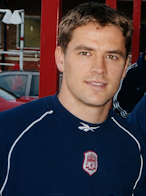
Michael Owen
Forward · Liverpool 1996–2004
Personal
- Born
- 14 December 1979
- Place of birth
- Chester, England
- International
- 89/40 (60/26 at LFC) - 26.03.2008 Debut 11.02.1998 vs.Chile
- Other clubs
- Real Madrid (2004-05), Newcastle United (2005-09), Manchester United (2009-12), Stoke City (2012-13)
At Liverpool
- Signed from
- Local
- Joined
- 1990 - Professional 18 December 1996
- Debut
- 6 May 1997
- First goal
- 6 May 1997
- Last goal
- 15 May 2004
- Last appearance
- 15 May 2004
- Left the club
- 14 August 2004
Also played against Liverpool — view opposition record
Liverpool career
- League 216 apps · 118 goals · 30 assists
- Win ratio 48.82% — W 145 · D 81 · L 71
Honours
Individual honours
- PFA Team of the Year
- 1998
- Ballon d'Or
- 2001
- PFA Young Player of the Year
- 1998
- Premier League Player of the Season
- 1997-98
- Premier League Golden Boot
- 1997-98 — shared with Chris Sutton and Dion Dublin · 1998-99 — shared with Jimmy Floyd Hasselbaink and Dwight Yorke
Player profile
In the 1995/96 season, Owen played for Liverpool's youth team even though he was still at Lilleshall. Most of the players were 18, but Owen was only 16. He scored a hat-trick against cup holders Man Utd in the quarter-finals, netting the winner in added time. Owen scored another hat-trick in a 4-2 win in the first leg of the semi against Crystal Palace. Liverpool were 3-0 down after only 50 minutes in the second leg, but Jamie Cassidy reduced the deficit. The scores were level 5-5 after 90 minutes with Owen taking control in extra-time and scoring two goals. Liverpool faced West Ham in the final, played over two legs as well. West Ham hadn't lost in 24 consecutive games, boasting future stars like Rio Ferdinand and Frank Lampard. Owen was missing from the first leg at Upton Park as he was busy scoring both goals for the English u-16 team against Turkey in the European youth finals in Austria. Jon Newby shone in his absence as Liverpool won 2-0. Owen was back for the second leg alongside teammates such as Jamie Carragher and David Thompson. Liverpool fell behind early but Owen equalized with his eleventh in five cup matches and Stuart Quinn scored the winner. Liverpool had won the FA Youth Cup for the first time in the club’s history.
Owen celebrated his seventeenth birthday by signing a professional contract and being handed a place in Roy Evans' senior squad. Steve Heighway had no doubt that a glittering career was ahead: "He is ready for whatever you throw at him; nothing fazes Michael Owen. He's ready. If the manager wants a recommendation from me, Michael gets it." Owen declared his intentions: "I've scored between 40 and 45 goals this season in 30 to 35 games and now my aim is a first-team place in the next year or so." Karl-Heinz Riedle, who prior to joining Liverpool in the summer of 1997 had never heard of Owen, joined his ever-growing fan club. "It's unbelievable when you see him play to realise that he's only 17," he said. "He's such a good player, so very quick and for his age, he has excellent vision and awareness. He's a great player already and in one or two years he will become a very great player." Owen had got his first taste of first-team football in the last couple of games in 1996/97, scoring on his debut against Wimbledon, becoming the youngest-ever scorer in the club's history at 17 years and 143 days. Evans’ plan was to ease the young striker into the first team but Fowler’s injury meant he was in the starting line-up in the first game of the 1997/98 season: "We said before the season started that we would take care of him, nurse him along, but he has changed all that. He wants to play all the time." Owen scored from the penalty spot in the first game of the season against the Dons again. Regular penalty taker Robbie Fowler was absent and Evans handed the responsibility to his young prodigy: "I asked him before the game if he wanted to take the penalties, and he said he did. I asked: 'Is that me pushing or you wanting?' - and he insisted he wanted to do it. But he still had to fight with Danny (Murphy) to get the ball - that's not bad confidence from a couple of kids." On 16 September Owen made his European debut against Celtic at Parkhead. Did that faze him? No, it took him only six minutes to get on the scoresheet. On 1 October 1997 Owen signed a five-year contract with Liverpool worth a basic £2.5 million. His £10,000-a-week deal made him the highest-paid teenager in British football. He became the youngest-ever player in the twentieth century to make his debut for England, aged 18 years and 59 days, on 11 February 1998. He was top-scorer in his first Premier League season with 18 goals, along with Dion Dublin and Chris Sutton, and voted PFA Young Player of the Year and third in the PFA Player of the Year award. Owen's incredible goal against Argentina in the World Cup in 1998 made him an international star.
"Form is temporary, class is permanent.", is a phrase that has often been repeated in Owen's career. He always delivered a fair amount of goals every season when fit. Forty-six goals in 84 matches in Owen's first two full campaigns was way above of what could be expected as the team was going through a big transition; Roy Evans stepping aside for Gerard Houllier. Owen's hamstring first gave way on 12 April 1999 against Leeds at Elland Road putting him out of action for almost five months. Owen returned to score again 20+ goals in the 2000/01 season when he was crowned the "Prince of Wales" when his two late goals against Arsenal won the FA Cup in 2001. His ongoing hamstring trouble caused concern as he was so dependent on his burst of pace. Owen crowned a memorable 12 months when he became the only Liverpool player to be voted European Footballer of the Year, in 2001, becoming the first Briton to win Ballon d'Or since Kevin Keegan in 1979. Owen received 176 points, 34 more than the formidable Raul, the Real Madrid and Spain forward. Owen was at his most prolific in the 2001/02 season with a goal in every 1.5 games and made a career-high 54 appearances in the 2002/03 when he was for the second consecutive season only two goals away from the 30 goals mark. Houllier made way for Rafa Benítez in the summer of 2004 and it also signalled the end for Owen at Liverpool. He wanted to test pastures new.
Real Madrid president, Florentine Perez, started as early as in March 2002 to woo Owen. "Owen can be one of the world's great players and the best players must play for Real Madrid." Houllier laughed off any apparent interest: "They might be able to afford Ronaldo but they cannot afford Michael Owen. For that kind of money, they could only buy his left foot but he is not going anywhere. Don't ever dream that Michael is going anywhere else, even if I am reading about other clubs. Michael is Liverpool through and through and he is staying with me." In the end, £8 million prized him away from Anfield to Real. "Since I was 10 I didn't just want to be a footballer, I wanted to be the best footballer in the world," Owen explained. "There are still lots of people ahead of me but if you want to get into that bracket, you have to break out of comfort zones. That is a nutshell is why I made the life-changing decision to leave Liverpool for Real Madrid. I have always had a burning desire to push myself and that is why I was disappointed with some of the defeatist reaction to my transfer. I don't know if it is an English trait to settle for what you've got but I was taken aback when the first thing some people said was 'how's he going to get into the first team'. They didn't say 'fantastic, he's moving to the biggest club in the world." Thirteen goals in 20 starts was by no means a bad record in Owen's sole season at the Bernabeu but he was still a fringe player with Raul and Ronaldo firmly first choice. Owen held discussions with Liverpool but once Newcastle offered a staggering £17 million a return to the Reds was out of the question. Liverpool's Chief Executive Rick Parry could hardly believe what he was witnessing. "Michael eventually emerges three coaches later as fifth choice, on a big wage and not happy and then somebody knocks on the door and offers to double their money," Parry said. "I'm sure the first reaction was to rub their eyes in surprise. From our point of view, Michael on the right terms - certainly, but not on the wrong terms."
Newcastle in total conceded 14 goals to Michael Owen in 11 games when he was a Red so maybe it was no surprise they wanted to have him on their side! However, this risky move only delivered 26 goals in 81 League matches in four seasons. Owen scored an impressive seven goals in 11 matches in 2005/06 and had recovered in time to be selected for England duty in the 2006 World Cup. However, a serious knee injury in the first minute of the group match against Sweden kept him out of action for almost the whole of the following campaign. Owen's Newcastle contract ended on the last day of June 2009 with him leaving the relegated club to look for a new employer as a free agent. Defending Premier League champions Manchester United dramatically became Owen's third English League club to the dismay of Liverpool supporters. Few can have been surprised that Owen's high-profile and controversial move to Manchester was wrecked by injury. Owen's highlights at United were a very late winner in the Manchester derby, a Champions League hat-trick at Wolfsburg and a Premier League medal in 2011. As a free agent following his release by United in the summer of 2012, Owen did not have to conform to the normal transfer-window regulations.
On 4 September 2012, the 32-year-old Owen signed for Stoke City on a 12-month pay-as-you-play contract. In December 2012 Owen reflected on his personal website on his struggle with injuries, having seen former teammates enjoy a lengthy career into their late 30's. Owen played 316 games for club and country ahead of his twenty-fourth birthday compared with 112 by Ryan Giggs, Paul Scholes (123) and David Beckham (184). "Had I been managed differently I would have been at my best for longer. As a youngster, I was considered exceptional and in many ways, that was to my detriment. While I was playing every game available to me, there was another young kid in the Liverpool Academy called Steven Gerrard who was also showing huge potential. Unlike me, who was playing 80-odd games a year, Stevie just couldn’t stay fit. I am convinced that this played to his advantage in the long run. I would play a full season with Liverpool and then I was jetting off to play for England, sometimes playing three years above my age group at the highest level.”
Owen was convinced that his hamstring injury in April 1999 proved a key moment. “My body made me pay for pushing it to the limit too often. My hamstring snapped in two and it was at that point that my ability to perform unimpeded was finished. My rehabilitation was compromised due to our physio leaving the club that summer and not being replaced until the following season. With no regular medical care, a routine injury was destined to restrict me for the rest of my career. People laugh when I say that I am not naturally injury prone. It is my genuine opinion that I have become so due to overplaying at a young age, suffering an injury and then having a dreadful rehabilitation at such a critical time. I cringe when I look back on a quote I came out with after Gérard Houllier rested me for a game. 'I will rest when I'm 40', I muttered in an interview."
Owen's playing-career drew quietly to a close in May 2013. Stoke City used him only rarely in his final season, so rarely that he did not make a single start for them. All his eight appearances came from the substitutes' bench. The last of his one hundred and fifty Premier League goals came at Swansea in January. It was his only goal of the season. He has since carved out a media career with BT Sport and as a breeder of racehorses.
Liverpool as a club and Liverpool supporters as a group saw the best years of Michael Owen's life as a professional footballer. Yes, he was sometimes beset by injuries in his Anfield days but nowhere near as much as he has suffered since he left Anfield for Madrid in 2004. Despite his great personal achievements at Liverpool Owen was never quite beloved on the Kop as might be expected. From the player's point of view, he might always regret stating that he left Liverpool 'to win the big trophies', only to watch from a distance as his new club won nothing and his old club won the biggest trophy of all just a year later.Appearances per season
| Season | League | FA | LC | Europe | Other | Total |
|---|---|---|---|---|---|---|
| 1996-1997 | 2 | 0 | 0 | 0 | 0 | 2 |
| 1997-1998 | 36 | 0 | 4 | 4 | 0 | 44 |
| 1998-1999 | 30 | 2 | 2 | 6 | 0 | 40 |
| 1999-2000 | 27 | 1 | 2 | 0 | 0 | 30 |
| 2000-2001 | 28 | 5 | 2 | 11 | 0 | 46 |
| 2001-2002 | 29 | 2 | 0 | 11 | 1 | 43 |
| 2002-2003 | 35 | 2 | 4 | 12 | 1 | 54 |
| 2003-2004 | 29 | 3 | 0 | 6 | 0 | 38 |
| 2004-2005 | 0 | 0 | 0 | 0 | 0 | 0 |
| Totals | 216 | 15 | 14 | 50 | 2 | 297 |
A more detailed look at the player's appearances
| Total | Started/substitutions |
|---|---|
| 267 | Started |
| 84 | Substituted |
| 30 | Substitute |
| 13 | On bench |
| Total | Venue |
|---|---|
| 144 | Home |
| 146 | Away |
| 7 | Neutral |
| Total | Competition |
|---|---|
| 216 | Premier League |
| 33 | UEFA Cup |
| 16 | Champions League |
| 15 | FA Cup |
| 14 | League Cup |
| 1 | Charity Shield |
| 1 | Community Shield |
| 1 | European Super Cup |
| Total | W | D | L | Win% | Manager |
|---|---|---|---|---|---|
| 233 | 117 | 61 | 55 | 50.2% | Gérard Houllier |
| 46 | 21 | 14 | 11 | 45.6% | Roy Evans |
| 18 | 7 | 6 | 5 | 38.9% | Evans / Houllier |
Goals per season
| Season | League | FA | LC | Europe | Other | Total |
|---|---|---|---|---|---|---|
| 1996-1997 | 1 | 0 | 0 | 0 | 0 | 1 |
| 1997-1998 | 18 | 0 | 4 | 1 | 0 | 23 |
| 1998-1999 | 18 | 2 | 1 | 2 | 0 | 23 |
| 1999-2000 | 11 | 0 | 1 | 0 | 0 | 12 |
| 2000-2001 | 16 | 3 | 1 | 4 | 0 | 24 |
| 2001-2002 | 19 | 2 | 0 | 6 | 1 | 28 |
| 2002-2003 | 19 | 0 | 2 | 7 | 0 | 28 |
| 2003-2004 | 16 | 1 | 0 | 2 | 0 | 19 |
| Totals | 118 | 8 | 9 | 22 | 1 | 158 |
The player scored 158 goals in 117 different matches.
A more detailed look at the player's goals
| Total | Opponent |
|---|---|
| 14 | Newcastle United |
| 8 | Southampton |
| 7 | Blackburn Rovers |
| 7 | West Ham United |
| 6 | Manchester United |
| 5 | Arsenal |
| 5 | Aston Villa |
| 5 | Chelsea |
| 5 | Coventry City |
| 5 | Derby County |
| 5 | Manchester City |
| 5 | Nottingham Forest |
| 5 | Tottenham Hotspur |
| 4 | Birmingham City |
| 4 | Charlton Athletic |
| 4 | Everton |
| 4 | Leeds United |
| 4 | Sheffield Wednesday |
| 4 | West Bromwich Albion |
| 3 | Grimsby Town |
| 3 | Haka |
| 3 | Ipswich Town |
| 3 | Leicester City |
| 3 | Middlesbrough |
| 3 | Portsmouth |
| 3 | Spartak Moscow |
| 3 | Sunderland |
| 3 | Wimbledon |
| 2 | Bolton Wanderers |
| 2 | Fulham |
| 2 | Roma |
| 2 | Vitesse Arnhem |
| 1 | Auxerre |
| 1 | Barcelona |
| 1 | Basel |
| 1 | Bayern Munich |
| 1 | Boavista |
| 1 | Bradford City |
| 1 | Celta Vigo |
| 1 | Celtic |
| 1 | Crystal Palace |
| 1 | FC Porto |
| 1 | Kosice |
| 1 | Levski Sofia |
| 1 | Olimpija Ljubljana |
| 1 | Port Vale |
| 1 | Sheffield United |
| 1 | Slovan Liberec |
| 1 | Tranmere Rovers |
| Total | Started/substitutions |
|---|---|
| 152 | Started |
| 6 | Substitute |
| Total | Competition |
|---|---|
| 118 | Premier League |
| 12 | UEFA Cup |
| 9 | Champions League |
| 9 | League Cup |
| 8 | FA Cup |
| 1 | Charity Shield |
| 1 | European Super Cup |
| Total | Goal minute period |
|---|---|
| 23 | 1-15 minutes |
| 28 | 16-30 minutes |
| 27 | 31-45 minutes |
| 24 | 46-60 minutes |
| 27 | 61-75 minutes |
| 26 | 76-90 minutes |
| 3 | 91-120 minutes |
| Total | Assisted by |
|---|---|
| 12 | Steven Gerrard |
| 11 | Emile Heskey |
| 10 | Danny Murphy |
| 8 | Vladimir Smicer |
| 6 | Patrik Berger |
| 5 | Didi Hamann |
| 5 | Robbie Fowler |
| 5 | Steve McManaman |
| 4 | Jamie Carragher |
| 4 | Milan Baros |
| 3 | David Thompson |
| 3 | Dominic Matteo |
| 3 | Harry Kewell |
| 3 | Paul Ince |
| 3 | Stig Inge Bjørnebye |
| 2 | Christian Ziege |
| 2 | El Hadji Diouf |
| 2 | Gary McAllister |
| 2 | Jamie Redknapp |
| 2 | Jason McAteer |
| 2 | John Arne Riise |
| 2 | Karl-Heinz Riedle |
| 2 | Markus Babbel |
| 2 | Sami Hyypia |
| 1 | Jari Litmanen |
| 1 | Nicolas Anelka |
| 1 | Øyvind Leonhardsen |
| 1 | Phil Babb |
| 1 | Titi Camara |
| 1 | Vegard Heggem |
Assists per season
| Season | League | FA | LC | Europe | Other | Total |
|---|---|---|---|---|---|---|
| 1997-1998 | 10 | 0 | 2 | 0 | 0 | 12 |
| 1998-1999 | 5 | 1 | 0 | 1 | 0 | 7 |
| 1999-2000 | 3 | 0 | 0 | 0 | 0 | 3 |
| 2000-2001 | 3 | 2 | 0 | 2 | 0 | 7 |
| 2001-2002 | 1 | 0 | 0 | 2 | 0 | 3 |
| 2002-2003 | 5 | 0 | 0 | 1 | 0 | 6 |
| 2003-2004 | 3 | 0 | 0 | 0 | 0 | 3 |
| Totals | 30 | 3 | 2 | 6 | 0 | 41 |
A more detailed look at the player's assists
| Total | Opponent |
|---|---|
| 4 | Arsenal |
| 4 | Middlesbrough |
| 3 | Charlton Athletic |
| 3 | Leeds United |
| 3 | Southampton |
| 2 | Watford |
| 2 | Wimbledon |
| 1 | Alaves |
| 1 | Aston Villa |
| 1 | Bayer Leverkusen |
| 1 | Bayern Munich |
| 1 | Blackburn Rovers |
| 1 | Bolton Wanderers |
| 1 | Coventry City |
| 1 | Crystal Palace |
| 1 | Derby County |
| 1 | Newcastle United |
| 1 | Port Vale |
| 1 | Portsmouth |
| 1 | Rapid Bucharest |
| 1 | Rotherham United |
| 1 | Spartak Moscow |
| 1 | Tottenham Hotspur |
| 1 | Tranmere Rovers |
| 1 | Valencia |
| 1 | West Bromwich Albion |
| 1 | West Ham United |
| Total | Competition |
|---|---|
| 30 | Premier League |
| 3 | FA Cup |
| 3 | UEFA Cup |
| 2 | Champions League |
| 2 | League Cup |
| 1 | European Super Cup |
| Total | For player |
|---|---|
| 7 | Robbie Fowler |
| 4 | Emile Heskey |
| 4 | Steve McManaman |
| 4 | Steven Gerrard |
| 3 | John Arne Riise |
| 3 | Paul Ince |
| 2 | Danny Murphy |
| 2 | Jamie Redknapp |
| 2 | Karl-Heinz Riedle |
| 1 | Didi Hamann |
| 1 | El Hadji Diouf |
| 1 | Harry Kewell |
| 1 | Jari Litmanen |
| 1 | Jason McAteer |
| 1 | Nick Barmby |
| 1 | Øyvind Leonhardsen |
| 1 | Patrik Berger |
| 1 | Sami Hyypia |
| 1 | Vladimir Smicer |
Related Articles
Carra and Owen reminisce
From 25 April 2013 in The Daily Express.
Dalglish stunned by Owen's strike
Reaction in the Mirror on Liverpool 1 - 0 Newcastle United on 20 January 1998.
Press Association report
Press Association report on Manchester United - Liverpool on 10.04.1998. Michael Owen sees red!
Liverpool Echo report
Liverpool Echo report on Sheffield Wednesday - Liverpool on 14.02.1998.
Owen's double gives Liverpool fresh hope
The Telegraph report on Liverpool - Portsmouth on 17.03.2004.
Liverpool Echo report
Report by Ric George of The Liverpool Echo on Liverpool - Grimsby Town on 18.11.1997.
Liverpool hit their stride as Owen rumours run and run
The Telegraph report on Fulham - Liverpool on 02.11.2003.
Owen hits century mark in rout
The Telegraph report on WBA - Liverpool on 26.04.2003.
Two down - one to go
Liverpoolfc.tv report on Liverpool - Arsenal on 12.05.2001.
Impressive Owen claims hat-trick to knacker Newcastle
The Observer report on Liverpool - Newcastle on 05.05.2001.
WHO would dare drop Michael Owen now?
Liverpool Echo report on Liverpool - Aston Villa on 06.09.2000.
A STUNNING goal by Robbie Fowler put Liverpool ahead
Liverpool Echo match report on Liverpool - Arsenal on 28.08.1999.
Owen's touch returns with a bang
The Telegraph report on Man City - Liverpool on 28.09.2002.
Press Association match report
Match report from Press Association on Southampton - Liverpool on 16.08.1998.
Press Association match report
Match report from Press Association on Newcastle United - Liverpool on 30.08.1998.
Press Association match report
Match report from Press Association on Liverpool - Nottingham Forest on 24.10.1998.
Press Association report
Match report from Press Association on Wimbledon - Liverpool on 09.09.1997.
Press Association match report
Press Association match report on Celtic - Liverpool on 16.09.1997.
Lifeless Liverpool wave the white flag
Match report from Wimbledon - Liverpool on 06.05.1997 by Press Association.
Owen goes back to the future
On Boxing Day the striker will run out at Anfield wearing a Newcastle shirt. But, says Rafael Benítez, it won't be long before he returns for good. December 24, 2005 The Guardian.
Liverpool lacked real desire to woo Owen
The Telegraph 3rd September 2005.
Why I made the move
Michael Owen comes clean in his column in The Times why a few hours earlier he chose Newcastle over a return to Liverpool.
2001-2007: Into The New Millennium
For the first time in 16 long years since the shame and tragedy that was Heysel, Liverpool took their place in European football's top club competition. Chris Wood documents Liverpool's European history.
Owen in brain scan fear
It has been revealed that Michael Owen had two brain scans and feared that he could have had a blood clot. From Soccernet - 05.11.2000.
Michael Owen's penalty record
13 out of 23 penalties scored. Not a good record by any means.
Michael Owen - European footballer of the Year
An article from The Guardian on 18th of December 2001.
Michael Owen makes Euro history
Michael Owen scored his 21st goal in European competitions versus Olimpia Ljubljana in Slovenia.
4 seconds - That's all it took Owen to prove his genius to amazed England bosses.
An article from the People on 31 August 1997.
Owen is ready for big time
by David Walmsley of "The Liverpool Echo" from January 1997.