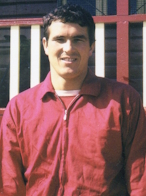
Ron Yeats
Defender · Liverpool 1961–1971
Personal
- Born
- 15 November 1937
- Place of birth
- Aberdeen, Scotland
- Died
- 6 September 2024
- International
- 2/0 - 07.12.1965 Debut 03.10.1964 vs. Wales
- Other clubs
- Dundee United (1957-61), Tranmere Rovers (1971-74), Stalybridge Celtic (1975-76), Los Angeles Skyhawks (1976), Barrow (1976), Santa Barbara Condors (1977), Formby (1977-78)
At Liverpool
- Signed from
- Dundee United
- Joined
- 22 July 1961
- Transfer fee
- £22,000
- Debut
- 19 August 1961
- First goal
- 23 November 1963
- Last goal
- 17 October 1970
- Last appearance
- 28 April 1971
- Left the club
- 30 December 1971
Liverpool career
- League 358 apps · 13 goals · 8 assists
- Win ratio 54.19% — W 246 · D 106 · L 102
Honours
Player profile
Ian St. John, who had arrived two months earlier, and Ron Yeats were the last pieces in the puzzle for Liverpool to succeed in Second Division. Shanks later reminisced: "They were the greatest signings and they were the beginning of Liverpool." After only half a season in the side, Shankly gave the 24-year-old the captain’s armband on Boxing Day, being his eyes and ears on the field. Shankly's prediction soon came true as with Yeats in the side Liverpool clinched their place in the First Division on 21 April 1962. Two goals from Kevin Lewis gave Liverpool a 2-0 win against Southampton at rainy Anfield. But conditions didn´t prevent a party amongst the Liverpool supporters. "Just after the final whistle, everyone was going berserk and amid the celebrations, I got thrown into the boys' pen!", Yeats remembers fondly. The Liverpool fans didn't want to let go of Yeats and it took him about fifteen minutes to return to the dressing room. Bill was very relieved to see his captain again and said: 'Jesus Christ, son, I thought we´d lost you forever!'" Yeats always led by example and after heading in the winner against Manchester United at Old Trafford on 23 November 1963, which was his first goal for Liverpool, Shankly announced in his typically understated manner that 'Yeats is the greatest centre-half in the world today'! Yeats' most glorious moment came in 1965 when he had the honour of lifting the FA Cup trophy for the first time in Liverpool's 73-year history after the 2-1 Leeds win in 1965. "It was an emotional time getting the cup from the Queen. In fact, I just wanted to throw it into the crowd, to the Liverpool supporters," Yeats said. "We won it now. Let's share it between us." Liverpool repeated their 1964 League Championship success in 1966 and reached a European final for the first time. Liverpool played Borussia Dortmund in Glasgow with the European Cup Winners' Cup at stake. The game went into extra-time after both sides had scored one goal after 90 minutes. In the 107th minute disaster struck. Reinhard Libuda tried his luck from all but 30 yards and the ball seemed to head straight into Liverpool’s goal. Yeats chased back to prevent the goal, but unfortunately, the ball hit the post and Yeats couldn´t get out of the way and the ball went off his thigh into the net. Dortmund celebrated victory.
Joe Royle, Manchester City’s centre forward and later manager, once said that Yeats was his most difficult opponent. "Ron Yeats just ran in straight lines and you had to make sure to get out of his way. Even when the ball was out of play, you just kept on moving to avoid him." When asked by LFChistory.net about this comment Yeats replied: "I was 6 feet, 2½ inches and 14½ stone, so when I tackled someone he must have felt it. I wasn’t dirty as far as dirty is concerned. I used to make sure I was there or thereabouts. At that time we had these big centre forwards to play against. I always knew if there was going to be a battle I would win the battle. I wouldn’t come second to nobody. I used to enjoy it. It was the small wiry striker I used to hate. He would come at you. You had just to play against anybody who was there. I never kicked anybody for kicking’s sake, I must admit. I went for the ball all the time." At the heart of Liverpool's defence for so many years, Yeats had a perfect partner in Tommy Smith, a formidable pairing if there ever was one! "We let the ball go past us, but never the ball and the man. Tommy was hard as nails, but a great player as well. He had a bit of Sami in him, he used the ball very well, a lot better than I did," Yeats told LFChistory.net. "I was a tackler, a header of the ball and read the game well. I got the ball and gave it to someone who could pass it. I knew my limitations. I was very left-footed. I would be lying if I said I would be comfortable on my right side. I had a left foot I could fish up legs with and balls. He was my right foot and I was his left. That’s how we worked."
We have the greatest skipper
Any manager could employ
Let’s drink six crates to Big Ron Yeats
Bill Shankly’s pride and joy
Despite his success with Liverpool Yeats only played two international games for Scotland in his career, which is surprisingly little, but the fact was that home-based players were preferred for the national team. Yeats’ last season as a regular was the 1969/70 season. He had constant backaches and Shankly had found a replacement in Larry Lloyd. In his last season in 1970/71, he played 16 games as left-back and scored one goal with a bullet header in front of the Kop in a 2-0 victory over Burnley in October 1970. His last game in Liverpool’s shirt was at Maine Road on 26 April 1971. Yeats was close to making the side that faced Arsenal in the FA cup final but Larry Lloyd was declared fit to play only two days prior to the game. Yeats moved to neighbours Tranmere Rovers and played around 100 matches there and managed the team for three years. It was a total nightmare. "That was the worst decision I had ever made in my life. Nice people except one guy who was the Chairman at the time. He made my life a misery," Yeats said. "Three of our youngsters were playing in the first team and he sold every one of them within 18 months for pittance of money. He sold Steve Coppell to United for £40,000. He was worth over £100,000. I thought, ‘What am I doing here?’ He could do that without even asking me. I was glad when everything came to halt after two and a half years. It were the worst years of my life." Three years later Yeats also had an unhappy stint as player-manager in California. Yeats returned home when it became apparent that the owner couldn't pay his players any wages. In 1986 Yeats asked Graeme Souness, then manager at Glasgow Rangers, about a job because he wanted to get back into football. In the meantime, Kenny Dalglish called Yeats and offered him the role of chief scout at his beloved Anfield. Yeats couldn't resist returning to his former club. Yeats went on to serve in the same role for Souness after Dalglish left, then Roy Evans, Gerard Houllier and Rafa Benítez.
"Big Ronny is the best centre-half I have ever seen," goalscoring legend, Roger Hunt, said in 1974. "With him in the team and at his best, we used to think we were unbeatable. In the air he was great. Some people used to think he was weak on the ground, but I never saw anybody give him a chasing. He was the right man for captain."
Yeats was awarded the Bill Shankly Memorial Award in 2002 for his fantastic service to Liverpool. He retired in 2006 following Liverpool's FA Cup victory at the Millennium Stadium, a competition so close to his heart since 41 years earlier. "I started with a win and ended with a win. I retired as a scout on cup final day in May 2006," Yeats said. "I was never at home. I’ve never been so happy... after retiring."
After a long battle with Alzheimer's Disease, Shankly's 'Colossus' passed away on 6th September 2024.
Appearances per season
| Season | League | FA | LC | Europe | Other | Total |
|---|---|---|---|---|---|---|
| 1961-1962 | 41 | 5 | 0 | 0 | 0 | 46 |
| 1962-1963 | 38 | 6 | 0 | 0 | 0 | 44 |
| 1963-1964 | 36 | 5 | 0 | 0 | 0 | 41 |
| 1964-1965 | 35 | 8 | 0 | 9 | 1 | 53 |
| 1965-1966 | 42 | 1 | 0 | 9 | 1 | 53 |
| 1966-1967 | 40 | 4 | 0 | 5 | 1 | 50 |
| 1967-1968 | 38 | 9 | 2 | 6 | 0 | 55 |
| 1968-1969 | 39 | 4 | 3 | 2 | 0 | 48 |
| 1969-1970 | 37 | 6 | 2 | 3 | 0 | 48 |
| 1970-1971 | 12 | 2 | 0 | 2 | 0 | 16 |
| Totals | 358 | 50 | 7 | 36 | 3 | 454 |
A more detailed look at the player's appearances
| Total | Started/substitutions |
|---|---|
| 453 | Started |
| 0 | Substituted |
| 1 | Substitute |
| 9 | On bench |
| Total | Venue |
|---|---|
| 226 | Home |
| 220 | Away |
| 8 | Neutral |
| Total | Competition |
|---|---|
| 358 | League |
| 50 | FA Cup |
| 14 | European Cup |
| 13 | European Fairs Cup |
| 9 | European Cup Winners Cup |
| 7 | League Cup |
| 3 | Charity Shield |
| Total | W | D | L | Win% | Manager |
|---|---|---|---|---|---|
| 454 | 246 | 106 | 102 | 54.2% | Bill Shankly |
Goals per season
| Season | League | FA | LC | Europe | Other | Total |
|---|---|---|---|---|---|---|
| 1963-1964 | 1 | 0 | 0 | 0 | 0 | 1 |
| 1964-1965 | 0 | 0 | 0 | 1 | 0 | 1 |
| 1965-1966 | 2 | 0 | 0 | 0 | 1 | 3 |
| 1966-1967 | 2 | 0 | 0 | 0 | 0 | 2 |
| 1967-1968 | 2 | 0 | 0 | 1 | 0 | 3 |
| 1968-1969 | 2 | 0 | 0 | 0 | 0 | 2 |
| 1969-1970 | 3 | 0 | 0 | 0 | 0 | 3 |
| 1970-1971 | 1 | 0 | 0 | 0 | 0 | 1 |
| Totals | 13 | 0 | 0 | 2 | 1 | 16 |
The player scored 16 goals in 16 different matches.
A more detailed look at the player's goals
| Total | Opponent |
|---|---|
| 3 | Manchester United |
| 3 | Sunderland |
| 2 | Arsenal |
| 1 | Anderlecht |
| 1 | Burnley |
| 1 | Leeds United |
| 1 | Leicester City |
| 1 | Malmo |
| 1 | Queens Park Rangers |
| 1 | Sheffield Wednesday |
| 1 | Southampton |
| Total | Started/substitutions |
|---|---|
| 16 | Started |
| Total | Competition |
|---|---|
| 13 | League |
| 1 | Charity Shield |
| 1 | European Cup |
| 1 | European Fairs Cup |
| Total | Goal minute period |
|---|---|
| 4 | 1-15 minutes |
| 1 | 16-30 minutes |
| 3 | 31-45 minutes |
| 2 | 46-60 minutes |
| 2 | 61-75 minutes |
| 4 | 76-90 minutes |
| Total | Goal origin |
|---|---|
| 16 | Open play |
| Total | Assisted by |
|---|---|
| 4 | Ian Callaghan |
| 3 | Tommy Smith |
| 1 | Chris Lawler |
| 1 | Emlyn Hughes |
| 1 | Ian St John |
| 1 | Peter Thompson |
| 1 | Willie Stevenson |
Assists per season
| Season | League | FA | LC | Europe | Other | Total |
|---|---|---|---|---|---|---|
| 1962-1963 | 3 | 0 | 0 | 0 | 0 | 3 |
| 1964-1965 | 0 | 1 | 0 | 0 | 0 | 1 |
| 1965-1966 | 2 | 0 | 0 | 0 | 0 | 2 |
| 1966-1967 | 1 | 0 | 0 | 0 | 0 | 1 |
| 1968-1969 | 1 | 0 | 0 | 1 | 0 | 2 |
| 1969-1970 | 1 | 0 | 0 | 0 | 0 | 1 |
| 1970-1971 | 0 | 1 | 0 | 0 | 0 | 1 |
| Totals | 8 | 2 | 0 | 1 | 0 | 11 |
A more detailed look at the player's assists
| Total | Opponent |
|---|---|
| 1 | Aston Villa |
| 1 | Athletic Bilbao |
| 1 | Blackburn Rovers |
| 1 | Blackpool |
| 1 | Coventry City |
| 1 | Leeds United |
| 1 | Leicester City |
| 1 | Manchester United |
| 1 | Nottingham Forest |
| 1 | Sunderland |
| 1 | Swansea City |
| Total | Competition |
|---|---|
| 8 | League |
| 2 | FA Cup |
| 1 | European Fairs Cup |
| Total | For player |
|---|---|
| 3 | Roger Hunt |
| 2 | Chris Lawler |
| 1 | Geoff Strong |
| 1 | Gordon Milne |
| 1 | Ian St John |
| 1 | Jimmy Melia |
| 1 | John Toshack |
| 1 | Kevin Lewis |
Related Articles
The Sauna guru
By Fran Kearney at Toffeeweb.
Memo to Boy fans: Keep off the pitch says Ron Yeats
Ron Yeats' column in the Liverpool Echo on 31 August 1963.
Tribute plan for Anfield legend Ron Yeats
Article by Philip Kirkbride, Liverpool Echo, published on Apr 23 2009.
Ian St John - Raging Bull
LFChistory.net had the great pleasure of interviewing the Saint. I was a bit unprepared for our talk, but considering the circumstances coped pretty well.
Ron Yeats and Tommy Smith in a gunfight!
Tommy Smith and Rowdy Yeats had a bit of an adventure when on tour with Liverpool in 1966.
Ron Yeats - Unbeatable at the back
LFChistory's second one-on-one with former Liverpool captain, Ron Yeats.
Ron Yeats' reunion with Liverpool's first Euro opponents
The Icelandic Liverpool supporters' club recently invited Ron Yeats as honourary guest at its annual festival in Reykjavik, Iceland's capital.
The first European night at Anfield
Forty years ago Liverpool played their first European game at Anfield Road.
European debut in Iceland
Forty years ago today Liverpool played their first European game in Iceland of all places.
Ron Yeats - Chief scout and Shankly's captain
lfchistory was lucky enough to interview Ron Yeats exclusively at Melwood and the big man didn't disappoint. The interview was published online in February 2004.