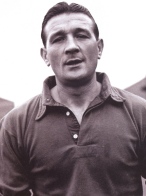
Bob Paisley
Defender · Liverpool 1939–1954
Personal
- Born
- 23 January 1919
- Place of birth
- Hetton-Le-Hole, England
- Died
- 14 February 1996
- Other clubs
- Bishop Auckland (1935-39)
At Liverpool
- Signed from
- Bishop Auckland
- Joined
- 8 May 1939
- Debut
- 5 January 1946
- First goal
- 1 May 1948
- Last goal
- 10 October 1953
- Last appearance
- 13 March 1954
- Contract expiry
- 30 June 1954
Liverpool career
- League 252 apps · 10 goals · 9 assists
- Win ratio 40.79% — W 113 · D 73 · L 91
- Wartime 60 apps · 12 goals
Honours
- League Championship
- 1946-47
Player profile
Before being posted abroad in the war in 1941 Paisley made 34 appearances and scored ten goals, the majority of them coming in the North Regional League. Paisley joined the seventy-third regiment of the Royal Artillery. He served as an anti-tank gunner with Montgomery's Eighth Army, the so-called Desert Rats, in the watershed victory at El Alamein. In June 1944 he proudly rode aboard a tank as the Allies liberated Rome. It was a proud moment as the relieving forces were welcomed as heroes by the Italians. Paisley resumed his Liverpool career in 1945/46 as the Football League set up a temporary North and South Division as well featuring in the FA Cup. On 31 August 1946, in a team that boasted Jackie Balmer and the great Billy Liddell, Liverpool finally kicked off the new post-war era. Paisley missed the opening two matches but made his full League debut in the third game of the season against Chelsea at Anfield on 7 September. On a dramatic afternoon Paisley helped Liverpool to an incredible 7-4 victory, with Liddell, Willie Fagan and Bill Jones scoring two apiece and Balmer claiming the other. According to the Liverpool Echo: "Paisley and Liddell transformed the attack." Four days after the Chelsea goal feast the Reds crashed 5-0 to Matt Busby's Manchester United and manager Kay promptly went out and signed 28-year-old Albert Stubbins from Newcastle United for a club record £13,000. The signing of Stubbins proved a masterstroke after he scored on his debut against Bolton and immediately won the fans over. The goals continued and Liverpool marched, eventually, to the title. Paisley played in 33 of Liverpool's 42 League matches that season and quickly established himself at left-half as a mainstay of the side. He had gained the admiration of others in the squad through his hard work and tenacity and his ability to correctly analyse the game's turning points in the dressing room afterwards.
If the success of 1946/47 had been a heady one for Liverpool, the following years were something of an anti-climax for the club. In 1949/50 Liverpool were seemingly marching on to new glories as they ripped through the first 19 League games unbeaten. It set a new record in English football; broken by Leeds United in 1973/74. Unfortunately, after losing their first game of the season to Huddersfield on 10 December the wheels began to come off the League campaign and attention turned instead to the FA Cup. The club progressed confidently through to the semi-finals after dismissing Blackpool 2-1 at Anfield. Neighbours Everton provided the opposition at Manchester City's Maine Road in front of 73,000 spectators. Paisley was never renowned as a goalscorer but a lob from the left caught the Everton goalkeeper out after 29 minutes. Liddell added another in the second half as Liverpool celebrated their first cup final participation since 1914. But there was great disappointment in store for the likeable Geordie. He had been absent through a knee injury leading up to the final and despite being declared fit in the days before the game he missed out on a cup final place. Paisley later said this disappointment helped him when he had to make similarly tough decisions as a manager. Paisley remained at Liverpool and went to play 41 of the 42 League games in the 1950/51 season but Liverpool were now set inexorably on a downward spiral. George Kay stood down as manager in February 1951 through ill health and was replaced by Don Welsh, but the decline was gathering pace. In the following three seasons Liverpool finished ninth, eleventh, and seventeenth. Relegation to the Second Division was avoided only on the last day of the 1952/53 season when the Reds roared to a 2-0 win over Chelsea in front of 47,000 at Anfield. Inevitably, Liverpool were relegated at the end of the 1953/54 season. Paisley was 35-years-old and on 4 May 1954 it was made public in the Liverpool Evening Express that "Bobby Paisley, the tough little North-Easterner who specialises in the long throw and is of the never-say-die order," was not on the retained list of players for the coming season. Paisley had his future mapped out when asked in 1950. "Though I hope to have a few more seasons still in senior football, I am studying to be a physiotherapist and masseur when my playing days are over. We married men have to look to the future, you know." The rest is history as they say.
Appearances per season
| Season | League | FA | LC | Europe | Other | Total |
|---|---|---|---|---|---|---|
| 1945-1946 | 0 | 4 | 0 | 0 | 0 | 4 |
| 1946-1947 | 33 | 6 | 0 | 0 | 0 | 39 |
| 1947-1948 | 37 | 2 | 0 | 0 | 0 | 39 |
| 1948-1949 | 36 | 4 | 0 | 0 | 0 | 40 |
| 1949-1950 | 23 | 5 | 0 | 0 | 0 | 28 |
| 1950-1951 | 41 | 1 | 0 | 0 | 0 | 42 |
| 1951-1952 | 37 | 3 | 0 | 0 | 0 | 40 |
| 1952-1953 | 26 | 0 | 0 | 0 | 0 | 26 |
| 1953-1954 | 19 | 0 | 0 | 0 | 0 | 19 |
| Totals | 252 | 25 | 0 | 0 | 0 | 277 |
A more detailed look at the player's appearances
| Apps | Mins | Opponent |
|---|---|---|
| 277 | 24,990 | All opponents |
| 16 | 1,440 | Bolton Wanderers |
| 15 | 1,350 | Manchester United |
| 14 | 1,260 | Derby County |
| 13 | 1,170 | Middlesbrough |
| 12 | 1,080 | Blackpool |
| 12 | 1,110 | Burnley |
| 12 | 1,080 | Chelsea |
| 12 | 1,080 | Sunderland |
| 11 | 990 | Aston Villa |
| 11 | 990 | Charlton Athletic |
| 11 | 990 | Stoke City |
| 11 | 990 | Wolves |
| 10 | 900 | Arsenal |
| 10 | 900 | Everton |
| 10 | 900 | Huddersfield Town |
| 10 | 900 | Newcastle United |
| 10 | 900 | West Bromwich Albion |
| 9 | 810 | Manchester City |
| 9 | 810 | Portsmouth |
| 8 | 720 | Preston North End |
| 7 | 630 | Sheffield United |
| 5 | 450 | Birmingham City |
| 5 | 450 | Blackburn Rovers |
| 5 | 450 | Grimsby Town |
| 5 | 450 | Sheffield Wednesday |
| 4 | 360 | Fulham |
| 4 | 360 | Tottenham Hotspur |
| 3 | 300 | Nottingham Forest |
| 2 | 180 | Brentford |
| 2 | 180 | Cardiff City |
| 2 | 180 | Chester City |
| 1 | 90 | Exeter City |
| 1 | 90 | Leeds United |
| 1 | 90 | Norwich City |
| 1 | 90 | Notts County |
| 1 | 90 | Stockport County |
| 1 | 90 | Walsall |
| 1 | 90 | Workington |
| Total | Venue |
|---|---|
| 141 | Home |
| 132 | Away |
| 4 | Neutral |
| Total | W | D | L | Win% | Manager |
|---|---|---|---|---|---|
| 178 | 80 | 43 | 55 | 44.9% | George Kay |
| 93 | 30 | 28 | 35 | 32.3% | Don Welsh |
| 6 | 3 | 2 | 1 | 50.0% | Caretaker Manager |
Goals per season
| Season | League | FA | LC | Europe | Other | Total |
|---|---|---|---|---|---|---|
| 1947-1948 | 1 | 0 | 0 | 0 | 0 | 1 |
| 1948-1949 | 1 | 1 | 0 | 0 | 0 | 2 |
| 1949-1950 | 1 | 1 | 0 | 0 | 0 | 2 |
| 1950-1951 | 1 | 0 | 0 | 0 | 0 | 1 |
| 1951-1952 | 2 | 1 | 0 | 0 | 0 | 3 |
| 1952-1953 | 2 | 0 | 0 | 0 | 0 | 2 |
| 1953-1954 | 2 | 0 | 0 | 0 | 0 | 2 |
| Totals | 10 | 3 | 0 | 0 | 0 | 13 |
The player scored 13 goals in 13 different matches.
A more detailed look at the player's goals
| Total | Opponent |
|---|---|
| 2 | Portsmouth |
| 2 | West Bromwich Albion |
| 2 | Wolves |
| 1 | Aston Villa |
| 1 | Everton |
| 1 | Newcastle United |
| 1 | Nottingham Forest |
| 1 | Sheffield Wednesday |
| 1 | Stoke City |
| 1 | Sunderland |
| Total | Started/substitutions |
|---|---|
| 13 | Started |
| Total | Goal minute period |
|---|---|
| 1 | 1-15 minutes |
| 3 | 16-30 minutes |
| 1 | 31-45 minutes |
| 2 | 46-60 minutes |
| 4 | 61-75 minutes |
| 2 | 76-90 minutes |
| Total | Goal origin |
|---|---|
| 13 | Open play |
| Total | Assisted by |
|---|---|
| 4 | Jimmy Payne |
| 1 | Billy Liddell |
| 1 | Brian Jackson |
Assists per season
| Season | League | FA | LC | Europe | Other | Total |
|---|---|---|---|---|---|---|
| 1946-1947 | 1 | 1 | 0 | 0 | 0 | 2 |
| 1948-1949 | 1 | 0 | 0 | 0 | 0 | 1 |
| 1949-1950 | 1 | 1 | 0 | 0 | 0 | 2 |
| 1950-1951 | 1 | 0 | 0 | 0 | 0 | 1 |
| 1951-1952 | 2 | 0 | 0 | 0 | 0 | 2 |
| 1952-1953 | 1 | 0 | 0 | 0 | 0 | 1 |
| 1953-1954 | 2 | 0 | 0 | 0 | 0 | 2 |
| Totals | 9 | 2 | 0 | 0 | 0 | 11 |
A more detailed look at the player's assists
| Total | Opponent |
|---|---|
| 1 | Aston Villa |
| 1 | Birmingham City |
| 1 | Blackpool |
| 1 | Chelsea |
| 1 | Fulham |
| 1 | Huddersfield Town |
| 1 | Preston North End |
| 1 | Stockport County |
| 1 | Sunderland |
| 1 | Tottenham Hotspur |
| 1 | Walsall |
| Total | For player |
|---|---|
| 4 | Billy Liddell |
| 2 | Jimmy Payne |
| 2 | Willie Fagan |
| 1 | Bill Jones |
| 1 | Cyril Done |
| 1 | Sammy Smyth |
Wartime Appearances / Goals
| Season | Appearances | Goals |
|---|---|---|
| 1939-1940 | 7 | 0 |
| 1940-1941 | 27 | 10 |
| 1945-1946 | 26 | 2 |
| Totals | 60 | 12 |
Related Articles
Review of Quiet Genius
The question is what Ian Herbert, who is the Independent's chief sportswriter and former deputy editor of the Liverpool Daily Post, can add to Bob Paisley's legacy.
The day Bob Paisley got knocked out
Bob Paisley described himself as "aggressive but I played the game because I loved and enjoyed it. I might have hurt people and I got hurt myself a few times, but not with any malice."
Liddell and Paisley make their League debut
Liverpool's game vs Chelsea on 7th of September 1946 was remarkable for various reasons.
Shape of Derby to come
The Liverpool Daily Post preview of the Merseyside derby on 16 September , 1950
Talking points
The Liverpool Echo on 27 March, 1950 on the Merseyside FA Cup semi-final.
Unique programmes: Two Legends Arrive
The first post-war season of 1946-47 saw Liverpool being crowned as Champions of England. Their second home match pitted them against Chelsea.