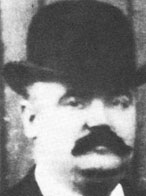
Tom Watson
Manager · Liverpool 1896–1915
Personal
- Born
- 8 April 1859
- Place of birth
- Newcastle upon Tyne, England
- Died
- 6 May 1915
- Other clubs managed
- Newcastle West End, Newcastle East End, Sunderland
At Liverpool
- Arrived from
- Sunderland
- Appointed
- 25 July 1896
- First match
- 1 September 1896
- Final match
- 24 April 1915
Liverpool record
- 678 league games · First match 1 September 1896 · Final match 24 April 1915
Season by season
Full season record →- 1896-97 5th
- 1897-98 9th
- 1898-99 2nd
- 1899-1900 10th
- 1900-01 1st 1 trophy
- 1901-02 11th
- 1902-03 5th
- 1903-04 17th
- 1904-05 1st Div 2 1 trophy
- 1905-06 1st 1 trophy
- 1906-07 15th
- 1907-08 8th
- 1908-09 16th
- 1909-10 2nd
- 1910-11 13th
- 1911-12 17th
- 1912-13 11th
- 1913-14 16th
- 1914-15 14th
Final league position for seasons he finished; position at the end of his spell for seasons he didn't.
Honours
3 trophies- Second Division
- 1904-05
Trophy count excludes the Charity/Community Shield.
Manager profile
Only 37 years old at the time of this move, Watson was still a relatively young man, certainly for a secretary. It was Watson’s job to arrange fixtures, keep records, and submit match details to local papers. At the time, there was no such thing as a football manager, but Watson went beyond the remit of club secretary, and got involved in team selection, tactics and player recruitment – becoming a manager in all but name. This was a radical change to Liverpool's set up as the Cricket and Football Field reported. "The team have never had a “boss” off the field, and there have been too many on, so that a central figure, and one that commands respect, should work wonders in this direction." Watson implemented a strict diet and new coaching regime at Anfield that had served him so well at Sunderland. The players' day started with half an hour stroll at 7.30am, breakfast at 8.30am ideally consisted of weak tea, chops, eggs, dry toast or stale bread. Butter, sugar, potatoes and milk were not held in high regard. Training was at 9.45am and again at 3.30pm. A glass of beer or claret was recommended at dinner and tobacco was to be “sparingly used". The day finished with a one hour stroll at 7.30pm.
Liverpool’s game against The Wednesday on 1 September 1896 was not only the first the team played under new management but also, as the Cricket and Football Field noted, the premiere of the club's new colours: "Liverpool’s new dress of red shirts and white knickers is striking, and a contrast to Everton’s blue shirts and white knickers." Following the 2-1 win, Liverpool failed to score in two matches in a row and a Liverpool director was strongly of the opinion that "the close passing game is almost played out, as it is so much overdone, and more goals will accrue, he thinks, if the swinging moves from wing to wing were indulged in." Whether Liverpool did overpass the ball or not the goals soon arrived and Watson delivered fifth place that was a big improvement on the previous top-flight campaign that ended in relegation. Watson was not only an accomplished manager but he liked a song as well as his players discovered on a day-out at Roscommon Music Hall in November 1896. "Tom Watson is a man of many parts, but his presence on the stage as a singer was never expected by those that know him.," the press noted.
Watson went to Scotland to look for young talent as he had done many times before with great success. Progress was almost as quick as it had been at his previous club. Two FA Cup semi-finals were reached before the turn of the century but not many supporters realise that 90 years before the crucial final League match with Arsenal in 1989 Liverpool were also involved in a “winner takes all” end to the season. Liverpool travelled to Birmingham to face Aston Villa on the last day of the season. A marginally superior goal-difference meant that a draw against their Midland rivals would be enough to secure the club’s first major title. But by the interval the Reds that had conceded only 28 goals in their previous 33 League matches that season had inexplicably let in another five and the match was over as a contest, as was Liverpool’s title dream.
Liverpool slipped to tenth the following season but recovered to mount a serious challenge for the championship in the first full season of the new century. Watson had already proved at Sunderland that he had a good eye for talented players and he continued to prove that for Liverpool. Numerous players that had a huge influence on the club’s early years … and in particular their double-title success in the first decade of the Twentieth century … were signed during Watson’s reign. Amongst them and in no particular order were Scotsman Alex Raisbeck, legendary goalkeepers Sam Hardy and Elisha Scott and prolific scorers Jack Parkinson and Sam Raybould. The 1901 championship was won by two points from, ironically enough, Watson’s former employees Sunderland and seemed to herald a new and exciting era. But rather surprisingly results took a turn for the worse and the club was relegated only three years after winning the League Championship, only to bounce back at the first time of asking and follow that with their second League title just 12 months later, the first club to achieve the ‘double’ feat of winning the Second and First Division championships in successive seasons.
In 1906 Watson suffered the disappointment for the sixth time of being the manager of a losing FA Cup semi-finalist, this time to Everton who went on to lift the trophy by beating Newcastle. League results for the next few years were rather erratic and only in 1910 when finishing runners-up to Aston Villa did Liverpool become seriously close to taking another championship. In 1914 Watson at last managed to overcome his semi-final jinx as Liverpool progressed to the cup final at Aston Villa’s expense but the big day at London’s Crystal Palace ground was to end in disappointment with a single-goal defeat to Burnley.
As World War I broke out, Tom Watson was preparing for his nineteenth season in charge at Anfield. It was to be his last. He had visited his native Newcastle for his fifty-sixth birthday on 9 April. Three weeks later he was back at work when he was seized with a severe chill. A few days later it had developed into a fatal attack of pneumonia. Tom Watson died on 6 May 1915. Watson had been a popular and successful manager and that was reflected in the turn-out for his funeral, where many of the players he signed acted as pall-bearers on his final journey. Alex Raisbeck, Ned Doig, Arthur Goddard, Charlie Wilson, Maurice Parry, George Fleming and Robbie Robinson as well as the club trainer William Connell carried his coffin. Watson is buried at Anfield Cemetery.
Few men take two different clubs to the biggest domestic prize, even in the sport’s early days. Even fewer win that championship as many as five times during their managerial lives. Tom Watson did and he was also the man responsible for Liverpool making the big breakthrough by taking them to their first two League titles in 1901 and 1906.
More on Tom Watson
Record
| Competition | Total | Won | Draw | Lost | Goals for | Goals against |
|---|---|---|---|---|---|---|
| Grand totals | 742 | 329 | 141 | 272 | 1226 | 1056 |
| League | 678 | 297 | 128 | 253 | 1123 | 980 |
| FA Cup | 63 | 31 | 13 | 19 | 98 | 75 |
| Other | 1 | 1 | 0 | 0 | 5 | 1 |
Related Articles
Kenneth Campbell's life story - Chapter 5
Scottish keeper, Kenny Campbell, told his life story in the Weekly News. Chapter five was published on 11 June 1921.
Kenneth Campbell’s unique life story - Chapter 1
Scottish keeper, Kenny Campbell, told his life story in the Weekly News. Chapter one was published on 7 May 1921.
How Liverpool prepare for the FA Cup semi-final 1899
From the Evening Express on 16 March 1899.
The funeral of Tom Watson
From the Liverpool Echo on Tuesday May 11, 1915.
An article written by Liverpool's manager in 1899
In July 1896 Liverpool pulled off a masterstroke by convincing the best manager in the country, Tom Watson, to leave Sunderland and join the Anfield brigade. Published in conjunction with kjelhanssen.com.
The thoughts of Sam Hardy
Published on 2 December 1909.
Liverpool in “Gay Paree”
Cricket and Football Field on 28 July 1906.
Tom Watson - A most beloved man
Tom Watson deserves his place among the greatest managers in Liverpool's history and he was clearly one of the most beloved figures that have ever graced the football club.
1901-1906: A rise from 2nd division to the title!
In 1904 Liverpool had been relegated to 2nd division only three years after winning the title for the first time. Liverpool were on their way to an amazing success!
1899-1901: Liverpool champions for the first time!
Liverpool won the league in the 1900-01 season. We give you unique insight into the local papers' reports and celebration of this glorious feat!
1896-1899: A new exciting era at Liverpool
Liverpool FC wear red for the first time. The most successful manager in the country takes over and brings his magic touch to the 'Reds' bringing them tantalizingly close to a league and cup double.
Our motto should be "Upwards"
Cricket and Football Field on 16 June 1906.
Watson death – from a Newcastle point of view
The Newcastle Journal on 7 May 1915.