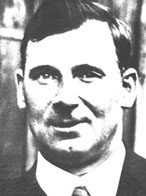
George Kay
Manager · Liverpool 1936–1951
Personal
- Born
- 21 September 1891
- Place of birth
- Manchester, England
- Died
- 18 April 1954
- Other clubs managed
- Luton Town, Southampton
At Liverpool
- Arrived from
- Southampton
- Appointed
- 6 August 1936
- First match
- 29 August 1936
- Final match
- 27 January 1951
- Time in charge
- 14 years, 5 months
Liverpool record
- 324 league games · First match 29 August 1936 · Final match 27 January 1951
Season by season
Full season record →- 1936-37 18th
- 1937-38 11th
- 1938-39 11th
- 1939-40 — part season
- 1946-47 1st 1 trophy
- 1947-48 11th
- 1948-49 12th
- 1949-50 7th
- 1950-51 13th at end of spell Jan 1951
Final league position for seasons he finished; position at the end of his spell for seasons he didn't.
Honours
1 trophy- League Championship
- 1946-47
Trophy count excludes the Charity/Community Shield.
Manager profile
Kay was 44 years old when he left Southampton for Liverpool in August 1936. He was born in Manchester and played for local club Eccles before joining Bolton Wanderers in 1911, with whom he had a very brief spell before moving across the Irish Sea to play in Belfast. When competitive soccer resumed after World War I, Kay joined West Ham United and was their skipper in the first FA Cup final to be staged at Wembley in 1923. The Hammers lost that day to Kay’s former club Bolton, but had the ample consolation of a place in the top league as runners-up in the Second Division. Towards the end of the 1920’s Kay moved to Stockport County as a player and then on to Luton Town, initially as their player-coach in 1928 before taking on the role of manager a year later at the age of 38. He held that post until the end of the 1930/31 season before being attracted by the opportunity of managing a club in a higher division, Southampton. The Saints had been promoted as Division Three South champions in 1922 and were anxious to taste life at the very top. But during the five full seasons that Kay was in charge at The Dell, the club never made the top-half of the table. All the same, Kay was respected within the game and was clearly knowledgeable and not afraid to try out new ideas. He was also experienced and probably a combination of all those qualities brought him to Liverpool’s attention when it was clear that George Patterson would be unable to continue the managerial side of his role as secretary-manager. Although appointed on 6 August 1936 Kay stayed at Southampton to fulfill his duties and started working for Liverpool on 21 August 1936.
Kay had only been at Anfield a couple of years when another World War broke out, a conflict that would interrupt and in some cases end the careers of many a fine footballer. The League was on hiatus but regional competitions took their place. Many of the club's players served their country and Kay was hard at work to find men to represent Liverpool's eleven. Billy Liddell noted that "with players in the forces stationed all over the country, Mr. Kay wrote thousands of letters and must have spent many hours on the phone to Commanding officers. Such was his personality that his own players and guest players would willingly make long journeys to play for the Reds." One of those men was a certain Bill Shankly who was impressed by Kay: "I played for Liverpool against Everton during the war in the Liverpool Senior Cup, as a guest from Preston. All the players were in the passageway including Billy Liddell and myself. But George Kay, the Liverpool manager, didn't speak. He just went round touching people on the shoulder. If he touched you then you were playing." With the war over, the club took the unusual step of deciding to tour North America and Canada. It is quite likely that George Kay was the instigator of this trip; certainly he was fully in favour of it because he felt that the climate and diet in a part of the world that hadn’t been affected by food rationing the way European countries had would be extremely beneficial. The schedule was punishing; ten matches at various venues between 12 May and 11 June, but it benefited the Reds who started the first post-war season in far better physical shape than many of their competitors as Kay claimed himself in a note to the Echo while in America: "The players are 25 percent above par in football, due in my opinion to the quality, quantity and variety of food."
Liverpool went on to win the championship in 1947 but it was a mighty close thing. A hard winter meant that a season which had begun at the end of August didn’t finish until the start of June. Liverpool, Manchester United, Wolverhampton Wanderers and Stoke City were all in with a chance of taking the title as the season reached its climax. Liverpool’s final fixture was against Wolves at Molineux. The hosts had 56 points, the visitors 55. Liverpool had to win and then wait and hope. They did their part of the job by winning 2-1, other results went their way and the Reds were champions of the Football League for a fifth time. It was George Kay’s finest moment as a football manager. One of his key players was Albert Stubbins: "George Kay was a first-class manager and a very big influence on me. He was a lovely man, quiet and a deep thinker. He’d read books about psychology and he knew how to get the best out of his players," the ginger-haired Geordie said. "George’s first thought was always for his players. He’d never tear a strip off us or criticise a Liverpool player in the press. That’s were the psychology came into play. If we were trailing at half-time he’d come into the dressing room and although he’d point out our errors he’d always say, ‘Well played, lads’. He knew and we knew, that we weren’t playing well, but because he was so understanding we felt we had to play extra well to repay his faith in us."
The club didn’t come close to another championship and the nearest it came to additional success was in 1950 when the Reds reached the FA Cup final for only the second time and the first for 36 years. Kay was intent on using his cup experience. "When I played in the first Cup final ever staged at Wembley, as captain of West Ham United, we did not win the trophy, but I am hoping that my second visit there, as manager of Liverpool will see us successful," Kay said enthusiastically. "We have a splendid lot of players, grand sportsmen every one of them. No manager ever had charge of a happier team." Sadly, the big day out at Wembley ended in disappointment with defeat to Arsenal. Kay travelled to London and led the team out but he was far from being a well man. Still his Liverpool contract was renewed for a further five years in June 1950. He retired in January 1951 a few months short of his sixtieth birthday, fought his continuing illness with strength and courage but died in Liverpool three years later on 18 April 1954. Liddell knew how much Kay's job had taken out of him: "He told me often of the times he had lain in bed, unable to sleep, pondering over the manifold problems that beset every manager... if any man gave his life for a club; George Kay did so for Liverpool."
Bob Paisley was full of praise for George Kay and his importance in the club's history. "He took Liverpool through the War to come out a bit like West Ham did after the First War. He was one of the people who laid the ground for the way Liverpool teams would play in the future... keeping the ball on the ground and passing it well, but being strong on the ball as well."
More on George Kay
Quotes 7
“The manager, George Kay wasn't a bad fella either. You'd never hear him cursing and swearing. He was the type of manager you could talk to a…”
All quotes →Record
| Competition | Total | Won | Draw | Lost | Goals for | Goals against |
|---|---|---|---|---|---|---|
| Grand totals | 357 | 142 | 93 | 122 | 551 | 511 |
| League | 324 | 123 | 88 | 113 | 495 | 472 |
| FA Cup | 33 | 19 | 5 | 9 | 56 | 39 |
Related Articles
‘Be my guest’ – George Kay keeping LFC afloat during World War II
“Well, that’s it, then!” said my mother. It is my earliest memory, and all I had to worry about was the horrified look on her face."