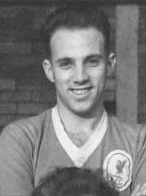
Ronnie Moran
Defender · Liverpool 1952–1965
Personal
- Born
- 28 February 1934
- Place of birth
- Crosby, Liverpool, England
- Died
- 22 March 2017
- Other clubs
- None
At Liverpool
- Signed from
- Local
- Joined
- 1949 - Professional 7 January 1952
- Debut
- 22 November 1952
- First goal
- 29 August 1959
- Last goal
- 22 February 1964
- Last appearance
- 12 May 1965
- Contract expiry
- 1998
Liverpool career
- League 342 apps · 15 goals · 20 assists
- Win ratio 49.34% — W 187 · D 79 · L 113
Honours
Player profile
Moran was club captain when Bill Shankly arrived in 1959. In Shankly's full debut season, 1960/61, Moran got injured on 1 October, and apart from a brief one-game unsuccessful return in January 1961, he was out injured for 14 months. Moran played in enough fixtures to qualify for a second division championship medal in 1962 and only missed seven games when the first division title was won two years later. Moran, who took over spot-kick duties in 1960, had scored eight out of ten penalties when he missed four penalties in a row, the last of which in the quarter-finals of the FA Cup in 1964 proved costly. Swansea City were leading 2-1 when Moran squandered his spot-kick in the eightieth minute. It was a harrowing experience for Moran who despaired: “I don’t think I’ll ever forget it." During the 1964/65 season, Chris Lawler became established as the club's right-back as Moran lost his place in the side. Moran did return at the end of this historic campaign playing in both legs against Inter Milan in the European Cup semi-finals but missed out on a place in Liverpool's cup-winning team at Wembley against Leeds as Gerry Byrne returned to the side. A successful playing career had come to an end, but a new career at the club was ahead.
Moran's qualities as a player ensured a longer stay for him at Liverpool. His enthusiasm for the game had always spread around his team. He was totally committed in every game, a quality that prompted Shankly to offer him the chance to join the training staff. Moran recalled the moment his life took a new turn during the 1966/67 pre-season. "Shanks called me to one side. I thought, this is it, he's going to tell me another club's come in for me and he said to me 'Ronnie, how would you like to join the backroom staff?,'" Moran told LFChistory.net. "I went off and discussed it with my wife. We are both from Liverpool and didn't want to leave, and the next day I told Bill, 'Yes.' We never really discussed specific roles, I guess Shanks and Bob had seen me shouting and talking a lot when I was playing and liked what they'd seen. They just let me get on with it." Moran's appointment didn't surprise Ian Callaghan. "I don't know how I would have managed without him. It was a big step up playing in the first team, and I don't know how I would have coped without someone keeping an eye on me and helping me out of difficult situations," Cally said. "I soon learned that at Liverpool, we were essentially part of a team and depended on each other."
The sergeant major of Melwood was well-known for keeping strict discipline at the club and despite Tommy Smith's quote that Moran "could moan for England" he was a vital part of the Boot Room and the club's success. Robbie Fowler was one of many players that were inspired by Moran. "At Liverpool we are all taught to keep our feet on the ground and I, for one, have reason to remember that no-one subscribed to that theory more than Ronnie," Fowler remembers. "After playing against Fulham and scoring five goals I was feeling well pleased with myself when Ronnie came in the dressing room and said: 'I don't know what you`re looking so smug about. You should have scored seven.' Those words will live with me forever and I think they sum up the greatness of the man."
Moran twice filled in as caretaker manager, initially after Dalglish's resignation in 1991 as he shared with LFChistory.net: "I Innocently answered the phone at home in the early spring of 1991. It was Kenny Dalglish. Me and the wife were just on our way out and I asked him what he wanted. 'I've packed in,' he said. 'I've had enough.' I thought he was joking, as he was a great practical joker and I told him to stop messing around. He must have filled up because he put the phone down and the line went dead." The next call Moran took was from Liverpool Chairman Noel White, who confirmed Dalglish's resignation and promptly offered the vacated manager's job to the scarcely believing assistant. "Of course I accepted, but becoming manager was not something I'd ever envisaged, but then again, neither had Bob nor Joe before me," Moran said. The 56-year-old Moran was the obvious candidate to come to the rescue in a crisis until a permanent successor to Dalglish could be named. After all he had been involved at Anfield in one capacity or another since the early 1950’s and knew the club inside out. He inherited a team that was top of the table and still very much involved in the race for the championship with Arsenal. Moran’s first task was to lift the gloom around the club and prepare the first team for a visit to Luton the following Saturday. The whole club still seemed to be in shock after Dalglish’s departure, although that can’t be used as an excuse for a tame 3-1 defeat at Kenilworth Road. The next two matches were lost as well, the FA Cup second replay at Goodison and more crucially, the home League fixture with title rivals Arsenal, decided by Paul Merson’s second-half goal.
But, three defeats were followed by three victories, the third of which was a stunning 7-1 triumph at the Baseball Ground against soon-to-be-relegated Derby County on a day when the Reds went back to the top of the table because of Arsenal’s failure to win at Norwich. But the two Easter fixtures ended in disappointing defeats, at home to QPR and away to Southampton, and those results put Arsenal firmly in charge of the championship’s destiny. Ronnie Moran would stay in charge for only two more matches, an uninspiring 1-1 home draw with Coventry and an astonishing game at Elland Road against Leeds, which Liverpool won 5-4 after holding a 4-0 lead with less than a third of the match played. There had been constant rumours about who was going to succeed Dalglish as manager and most of those rumours seemed to centre on Graeme Souness at Glasgow Rangers. It looked as if the club’s former skipper would be unveiled as the new manager at the end of the season but as media interest escalated it made his position at Ibrox almost untenable and he eventually moved south just before Liverpool were due to play Norwich City at Anfield on 20 April 1991. Ronnie Moran had been a willing deputy for a few weeks but his record was modest; four victories, one draw, five defeats. According to Phil Thompson, who calls Moran his mentor, Moran had wanted, contrary to popular opinion, the manager's job on a full-time basis. "Kenny left and Ronnie took over. I was with the reserves. I stepped up and helped Ronnie and Roy," Thompson told LFChistory.net. "It was the three of us. Ronnie straight away said: 'I don't want this. I can't handle the press. I can do all the things on the training field, but dealing with the media, signings and everything I don't think.' After a few good weeks Ronnie decided that: 'I can handle this.' He went to see Peter Robinson and Sir John Smith and he said: 'I can do this. If you want to offer me the job again I'll take it.' They went: 'Ronnie, I wish you had come last week because we've got a new manager. It's Graeme Souness!' Ronnie's chance of being manager at Liverpool ended then and there."
When Souness was recovering from his triple by-pass heart surgery in 1992 Moran was happy to deputise again. He was in charge for the final seven League matches of that 1991/92 season plus the FA Cup semi-final replay with Portsmouth before Souness returned for the cup final, closely watched by a doctor, with Moran having the honour of leading the Liverpool team out on this successful day at Wembley. Moran retired in 1998 after 49 years at the club and was rewarded with a well-attended testimonial match against Glasgow Celtic on 16 May 2000.
Appearances per season
| Season | League | FA | LC | Europe | Other | Total |
|---|---|---|---|---|---|---|
| 1952-1953 | 11 | 1 | 0 | 0 | 0 | 12 |
| 1953-1954 | 1 | 0 | 0 | 0 | 0 | 1 |
| 1954-1955 | 17 | 4 | 0 | 0 | 0 | 21 |
| 1955-1956 | 39 | 5 | 0 | 0 | 0 | 44 |
| 1956-1957 | 42 | 1 | 0 | 0 | 0 | 43 |
| 1957-1958 | 41 | 5 | 0 | 0 | 0 | 46 |
| 1958-1959 | 40 | 1 | 0 | 0 | 0 | 41 |
| 1959-1960 | 42 | 2 | 0 | 0 | 0 | 44 |
| 1960-1961 | 12 | 0 | 0 | 0 | 0 | 12 |
| 1961-1962 | 16 | 3 | 0 | 0 | 0 | 19 |
| 1962-1963 | 33 | 6 | 0 | 0 | 0 | 39 |
| 1963-1964 | 35 | 4 | 0 | 0 | 0 | 39 |
| 1964-1965 | 13 | 0 | 0 | 4 | 1 | 18 |
| Totals | 342 | 32 | 0 | 4 | 1 | 379 |
A more detailed look at the player's appearances
| Total | Started/substitutions |
|---|---|
| 379 | Started |
| 0 | Substituted |
| 0 | Substitute |
| 0 | On bench |
| Total | Venue |
|---|---|
| 190 | Home |
| 187 | Away |
| 2 | Neutral |
| Total | Competition |
|---|---|
| 342 | League |
| 32 | FA Cup |
| 4 | European Cup |
| 1 | Charity Shield |
| Total | W | D | L | Win% | Manager |
|---|---|---|---|---|---|
| 150 | 78 | 31 | 41 | 52.0% | Bill Shankly |
| 147 | 75 | 31 | 41 | 51.0% | Phil Taylor |
| 78 | 31 | 17 | 30 | 39.7% | Don Welsh |
| 4 | 3 | 0 | 1 | 75.0% | Caretaker Manager |
Goals per season
| Season | League | FA | LC | Europe | Other | Total |
|---|---|---|---|---|---|---|
| 1959-1960 | 5 | 0 | 0 | 0 | 0 | 5 |
| 1960-1961 | 2 | 0 | 0 | 0 | 0 | 2 |
| 1961-1962 | 1 | 0 | 0 | 0 | 0 | 1 |
| 1962-1963 | 5 | 2 | 0 | 0 | 0 | 7 |
| 1963-1964 | 2 | 0 | 0 | 0 | 0 | 2 |
| Totals | 15 | 2 | 0 | 0 | 0 | 17 |
The player scored 17 goals in 17 different matches.
A more detailed look at the player's goals
| Total | Opponent |
|---|---|
| 2 | Arsenal |
| 2 | Blackburn Rovers |
| 2 | Luton Town |
| 1 | Birmingham City |
| 1 | Burnley |
| 1 | Hull City |
| 1 | Lincoln City |
| 1 | Manchester City |
| 1 | Manchester United |
| 1 | Plymouth Argyle |
| 1 | Portsmouth |
| 1 | Stoke City |
| 1 | Swansea City |
| 1 | West Bromwich Albion |
| Total | Started/substitutions |
|---|---|
| 17 | Started |
| Total | Goal minute period |
|---|---|
| 3 | 1-15 minutes |
| 2 | 16-30 minutes |
| 1 | 31-45 minutes |
| 2 | 46-60 minutes |
| 4 | 61-75 minutes |
| 4 | 76-90 minutes |
| 1 | 91-120 minutes |
| Total | Assisted by |
|---|---|
| 1 | Alan A'Court |
| 1 | Willie Stevenson |
Assists per season
| Season | League | FA | LC | Europe | Other | Total |
|---|---|---|---|---|---|---|
| 1956-1957 | 1 | 0 | 0 | 0 | 0 | 1 |
| 1957-1958 | 1 | 0 | 0 | 0 | 0 | 1 |
| 1958-1959 | 6 | 0 | 0 | 0 | 0 | 6 |
| 1959-1960 | 5 | 0 | 0 | 0 | 0 | 5 |
| 1960-1961 | 2 | 0 | 0 | 0 | 0 | 2 |
| 1961-1962 | 1 | 0 | 0 | 0 | 0 | 1 |
| 1963-1964 | 3 | 0 | 0 | 0 | 0 | 3 |
| 1964-1965 | 1 | 0 | 0 | 0 | 0 | 1 |
| Totals | 20 | 0 | 0 | 0 | 0 | 20 |
A more detailed look at the player's assists
| Total | Opponent |
|---|---|
| 3 | Derby County |
| 2 | Ipswich Town |
| 2 | Lincoln City |
| 2 | Stoke City |
| 2 | West Ham United |
| 1 | Blackburn Rovers |
| 1 | Charlton Athletic |
| 1 | Leyton Orient |
| 1 | Nottingham Forest |
| 1 | Rotherham United |
| 1 | Sheffield United |
| 1 | Sunderland |
| 1 | Swansea City |
| 1 | Tottenham Hotspur |
| Total | Competition |
|---|---|
| 20 | League |
| Total | For player |
|---|---|
| 4 | Roger Hunt |
| 3 | Billy Liddell |
| 3 | Jimmy Melia |
| 2 | Alan A'Court |
| 2 | Ian St John |
| 2 | Louis Bimpson |
| 1 | Fred Morris |
| 1 | Jimmy Harrower |
| 1 | Johnny Morrissey |
| 1 | Johnny Wheeler |
Related Articles
View from the people - Jimmy McGovern
Jimmy McGovern wrote the screenplay for "Hillsborough", his wonderfully evocative screenplay about the eponymous 1989 tragedy.
How could I forget Bill Shankly's first Liverpool FC game?
Written on 15 December 2009 by David Randles, Liverpool Echo.
The last of Bill Shankly's original Bootroom Boys
1 December 2009 by the Liverpool Echo.
Ronnie Moran - Vocal Hero
An exclusive interview in October 1999 for Shankly.com.
Dalglish pays tribute to loyal Moran
Liverpool Echo on 16th May 2000.
Moran: I'm so grateful
Liverpool beat Celtic 4-1 on 16th of May 2000 in a testimonial for Ronnie Moran.
The first European night at Anfield
Forty years ago Liverpool played their first European game at Anfield Road.
European debut in Iceland
Forty years ago today Liverpool played their first European game in Iceland of all places.